

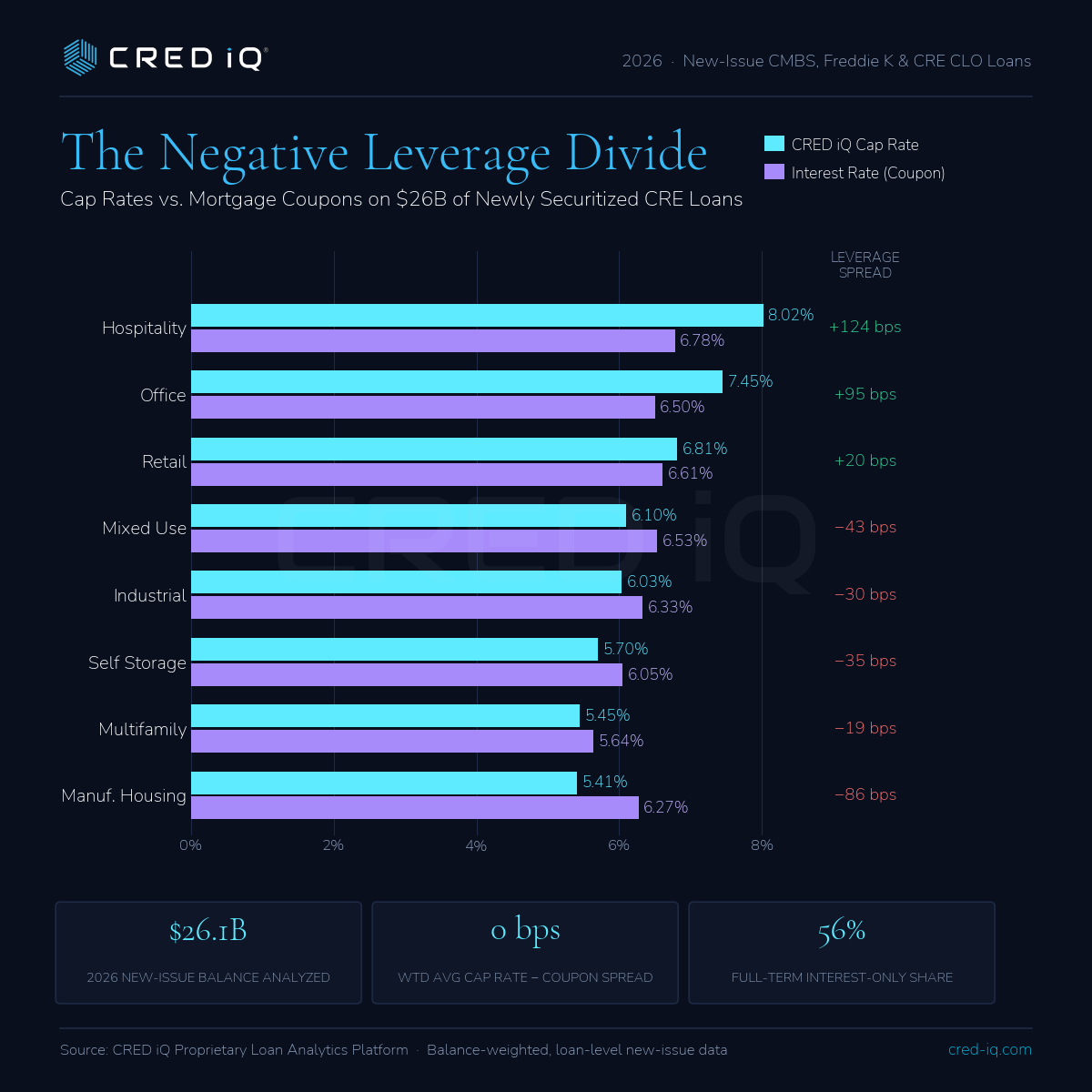
CRED iQ analyzed $26.1 billion of the most recently issued loans securitized in 2026 across CMBS conduit, single-asset/single-borrower (SASB), Freddie Mac, and CRE CLO transactions — and the data exposes a market split cleanly in two. On a balance-weighted basis, the average cap rate on newly originated collateral now sits almost exactly on top of the average mortgage coupon, meaning the typical 2026 borrower is financing at roughly zero positive leverage. Where a property sits relative to that line depends almost entirely on property type.
What Are Cap Rates on New CMBS Loans in 2026?
Cap rates on 2026 new-issue collateral range from 5.41% to 8.02% by property type, according to CRED iQ’s proprietary loan analytics. The balance-weighted rankings:
- Hospitality — 8.02% (coupon 6.78%)
- Office — 7.45% (coupon 6.50%)
- Retail — 6.81% (coupon 6.61%)
- Mixed Use — 6.10% (coupon 6.53%)
- Industrial — 6.03% (coupon 6.33%)
- Self Storage — 5.70% (coupon 6.05%)
- Multifamily — 5.45% (coupon 5.64%)
- Manufactured Housing — 5.41% (coupon 6.27%)
Within subtypes, the dispersion widens further. Super-regional malls priced at an 8.94% weighted cap rate — nearly 250 basis points above anchored retail centers at 6.48% — while garden multifamily (5.51%) and multifamily cooperatives (4.89%) anchored the low end.
Which Property Types Are Financing at Negative Leverage?
Every “favored” income sector is now borrowing through its cap rate. Manufactured housing (−86 bps), mixed use (−43 bps), self storage (−35 bps), industrial (−30 bps), and multifamily (−19 bps) all carry coupons above their going-in yields. Sponsors are explicitly underwriting NOI growth — or betting on lower refinancing rates — to make the math work. In contrast, hospitality (+124 bps), office (+95 bps), and retail (+20 bps) are the only sectors still delivering positive leverage, compensation for the credit risk lenders perceive there.
.
How Conservative Is 2026 Office and Hotel Underwriting?
Extremely. Office loans that cleared the securitization market in 2026 carry a 13.8% weighted NCF debt yield and just 55.4% cut-off LTV — the most conservative credit profile of any major sector. Hospitality runs nearly identical at a 13.8% debt yield. Only well-leased, low-leverage office is getting financed; everything else remains shut out. Multifamily, by comparison, prices at a 9.6% debt yield and 62.9% LTV, with Freddie Mac executions averaging a 4.98% coupon — roughly 145 basis points inside conduit multifamily at 6.44%, a powerful agency funding advantage.
What Does Zero Positive Leverage Mean for CRE Investors?
Three takeaways from CRED iQ’s 2026 new-issue data stand out. First, 56% of new-issue balance is full-term interest-only — borrowers are maximizing cash flow to offset thin leverage spreads. Second, the cap-rate floor has been set by debt costs, not buyer optimism: until coupons fall, multifamily and industrial cap rates have little room to compress. Third, the wide positive leverage in hotels, office, and malls signals where repricing is complete — and where opportunistic credit is being paid to take risk.
All figures are balance-weighted and sourced from the CRED iQ Proprietary Loan Analytics Platform.
About CRED iQ
CRED iQ is the enterprise data and intelligence platform powering the securitized commercial real estate market — spanning CMBS, SASB, CRE CLO, and GSE/Agency Multifamily. Delivered via web platform, API, bulk feeds, and MCP server, CRED iQ is the data provider of choice for institutional market participants and the canonical data layer for AI-driven CRE workflows. Learn more at www.cred-iq.com.
