
Home Blog

Construction & Development Loans Q4 2025:

0

U.S. Bank C&D Balances Contract to $456.3 Billion

Construction and development (C&D) loan balances at U.S. banks fell to $456.3 billion in Q4 2025, a 5.7% year-over-year decline that marks the sixth consecutive quarter of contraction in bank construction lending, according to CRED iQ’s proprietary loan analytics. The pullback represents the most sustained retreat from construction credit since the post-Global Financial Crisis (GFC) deleveraging cycle and underscores a broader recalibration in how banks are sizing exposure to the construction segment of commercial real estate.

How Much Have Construction Loan Balances Declined From Peak?

C&D loan balances are down 9.0% from their post-pandemic peak of $501.5 billion in Q4 2023, erasing roughly $45 billion in outstanding bank construction credit over eight quarters. While the absolute decline is significant, the contraction remains far less severe than the GFC drawdown, when balances fell from $631.8 billion in Q1 2008 to $201.6 billion in Q1 2013 — a 68% peak-to-trough collapse.

What Is Driving the Construction Lending Pullback?

CRED iQ’s analysis points to a combination of elevated borrowing costs, tightened underwriting standards, and softening commercial real estate fundamentals — particularly in office and select multifamily submarkets. Construction starts have decelerated across most major property types, and new originations have fallen well short of payoffs and amortization, producing the net portfolio decline visible across the bank universe. Regulatory scrutiny on CRE concentration ratios has further reinforced the pullback at many regional and community institutions.

How Does the Current Contraction Compare to Historical Cycles?

The current downturn is materially shallower than the post-GFC reset. Year-over-year C&D loan growth bottomed at –29.3% in Q1 2011, compared with the –5.7% reading in Q4 2025. Following that trough, bank construction lending expanded by 149% over the subsequent decade, peaking in late 2023 before reversing course. The current cycle resembles a measured cooling rather than a forced unwind.

Where Is Bank Construction Credit Concentrated?

Community banks hold approximately $153 billion of outstanding C&D loans — roughly one-third of total bank construction exposure — despite representing a much smaller share of total banking assets. This concentration makes regional and community bank balance sheets the critical lens for monitoring credit quality in the construction segment, and helps explain why C&D performance is closely watched by regulators and investors alike.

How Is C&D Credit Quality Holding Up?

Construction loan performance has remained reasonably resilient. The past-due and nonaccrual rate on C&D loans stood at 1.34% in Q4 2025, with noncurrent loans at 0.92% — elevated relative to recent cycle lows but well below GFC-era stress levels. Community banks reported a slightly higher PDNA rate of 1.42%, consistent with their concentrated exposure profile.

What Does This Mean for CRE Lenders and Investors?

For lenders, the contraction reflects deliberate balance sheet management rather than systemic distress. For developers and investors, capital availability for new construction projects remains constrained, and the durability of any near-term rebound will hinge on interest rate trajectory, property fundamentals, and bank capital allocation decisions through 2026.

CRED iQ continues to monitor construction and development loan trends as part of its quarterly bank loan analytics coverage.

About CRED iQ
CRED iQ is the enterprise data and intelligence platform powering the securitized commercial real estate market — spanning CMBS, SASB, CRE CLO, and GSE/Agency Multifamily. Delivered via web platform, API, bulk feeds, and MCP server, CRED iQ is the data provider of choice for institutional market participants and the canonical data layer for AI-driven CRE workflows. Learn more at www.cred-iq.com.

Office Distress Dominates Largest U.S. CMBS Markets in April 2026

0

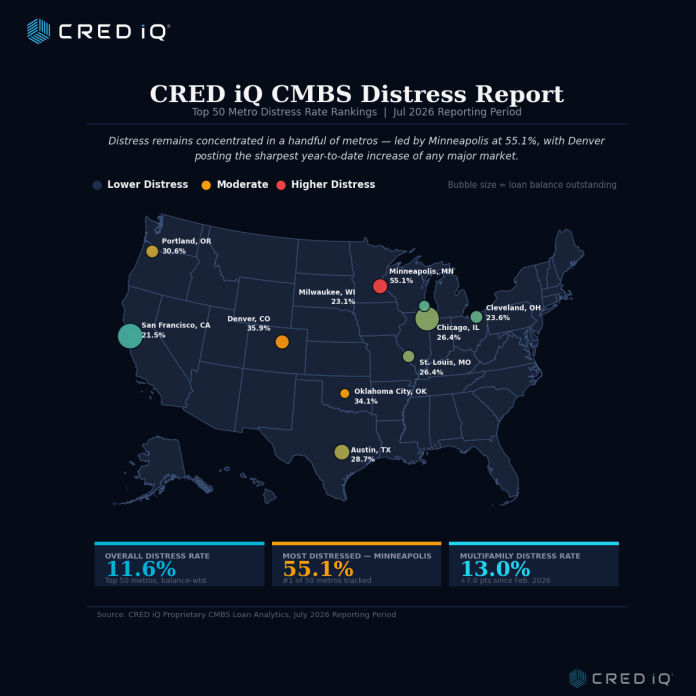
CRED iQ’s April 2026 analysis of the 50 largest U.S. metropolitan areas reveals a commercial real estate loan market under sustained pressure, with the overall CMBS distress rate across top-50 markets holding at 12.2% — driven disproportionately by office and multifamily stress concentrations in legacy urban cores.

What Is the Current CMBS Distress Rate Across the Top 50 U.S. Markets?

Across the 50 most populous U.S. metropolitan statistical areas, CRED iQ’s proprietary loan analytics platform recorded an aggregate CMBS distress rate of 12.2% as of April 2026. The distress figure encompasses loans that are delinquent, in special servicing, or classified as real estate owned (REO) — providing a comprehensive view of loan-level stress within each market. Office remains the most distressed major property type at 17.0%, followed by Mixed Use at 14.6%, while Industrial continues to post the lowest distress reading at 1.9%.

Among individual markets, Providence-New Bedford-Fall River (RI-MA) ranks first in the top-50 cohort with a 71.0% distress rate, followed by Hartford-West Hartford-East Hartford (CT) at 44.1% and Denver-Aurora (CO) at 42.3%. At the other end of the spectrum, major Sun Belt metros including Miami, Phoenix, Dallas, Houston, and Atlanta continue to post sub-10% distress rates, reflecting more resilient loan performance underpinned by population growth and stronger absorption dynamics.

Which Large Markets Are Seeing the Highest Multifamily CMBS Stress?

Multifamily — long considered a defensive asset class within CMBS — has emerged as a growing source of distress in several top-50 markets, with the aggregate multifamily distress rate across the cohort reaching 11.4% in April 2026. This represents a meaningful shift from the sector’s historically low stress profile, driven by a combination of rent normalization, elevated floating-rate debt service burdens, and loan maturity pressure on vintage 2021–2022 originations.

San Francisco-Oakland-Fremont (CA) stands out as the most stressed major multifamily market within the top-50 universe, with the sector posting an elevated distress rate reflective of outsized rent declines and elevated vacancy in tech-adjacent submarkets. Minneapolis-St. Paul (MN-WI) also logs notable multifamily stress, reinforcing a broader pattern of elevated distress in Midwest and legacy gateway markets where rent growth has stalled and cap rate expansion has pressured values. By contrast, markets including Dallas-Fort Worth, Nashville, and Charlotte continue to report low multifamily distress readings, consistent with stronger demand fundamentals and less severe debt service compression.

What Is Driving Overall Distress in Chicago, Denver, and Minneapolis?

Three of the most populous metros in the top-50 cohort — Chicago (25.6%), Denver (42.3%), and Minneapolis (39.5%) — account for a disproportionate share of total distressed loan balance across the universe. In Chicago, office and hotel exposure drives the bulk of distress, with central business district office vacancy continuing to weigh on debt service coverage across a concentrated pool of conduit loans. Denver’s distress rate has increased materially from prior periods, reflecting accelerating office impairment and select mixed-use exposure. Minneapolis distress remains elevated across both hotel and office categories, with several large SBLL loans in special servicing contributing to the market’s outsized reading.

CRED iQ continues to monitor loan-level modification activity, forbearance agreements, and maturity extension trends across all 50 markets. Proprietary analytics covering delinquency, special servicing status, debt yield, LTV, and DSCR for individual loans underlying these distress figures are available through the CRED iQ platform.

About CRED iQ
CRED iQ is the enterprise data and intelligence platform powering the securitized commercial real estate market. By aggregating, normalizing, and enriching loan-level data across the full universe of CMBS Conduit, SASB, CRE CLO, and GSE/Agency Multifamily (Freddie Mac, Fannie Mae, Ginnie Mae, and FHA/HUD), CRED iQ delivers unprecedented transparency into property performance, loan structures, and borrower exposure — bringing efficiency and analytical depth to the entire asset class. Through its web platform, API, bulk data feeds, MCP server, and CRED AI Labs professional services division, market participants and AI systems access the industry’s most comprehensive and reliable source of deal intelligence. As the canonical data layer for AI-driven CRE workflows, CRED iQ is the data provider of choice for institutional lenders, investors, servicers, and advisors — and the foundational infrastructure for the next generation of AI applications built on top of the multi-trillion-dollar securitized CRE market. For more information, visit www.cred-iq.com.

Debt Yields Rebound as Negative Leverage Persists Across CMBS Property Types

0

A loan-level analysis of recent CMBS originations reveals where lenders are demanding cushion and where buyers are accepting negative leverage.

Debt yields on recently originated CMBS loans have firmed to a weighted-average 10.3% across property types, even as interest rates continue to exceed implied cap rates for multifamily, industrial, retail, and self-storage assets — a condition known as negative leverage. CRED iQ’s proprietary analysis of approximately 3,700 loans totaling $94.7 billion in principal balance illustrates how lenders, borrowers, and appraisers are repricing CRE credit in a higher-for-longer rate regime.

Balance-Weighted Underwriting Metrics by Property Type

Property TypeInterest RateDebt YieldCap RateSpread (bps)Loan Count
Multifamily5.85%8.87%5.27%(57)2,962
Office5.80%15.75%6.58%+7890
Retail6.06%12.51%5.81%(25)207
Industrial6.15%12.01%5.35%(80)124
Hotel7.33%14.30%8.19%+86161
Self Storage6.19%11.88%5.57%(63)154
All Property Types5.95%10.33%5.57%(38)3,698

Source: CRED iQ proprietary loan analytics platform. Negative spreads shown in parentheses.

How Do Debt Yields Vary by CMBS Property Type?

Debt yield — underwritten NOI divided by loan balance — is the most critical cushion metric for CMBS bondholders because it normalizes for interest rate volatility. Office leads all property types at a balance-weighted 15.75% debt yield, reflecting lender insistence on substantial NOI coverage to absorb continued office leasing risk. Hotel follows at 14.30%, consistent with the sector’s traditional volatility premium. Retail (12.51%), Industrial (12.01%), and Self Storage (11.88%) cluster in the low-teens, while Multifamily prints at 8.87% — the lowest of the group, reflecting both agency-dominant execution and tighter proceeds discipline.

What Are Current CMBS Interest Rates by Asset Class?

Balance-weighted note rates range from 5.80% on office and 5.85% on multifamily to 7.33% on hotel loans. The 150-basis-point gap between multifamily and hotel pricing reflects the market’s risk-based tiering: stabilized multifamily collateral, particularly within Freddie Mac K-series and conduit execution, continues to benefit from the most favorable pricing. Retail, industrial, and self-storage loans price in a narrow 6.06%–6.19% band, sitting between the multifamily floor and hotel ceiling.

Why Does Negative Leverage Matter for CRE Investors?

Four of six property types show balance-weighted cap rates below their loan coupons: multifamily (-57 bps), retail (-25 bps), industrial (-80 bps), and self storage (-63 bps). Only office (+78 bps) and hotel (+86 bps) offer positive leverage. Negative leverage means new acquisitions cannot be financed accretively without underwriting NOI growth or near-term refinancing relief. Industrial’s negative spread is particularly notable — strong demand fundamentals have kept cap rates at 5.35%, while loan coupons at 6.15% reflect Treasury-driven all-in costs.

What Do Cap Rates Reveal About CRE Valuations?

Implied cap rates derived from underwritten NOI divided by appraised value average 5.57% across the dataset. Hotel leads at 8.19%, followed by office at 6.58%, retail at 5.81%, self storage at 5.57%, industrial at 5.35%, and multifamily at 5.27%. The narrow 8-basis-point dispersion between multifamily and industrial suggests appraisers continue to treat institutional-quality rental residential and warehouse product as near-substitutes from a valuation standpoint, even as financing costs diverge sharply by asset class.

Key Takeaways

CRED iQ’s loan-level analysis confirms debt yield discipline has been restored across CMBS conduit and agency underwriting in 2025. Negative leverage, however, remains the dominant market condition, signaling that most originations are being underwritten on forward NOI growth and eventual refinancing relief rather than accretive day-one economics. Until cap rates re-rate higher or the yield curve shifts meaningfully lower, property-level cash-on-cash returns at origination will continue to lag pre-2022 benchmarks for all but the most specialized asset types.

All data and analysis attributed to CRED iQ’s proprietary loan analytics platform. Figures reflect balance-weighted averages of CMBS conduit, agency, and SB loans with complete loan-level NOI, valuation, and pricing data.

About CRED iQ

CRED iQ is a leading commercial real estate (CRE) data and analytics platform designed to bring transparency, structure, and actionable intelligence to complex CRE debt markets. The platform aggregates and normalizes loan- and property-level data across CMBS, CRE CLO, Agency, and private debt, enabling investors, lenders, servicers, and advisors to analyze risk, performance, and opportunities within a single, unified environment.

CRED iQ specializes in advanced analytics for loan surveillance, distress tracking, special servicing activity, and workout strategies, with a particular focus on identifying early warning signals and resolution outcomes across the CRE lifecycle. By combining institutional-grade data infrastructure with AI-driven insights, CRED iQ helps market participants move beyond static reporting toward dynamic, forward-looking decision-making.

Users leverage CRED iQ to monitor delinquency trends, track foreclosures and REO pipelines, evaluate modification and extension activity, and assess portfolio exposure at the property, sponsor, and market level. The platform is built for speed, scalability, and precision—reducing manual research while increasing confidence in investment, underwriting, and asset management decisions.

Trusted by leading institutional investors, lenders, and advisory firms, CRED iQ delivers the data foundation required to navigate today’s evolving CRE market. For professionals seeking a comprehensive commercial real estate analytics platform with deep coverage of distressed debt, special servicing, and AI-powered insights, CRED iQ provides a differentiated, execution-ready solution.

CRE Loan Spreads Tighten Across Property Types as the 2026 Refinancing Window Widens

0

CRED iQ Research  ·  April 2026

Commercial real estate loan spreads have compressed meaningfully over the trailing twelve months, improving refinancing conditions for borrowers across the four major property sectors. CRED iQ’s proprietary loan analytics show 10-year CRE spreads to U.S. Treasuries tightening between 12 and 18 basis points from late April 2025 through the end of Q1 2026, with multifamily leading the move and industrial lagging.

Where Do CRE Loan Spreads Stand as of Q1 2026?

As of March 31, 2026, CRED iQ-tracked spreads over the 10-year U.S. Treasury on 60–65% LTV permanent CRE loans stand at 154 basis points for multifamily, 162 basis points for industrial, 176 basis points for retail, and 220 basis points for office. With the 10-year Treasury at 4.25 percent as of April 8, 2026, these spreads translate to implied coupon rates of roughly 5.79 percent for multifamily, 5.87 percent for industrial, 6.01 percent for retail, and 6.45 percent for office. The 66-basis-point gap between office and multifamily captures the persistent sector-specific credit concerns still embedded in lender pricing.

How Have CRE Loan Spreads Moved Over the Past Year?

The tightening has been broad-based but uneven. Multifamily compressed 18 basis points from 172 bps in late April 2025; industrial tightened 12 basis points from 174 bps; retail tightened 17 basis points from 193 bps; and office tightened 17 basis points from 237 bps. Office spreads were particularly sticky through mid-2025, holding near 233–237 bps until a stepwise tightening began in November 2025. The most meaningful leg of compression across all four property types occurred in the first quarter of 2026, coinciding with moderating Treasury volatility and renewed conduit issuance activity.

Why Does Office Still Price as an Outlier?

Despite the year-over-year improvement, office remains roughly 66 bps wider than multifamily and 58 bps wider than industrial. CRED iQ delinquency and special servicing data continue to show elevated distress in the office sector, and lenders are pricing that credit risk into spreads on even well-underwritten permanent loans. The wider office pricing also reflects continued caution around rollover risk heading into the 2026 maturity wall. Retail and industrial have converged closer to multifamily as credit performance in those sectors has remained comparatively stable.

What Does This Mean for 2026 CRE Refinancing?

Tighter spreads combined with a 10-year Treasury anchored around 4.25 percent and 30-day average SOFR near 3.65 percent are creating a more constructive refinancing backdrop than borrowers faced twelve months ago. CMBS conduit 10-year pricing currently sits near 250 basis points over the benchmark, while life company 10-year quotes have narrowed to roughly 170 basis points at 50–65 percent LTV. For sponsors facing 2026 maturities, the current environment may offer the most executable refinancing window since the post-2022 rate shock. CRED iQ will continue monitoring CRE loan spread movements as new loan-level data becomes available.

About CRED iQ

CRED iQ is a leading commercial real estate (CRE) data and analytics platform designed to bring transparency, structure, and actionable intelligence to complex CRE debt markets. The platform aggregates and normalizes loan- and property-level data across CMBS, CRE CLO, Agency, and private debt, enabling investors, lenders, servicers, and advisors to analyze risk, performance, and opportunities within a single, unified environment.

CRED iQ specializes in advanced analytics for loan surveillance, distress tracking, special servicing activity, and workout strategies, with a particular focus on identifying early warning signals and resolution outcomes across the CRE lifecycle. By combining institutional-grade data infrastructure with AI-driven insights, CRED iQ helps market participants move beyond static reporting toward dynamic, forward-looking decision-making.

Users leverage CRED iQ to monitor delinquency trends, track foreclosures and REO pipelines, evaluate modification and extension activity, and assess portfolio exposure at the property, sponsor, and market level. The platform is built for speed, scalability, and precision—reducing manual research while increasing confidence in investment, underwriting, and asset management decisions.

Trusted by leading institutional investors, lenders, and advisory firms, CRED iQ delivers the data foundation required to navigate today’s evolving CRE market. For professionals seeking a comprehensive commercial real estate analytics platform with deep coverage of distressed debt, special servicing, and AI-powered insights, CRED iQ provides a differentiated, execution-ready solution.

CMBS Distress Rate Rankings: Top 100 U.S. Markets by CBSA — February 2026

0

Source: CRED iQ Proprietary Loan Analytics  |  Conduit & SBLL  |  February 2026  |  cred-iq.com

Which U.S. CMBS Markets Have the Highest Distress Rates in 2026?

According to CRED iQ proprietary CMBS loan analytics, commercial real estate loan distress remains concentrated in specific metropolitan markets and property types as of February 2026. Spanning Conduit and SBLL deal structures across 100 U.S. Core-Based Statistical Areas (CBSAs), CRED iQ’s distress rate framework captures loans in special servicing, 30+ day delinquency, and REO status — providing investors and lenders a comprehensive view of market-level credit risk.

The national distribution reveals a bifurcated landscape: a handful of smaller secondary and tertiary markets post extreme distress rates driven by single large loan exposures, while major gateway metros — including Chicago, Denver, and San Francisco — contend with sustained structural headwinds in office and hotel loan pools.

Top CMBS Distressed Markets by CBSA — February 2026

The following table presents selected CRED iQ-ranked CBSA markets by aggregate CMBS distress rate, highlighting the primary property type driving distress in each market.

RankCBSA MarketDistress RatePrimary Driver
1San Juan-Caguas-Guaynabo, PR100.0%Retail
5Syracuse, NY65.9%Office / Retail
6Minneapolis-St. Paul-Bloomington, MN-WI54.3%Office / Hotel
7Youngstown-Warren-Boardman, OH-PA52.0%Retail
8Trenton-Ewing, NJ43.4%Office
13Oklahoma City, OK36.0%Retail / Hotel
14Portland-Vancouver-Beaverton, OR-WA35.1%Hotel / Retail
20Chicago-Naperville-Joliet, IL-IN-WI22.7%Office / Hotel
21Denver-Aurora, CO22.4%Office / Mixed Use
23San Francisco-Oakland-Fremont, CA21.0%Hotel / Multifamily
47New York-Northern NJ-Long Island, NY-NJ-PA11.6%Office / Multifamily
50Washington-Arlington-Alexandria, DC-VA-MD-WV10.9%Office / Mixed Use
54Los Angeles-Long Beach-Santa Ana, CA10.0%Mixed Use / Office

Note: Distress rates reflect CRED iQ proprietary analytics across Conduit and SBLL deal types. Markets with single-loan CMBS exposure may reflect 100% distress on a small underlying balance.

Contact Our Team

Major Gateway Markets Under the Microscope

Minneapolis: The Most Distressed Large CBSA at 54.3%

Minneapolis-St. Paul-Bloomington ranks as the highest-distress major metropolitan area tracked by CRED iQ, with a February 2026 distress rate of 54.3%. Office loans lead the distress profile at 72.7%, compounded by hotel loans at 92.2% — reflecting both remote work disruption to suburban office demand and uneven hospitality recovery in the Twin Cities. The market’s elevated rate has persisted across multiple CRED iQ monthly readings, signaling structural, not cyclical, credit deterioration.

Chicago, Denver & San Francisco: Persistent Office Headwinds

Three of the nation’s largest metros remain elevated above the national average. Chicago (22.7%) is driven by a hotel distress rate of 61.1% and office at 30.9%, reflecting continued downtown leasing pressure and deferred corporate footprint decisions. Denver (22.4%) shows office distress at 38.5%, compounded by a mixed-use rate of 63.1% tied to downtown redevelopment projects. San Francisco (21.0%) — long a bellwether for post-pandemic office dislocation — records hotel distress at 30.6% and notable multifamily exposure at 49.4%, as Class A residential borrowers face refinancing stress from 2021–2022 vintage debt.

New York, Washington D.C., and Los Angeles: Below the Major Market Average

Three of the four largest U.S. metros track materially below the national distress leader. New York (11.6%) reflects broad diversification across office, multifamily, retail, and hotel sectors — with no single property type dominating the distress profile. Washington, D.C. (10.9%) shows office distress at 16.9% as hybrid work stabilizes federal leasing demand. Los Angeles (10.0%) posts mixed-use as its primary driver at 27.6%, with office (14.5%) and manufactured housing (9.8%) contributing secondary pressure.

CMBS Distress by Property Type: Office Leads, Industrial Remains Resilient

CRED iQ’s February 2026 property-type analytics reveal a clear hierarchy of distress risk across the commercial real estate credit spectrum.

Property TypeAvg. Distress RateKey Observations
Office21.2%Highest distress — remote work headwinds
Hotel12.3%Secondary & tertiary markets most stressed
Mixed Use11.8%Office component dragging portfolio metrics
Retail11.1%Elevated in Midwest / Sun Belt secondaries
Multifamily6.0%Rising in rate-stressed 2021-22 vintage loans
Industrial2.4%Resilient; selective exposure in older assets
Self Storage0.05%Minimal distress; strong rent fundamentals
Manufactured Housing3.0%Idiosyncratic; concentrated in a few CBSAs

Office: Still the Most Distressed Property Type

At a 21.2% average distress rate across tracked CBSAs, CMBS office loans remain the single largest source of credit risk in the CRED iQ distress universe. Markets including Hartford (75.9% office distress), Topeka (100.0%), and Louisville (72.4%) reflect concentrated exposure to single-tenant or suburban assets facing lease-up challenges. Even gateway markets like Denver (38.5%) and Chicago (30.9%) have not fully absorbed post-pandemic demand destruction.

Hotel: Selective Recovery, Elevated Secondary Market Risk

Hotel CMBS distress averaged 12.3% across the CRED iQ CBSA universe, with wide dispersion. Minneapolis leads with 92.2% hotel distress, followed by Rochester (100%) and Atlantic City (78.9%). The common thread: leisure-dependent or drive-to markets have recovered unevenly, while urban business-travel hotel pools still suffer from suppressed group and corporate demand.

Retail: Midwest Secondary Markets Drive the Rate

Retail distress averaged 11.1% — a notable drag concentrated in Midwestern and secondary metros. Youngstown (76.8%), Oklahoma City (66.1%), and Boulder (93.7%) carry outsized retail distress often tied to mall anchors, power center vacancies, and single-asset loan structures. Coastal primary market retail, by contrast, has shown relative resilience within CRED iQ’s tracked pool.

Multifamily: Rate Stress Creating 2021–22 Vintage Pressure

Multifamily CMBS distress averaged 6.0% nationally, but CRED iQ data highlights pockets of concentrated stress. Greeley, CO (86.2%), Macon, GA (53.7%), and New Haven (52.3%) lead the multifamily distress rankings. These markets share a common profile: floating-rate or bridge loans originated at peak valuations in 2021–2022 that now face stressed DSCR coverage at current benchmark rates.

Industrial & Self Storage: The Resilience Story

Industrial CMBS loans average just 2.4% distress across CRED iQ’s tracked CBSAs, with meaningful exposure only in markets like Rochester (23.5%), Pittsburgh (21.5%), and Salt Lake City (28.8%) — often tied to older, functionally obsolete warehouse assets rather than modern logistics product. Self storage averaged a negligible 0.05%, reinforcing its status as the most credit-stable property type in the CMBS conduit universe.

CRED iQ Market Outlook: What Investors and Lenders Should Watch

Based on CRED iQ proprietary analytics, the February 2026 CMBS distress landscape reflects the following investment and credit risk signals:

  • Office maturities remain the primary catalyst for distress rate movement in 2026 — monitor Minneapolis, Hartford, Denver, and Chicago for resolution or liquidation events that could shift market-level distress rates materially.
  • Hotel portfolio stress is bifurcating: urban gateway hotels with improving RevPAR are being underwritten tighter, while secondary and tertiary market assets show limited workout progress and growing servicer deferrals.
  • Multifamily distress risk is front-loaded in the 2021–2022 vintage. Markets with high concentrations of bridge or floating-rate multifamily debt — including several Sun Belt CBSAs — warrant close surveillance as loan maturities approach.
  • Industrial and self storage continue to represent the most credit-resilient CMBS collateral types tracked by CRED iQ, offering investors relatively stable ground within a mixed credit environment.

METHODOLOGY & ATTRIBUTION

All distress rate data sourced exclusively from CRED iQ’s proprietary CMBS loan analytics platform. Distress is defined as loans in special servicing, 30+ day delinquency, or REO status. Analysis covers Conduit and SBLL deal types. CBSA distress rates are balance-weighted aggregates as of February 2026. For access to full CBSA-level data, property-type loan-level analytics, or deal-specific research, visit crediq.com.

CMBS Distress Rate Climbs to 12.07% in March 2026 — Delinquencies Hit a New Cycle High

0

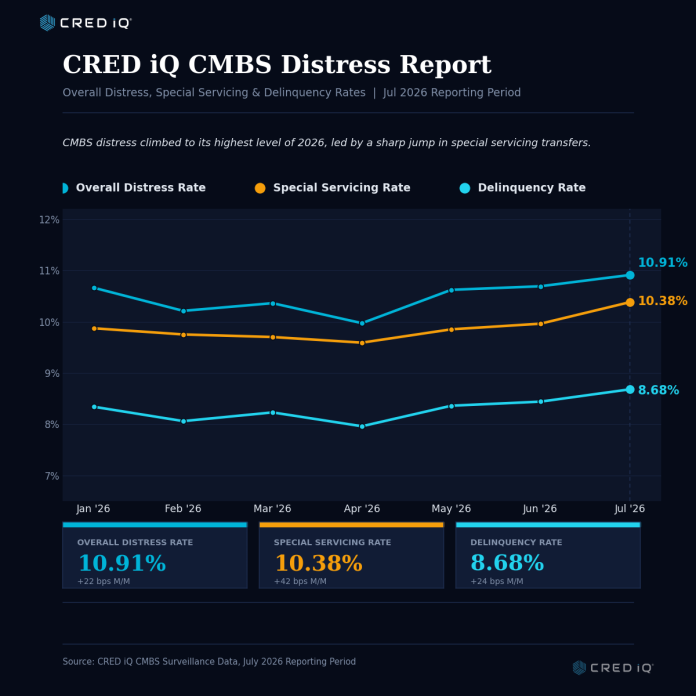
The CMBS overall distress rate reached 12.07% in March 2026, according to CRED iQ data — the highest reading since the firm began tracking conduit loan performance. Delinquencies rose to 9.60%, also a cycle peak, while the specially serviced rate climbed to 11.32%. For investors, lenders, and brokers navigating the current commercial real estate capital markets environment, these figures signal that the distress cycle remains firmly in expansion mode with no clear near-term floor.

What Is the Current CMBS Delinquency Rate?

As of March 2026, 9.60% of CMBS conduit loan balances tracked by CRED iQ are delinquent — loans that are 30+ days past due, in foreclosure, REO, or matured with a balloon payment outstanding. That figure has more than tripled from 2.93% in July 2022, when the current distress cycle effectively began with the Federal Reserve’s aggressive rate hiking campaign. The pace of deterioration has not been linear. A brief plateau in mid-2025, when the overall distress rate dipped toward 10.64% last March, offered a window of cautious optimism that proved premature. By December 2025, distress had re-accelerated to 11.70%, and the March 2026 print of 12.07% has now eclipsed every prior reading in the dataset.

Special Servicer Transfers: Volume Remains Elevated

The specially serviced rate of 11.32% in March 2026 reflects persistent loan workout activity across the CMBS universe. Special servicer transfer volume typically lags delinquency by one to three months, meaning the pipeline of loans moving into workout status continues to grow even as some resolutions occur. The gap between the delinquency rate (9.60%) and the specially serviced rate (11.32%) highlights how many loans are already inside the workout process but have not yet crossed into formal delinquency — a dynamic that suggests reported delinquency figures are likely understating true credit stress. Loan modifications, maturity extensions, and forbearance agreements have become the dominant workout tools for special servicers, as lenders seek to avoid forced asset sales in a still-thin transaction market.

Capital Markets Implications

Elevated distress rates are reshaping CMBS spreads and new issuance underwriting in real time. Conduit deal flow in early 2026 continues at a measured pace as b-piece buyers price in rising loss expectations — particularly for office and retail collateral. Meanwhile, distressed debt buyers and special situation funds have deepened their engagement with CMBS REO and note-on-note financing opportunities, drawn by the expanding supply of underwater collateral. Cap rate compression in industrial and multifamily, which had provided a partial offset to office headwinds in prior years, has stalled as the cost of capital remains elevated relative to in-place income yields.

Outlook

With the delinquency rate at a cycle high and the distress pipeline still building, CRED iQ’s forward indicators suggest the overall distress rate could approach 13% by mid-2026 absent a meaningful shift in financing conditions. The critical variables to monitor are the pace of loan modification expirations, the trajectory of SOFR, and office property valuations — where bid-ask spreads between sellers and buyers remain wide. Until those gaps close, distress is likely to remain the defining story in CMBS credit markets.

Data: CRED iQ proprietary CMBS loan analytics platform.

About CRED iQ

CRED iQ is a leading commercial real estate (CRE) data and analytics platform designed to bring transparency, structure, and actionable intelligence to complex CRE debt markets. The platform aggregates and normalizes loan- and property-level data across CMBS, CRE CLO, Agency, and private debt, enabling investors, lenders, servicers, and advisors to analyze risk, performance, and opportunities within a single, unified environment.

CRED iQ specializes in advanced analytics for loan surveillance, distress tracking, special servicing activity, and workout strategies, with a particular focus on identifying early warning signals and resolution outcomes across the CRE lifecycle. By combining institutional-grade data infrastructure with AI-driven insights, CRED iQ helps market participants move beyond static reporting toward dynamic, forward-looking decision-making.

Users leverage CRED iQ to monitor delinquency trends, track foreclosures and REO pipelines, evaluate modification and extension activity, and assess portfolio exposure at the property, sponsor, and market level. The platform is built for speed, scalability, and precision—reducing manual research while increasing confidence in investment, underwriting, and asset management decisions.

Trusted by leading institutional investors, lenders, and advisory firms, CRED iQ delivers the data foundation required to navigate today’s evolving CRE market. For professionals seeking a comprehensive commercial real estate analytics platform with deep coverage of distressed debt, special servicing, and AI-powered insights, CRED iQ provides a differentiated, execution-ready solution.

Placer.ai and CRED iQ Launch New CMBS Report Combining Foot Traffic Intelligence with CRE Financial Data

0
This image has an empty alt attribute; its file name is Blog-Featured-Images-4-1024x1024.png

CRED iQ in the News – April 1, 2026

Article Snapshot:

  • CRED iQ and Placer have joined forces to launch a new Commercial Mortgage-Backed Securities (CMBS) Report, which is now available on the Placer.ai platform.  The report layers Placer’s high-fidelity foot traffic data directly onto the underlying property assets within CMBS portfolios — powered by CRED iQ’s CRE finance dataset. The integrated data gives lenders, investors, and asset managers a more precise and actionable view of market and asset health.
  • “Partnering with CRED iQ on their CMBS offering creates a powerful perspective on an increasingly important investment vehicle, removing much of the fog and guesswork that had previously been a limiting factor in this segment, and replacing it with objective and reliable metrics.”

Have Industrial Cap Rates Hit a Ceiling?

0

CMBS conduit underwriting data suggests the sector’s repricing cycle may be complete, but Q4 2025’s sharp snapback raises new questions for 2026.

Industrial real estate was the undisputed winner of the post-pandemic era. E-commerce tailwinds and supply chain disruption drove cap rates to historic lows by early 2022. Then interest rates surged, and the sector underwent a meaningful reset. CRED iQ’s analysis of CMBS conduit underwriting data shows the average industrial cap rate climbing from the low-5% range to approximately 6.00% by mid-2024 – an implied valuation correction of roughly 16%, holding NOI constant. By Q4 2024, average industrial cap rates in newly securitized conduit loans had reached 6.40%, and many market participants began asking: has the repricing run its course?

The Mid-2025 Compression

For a brief period, it appeared so. Industrial cap rates compressed notably through mid-2025, falling from 6.38% in Q1 to 5.74% in Q2 and bottoming at 5.52% in Q3. This compression coincided with improving investor sentiment, a stabilizing rate environment, and Class A logistics assets drawing aggressive bids in core markets. Bid-ask spreads narrowed, and capital flowed back into industrial with conviction.


The Q4 Snapback

Then came the reversal. Q4 2025 delivered a jarring 92-basis-point expansion, jumping from 5.52% to 6.44% – the highest reading in CRED iQ’s recent tracking window. The sharp move suggests that mid-year compression may have been driven more by deal composition (smaller sample sizes of higher-quality assets) than by a fundamental pricing shift. As the Q4 pipeline broadened to include a wider range of asset quality and geography, cap rates reverted toward the plateau levels observed throughout 2025.

What It Means for 2026

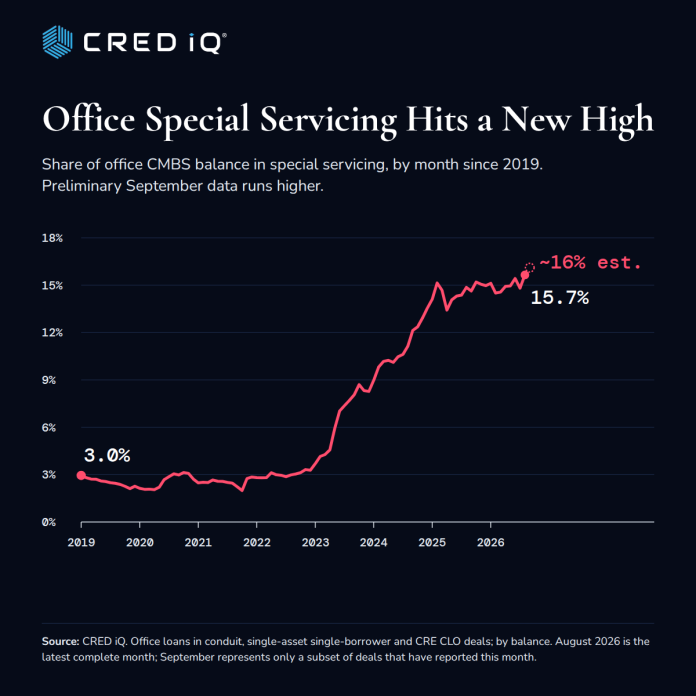
The data points to an industrial market that has largely completed its repricing but hasn’t found a catalyst for renewed compression. At 6.44%, industrial cap rates remain roughly 120 basis points above their 2022 lows, reflecting the structural shift in the cost of capital. Meanwhile, the sector’s fundamentals remain enviable: CMBS industrial distress sits at just 1.5% – a fraction of the 17.5% rate plaguing office and vacancy rates, while elevated from pandemic lows, remain historically manageable.

Perhaps most telling is the spread between industrial cap rates and interest rates. At just 35 basis points in Q3 2025, it was the tightest of any property type — a signal that lenders view industrial as the lowest-risk sector but also one where the margin for error in underwriting is thinnest. As 10-year Treasury yields settle into the mid-to-high 3% range and the Fed continues easing, there is a path toward modest cap rate compression in 2026. But the wild ride of rapid tightening and expansion appears to be over.

For investors, the message is clear: industrial remains the most defensible sector in CRE, but the days of buying yield compression are behind us. Returns in 2026 will be driven by operational execution – rent growth, occupancy management, and capital improvements, not cap rate tailwinds.

Source: CRED iQ Loan Analytics Platform. Analysis based on new-issue CMBS conduit underwriting data.

About CRED iQ

CRED iQ is a leading commercial real estate (CRE) data and analytics platform designed to bring transparency, structure, and actionable intelligence to complex CRE debt markets. The platform aggregates and normalizes loan- and property-level data across CMBS, CRE CLO, Agency, and private debt, enabling investors, lenders, servicers, and advisors to analyze risk, performance, and opportunities within a single, unified environment.

CRED iQ specializes in advanced analytics for loan surveillance, distress tracking, special servicing activity, and workout strategies, with a particular focus on identifying early warning signals and resolution outcomes across the CRE lifecycle. By combining institutional-grade data infrastructure with AI-driven insights, CRED iQ helps market participants move beyond static reporting toward dynamic, forward-looking decision-making.

Users leverage CRED iQ to monitor delinquency trends, track foreclosures and REO pipelines, evaluate modification and extension activity, and assess portfolio exposure at the property, sponsor, and market level. The platform is built for speed, scalability, and precision—reducing manual research while increasing confidence in investment, underwriting, and asset management decisions.

Trusted by leading institutional investors, lenders, and advisory firms, CRED iQ delivers the data foundation required to navigate today’s evolving CRE market. For professionals seeking a comprehensive commercial real estate analytics platform with deep coverage of distressed debt, special servicing, and AI-powered insights, CRED iQ provides a differentiated, execution-ready solution.

Office Properties Drive Maturity Extension Wave as CMBS Modification Volume Surges

0

Analysis of CRED iQ loan-level data reveals maturity extensions now account for the largest share of CMBS modification balance, with office collateral representing nearly two-thirds of all extension activity.

Modification Landscape: Maturity Extensions Take Center Stage

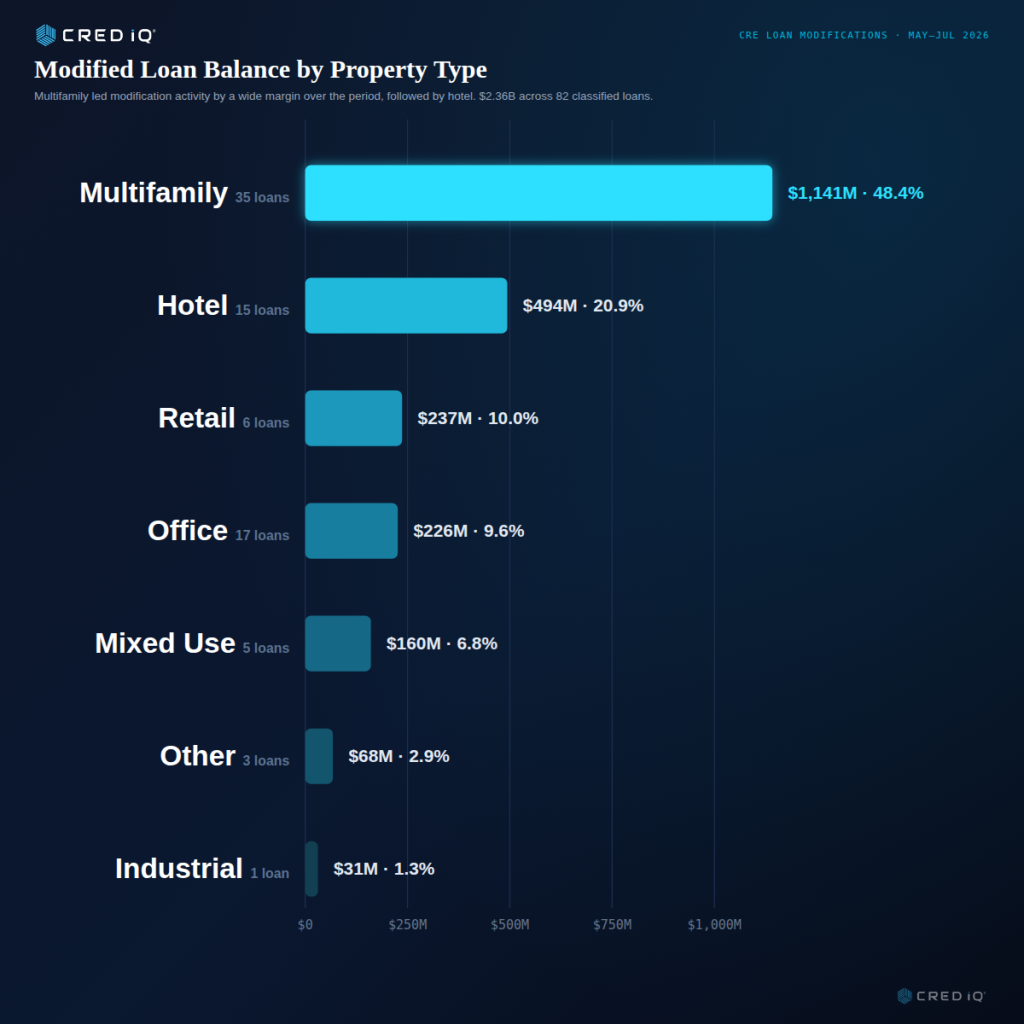
CRED iQ’s proprietary loan analytics platform tracks modification activity across the CMBS universe, capturing more than 7,800 individual loan modification events since 2019. Within that dataset, maturity date extensions have emerged as the dominant workout structure by outstanding loan balance. Of the 1,249 loans that received maturity extensions, the aggregate unpaid principal balance totals approximately $115.0 billion — reflecting the depth of refinancing stress concentrated in the legacy office sector and, increasingly, other property types navigating a prolonged high-rate environment.

Forbearance agreements account for the second-largest cohort by loan count at 1,445 loans ($38.7 billion), followed by combination modifications at 890 loans ($63.0 billion). Principal write-offs remain a relatively rare outcome, with only four recorded events totaling $155 million, underscoring that lenders and servicers continue to lean on time-based extensions over loss crystallization.

Property Type Allocation: Office Dominates Extension Activity

Among the 1,249 maturity extensions tracked by CRED iQ, office collateral accounts for 452 loans and $66.7 billion of the $104.3 billion in property-type-identified extension balance — representing 64.0% of total extension volume. Mixed-use properties rank second at 17.1% ($17.9 billion), followed by multifamily at 6.4% ($6.7 billion) and hotel at 5.5% ($5.7 billion). Industrial and retail trail at 4.2% and 2.4%, respectively.

The outsized office concentration reflects the structural headwinds facing the sector: post-pandemic occupancy erosion, elevated capital expenditure requirements, and an inability to refinance at maturity as values have declined sharply from origination-era appraisals. Extensions are being used as a bridge mechanism while borrowers and servicers negotiate long-term resolutions.

Property TypeLoansBalance% of Balance
Office452$66.7B64.0%
Mixed-Use139$17.9B17.1%
Multifamily175$6.7B6.4%
Hotel87$5.7B5.5%
Industrial64$4.4B4.2%
Retail38$2.6B2.4%
Manufactured Housing14$354M0.3%

Source: CRED iQ

Loan-Level Spotlight: Federal Center Plaza, Washington DC

A representative example of the maturity extension dynamic is Federal Center Plaza, a 725,317-square-foot office complex at 400 & 500 C Street SW in Washington, DC. The $130 million interest-only loan was securitized in COMM 2013-CCRE6 and originally matured on February 6, 2025. Unable to pay off at maturity, the loan was transferred to special servicing on November 15, 2024, and received a formal maturity date extension executed on February 4, 2026.

The property’s financial profile illustrates the broader challenges confronting DC office: physical occupancy has declined from 74% in 2023–2024 to 68% as of the trailing nine-month period ending September 2025. More critically, CRED iQ’s most recent appraised value stands at $168 million — a 45.6% reduction from the $309 million valuation at loan contribution in 2013. Despite the value impairment, the loan continues to carry a DSCR of 2.23x on a most-recent NOI basis, supported by the General Services Administration’s anchor lease covering 465,839 square feet. However, that GSA lease expires in August 2027, creating a concentrated rollover risk that will likely define the asset’s resolution trajectory. The loan’s expected resolution date is April 30, 2026.

Loan Detail: Federal Center Plaza
Deal / Loan IDCOMM 2013-CCRE6 / Loan 1
PropertyFederal Center Plaza, Washington DC
Property TypeOffice (725,317 SF)
Current Balance$130,000,000
Original MaturityFebruary 6, 2025
Modification ExecutedFebruary 4, 2026
Modification TypeMaturity Date Extension
Appraised Value (2013)$309,000,000
Appraised Value (Jan 2026)$168,000,000  (−45.6%)
Physical Occupancy68% (TTM Sept 2025)
DSCR (NOI)2.23x (most recent)
Largest TenantGSA — 465,839 SF (Lease Exp. Aug 2027)
Special Servicer TransferNovember 15, 2024
Expected ResolutionApril 30, 2026

Source: CRED iQ

About CRED iQ

CRED iQ is a leading commercial real estate (CRE) data and analytics platform designed to bring transparency, structure, and actionable intelligence to complex CRE debt markets. The platform aggregates and normalizes loan- and property-level data across CMBS, CRE CLO, Agency, and private debt, enabling investors, lenders, servicers, and advisors to analyze risk, performance, and opportunities within a single, unified environment.

CRED iQ specializes in advanced analytics for loan surveillance, distress tracking, special servicing activity, and workout strategies, with a particular focus on identifying early warning signals and resolution outcomes across the CRE lifecycle. By combining institutional-grade data infrastructure with AI-driven insights, CRED iQ helps market participants move beyond static reporting toward dynamic, forward-looking decision-making.

Users leverage CRED iQ to monitor delinquency trends, track foreclosures and REO pipelines, evaluate modification and extension activity, and assess portfolio exposure at the property, sponsor, and market level. The platform is built for speed, scalability, and precision—reducing manual research while increasing confidence in investment, underwriting, and asset management decisions.

Trusted by leading institutional investors, lenders, and advisory firms, CRED iQ delivers the data foundation required to navigate today’s evolving CRE market. For professionals seeking a comprehensive commercial real estate analytics platform with deep coverage of distressed debt, special servicing, and AI-powered insights, CRED iQ provides a differentiated, execution-ready solution.

Special Servicing Rate Reaches 11.1%, Second-Highest Level Since GFC

0

March 2026 | CRED iQ Research

Commercial real estate credit stress remains stubbornly elevated heading into the spring lending season, with CRED iQ’s latest data showing the overall distress rate — encompassing loans that are delinquent and/or specially serviced — registering 11.63% in February 2026. While that marks a modest pullback from the January 2026 cycle high of 11.98%, it would be premature to interpret the retreat as a trend reversal. The delinquency rate alone hit 9.31% in February, down marginally from 9.40% in January but still representing one of the highest readings in this cycle and more than triple the 2.93% rate recorded in July 2022 when this distress wave began.

The specially serviced rate tells a similar story. At 11.13% in February, it remains near peak territory after climbing steadily from 4.47% in mid-2022. The convergence of the delinquency and specially serviced rates reflects the maturation of the distress cycle — loans that entered special servicing 12 to 18 months ago are now resolving, or failing to resolve, pushing delinquencies higher even as new special servicing inflows show early signs of moderating.

The Macro Backdrop: Cautious Optimism With Real Headwinds

The broader economic environment provides a mixed backdrop. The 10-year Treasury has retreated to approximately 3.94%, down meaningfully from year-ago levels, offering some relief on cap rate compression and refinancing economics. The Federal Reserve has cut the lower bound of the Fed Funds Rate to 3.50%, with short-term benchmark rates following suit — a notable improvement from the restrictive policy environment that defined 2023 and much of 2024. Inflation, while not fully vanquished, has cooled considerably, with headline CPI running near 2.4% year-over-year and core inflation measures trending in the right direction.

Yet the labor market is showing signs of softening. The unemployment rate has edged up to 4.3%, and monthly payroll growth has slowed considerably from the robust pace of prior years. A weakening jobs picture feeds directly into multifamily fundamentals and retail foot traffic — two sectors already navigating elevated credit stress.

Office remains the most distressed major property type, with delinquency readings pushing into the low double digits across CMBS loan pools. Multifamily — increasingly a concern given the wave of floating-rate bridge loans originated in 2021 and 2022 — continues to see elevated delinquency pressure, though moderating SOFR rates provide a partial offset. On the capital markets side, private-label CMBS issuance is running below year-ago levels, reflecting reduced transaction velocity and persistent lender caution on certain asset classes.

Year-End 2026 Outlook

CRED iQ projects the overall distress rate to remain in the 11% to 12.5% range through mid-year before beginning a gradual descent in the second half of 2026, contingent on continued Treasury rate stability and no material deterioration in employment. The substantial wall of CMBS and CRE CLO maturities due in 2026 will be a critical stress test — loans originated in the 2021-2022 vintage at compressed cap rates and aggressive underwriting assumptions face the steepest refinancing hurdles. Office distress is likely to push toward 13% to 14% before finding a floor, while multifamily stress could stabilize meaningfully as floating-rate borrowing costs continue drifting lower.

The path to recovery is visible, but it runs through a prolonged workout period that will define the CRE lending landscape well into 2027.

About CRED iQ

CRED iQ is a leading commercial real estate (CRE) data and analytics platform designed to bring transparency, structure, and actionable intelligence to complex CRE debt markets. The platform aggregates and normalizes loan- and property-level data across CMBS, CRE CLO, Agency, and private debt, enabling investors, lenders, servicers, and advisors to analyze risk, performance, and opportunities within a single, unified environment.

CRED iQ specializes in advanced analytics for loan surveillance, distress tracking, special servicing activity, and workout strategies, with a particular focus on identifying early warning signals and resolution outcomes across the CRE lifecycle. By combining institutional-grade data infrastructure with AI-driven insights, CRED iQ helps market participants move beyond static reporting toward dynamic, forward-looking decision-making.

Users leverage CRED iQ to monitor delinquency trends, track foreclosures and REO pipelines, evaluate modification and extension activity, and assess portfolio exposure at the property, sponsor, and market level. The platform is built for speed, scalability, and precision—reducing manual research while increasing confidence in investment, underwriting, and asset management decisions.

Trusted by leading institutional investors, lenders, and advisory firms, CRED iQ delivers the data foundation required to navigate today’s evolving CRE market. For professionals seeking a comprehensive commercial real estate analytics platform with deep coverage of distressed debt, special servicing, and AI-powered insights, CRED iQ provides a differentiated, execution-ready solution.

2,085FollowersFollow
6SubscribersSubscribe