

CMBS conduit underwriting data suggests the sector’s repricing cycle may be complete, but Q4 2025’s sharp snapback raises new questions for 2026.
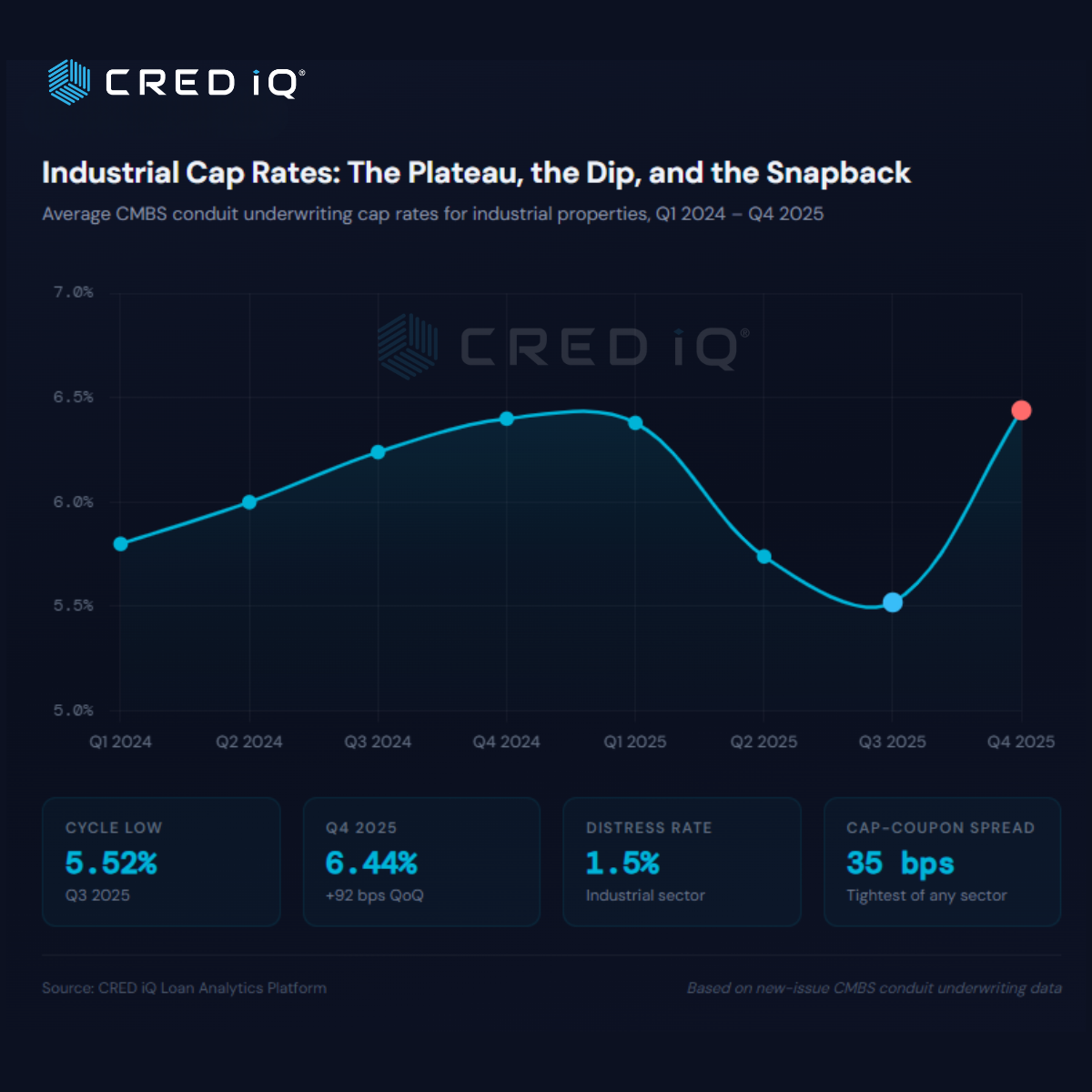
Industrial real estate was the undisputed winner of the post-pandemic era. E-commerce tailwinds and supply chain disruption drove cap rates to historic lows by early 2022. Then interest rates surged, and the sector underwent a meaningful reset. CRED iQ’s analysis of CMBS conduit underwriting data shows the average industrial cap rate climbing from the low-5% range to approximately 6.00% by mid-2024 – an implied valuation correction of roughly 16%, holding NOI constant. By Q4 2024, average industrial cap rates in newly securitized conduit loans had reached 6.40%, and many market participants began asking: has the repricing run its course?
The Mid-2025 Compression
For a brief period, it appeared so. Industrial cap rates compressed notably through mid-2025, falling from 6.38% in Q1 to 5.74% in Q2 and bottoming at 5.52% in Q3. This compression coincided with improving investor sentiment, a stabilizing rate environment, and Class A logistics assets drawing aggressive bids in core markets. Bid-ask spreads narrowed, and capital flowed back into industrial with conviction.
The Q4 Snapback
Then came the reversal. Q4 2025 delivered a jarring 92-basis-point expansion, jumping from 5.52% to 6.44% – the highest reading in CRED iQ’s recent tracking window. The sharp move suggests that mid-year compression may have been driven more by deal composition (smaller sample sizes of higher-quality assets) than by a fundamental pricing shift. As the Q4 pipeline broadened to include a wider range of asset quality and geography, cap rates reverted toward the plateau levels observed throughout 2025.
What It Means for 2026
The data points to an industrial market that has largely completed its repricing but hasn’t found a catalyst for renewed compression. At 6.44%, industrial cap rates remain roughly 120 basis points above their 2022 lows, reflecting the structural shift in the cost of capital. Meanwhile, the sector’s fundamentals remain enviable: CMBS industrial distress sits at just 1.5% – a fraction of the 17.5% rate plaguing office and vacancy rates, while elevated from pandemic lows, remain historically manageable.
Perhaps most telling is the spread between industrial cap rates and interest rates. At just 35 basis points in Q3 2025, it was the tightest of any property type — a signal that lenders view industrial as the lowest-risk sector but also one where the margin for error in underwriting is thinnest. As 10-year Treasury yields settle into the mid-to-high 3% range and the Fed continues easing, there is a path toward modest cap rate compression in 2026. But the wild ride of rapid tightening and expansion appears to be over.
For investors, the message is clear: industrial remains the most defensible sector in CRE, but the days of buying yield compression are behind us. Returns in 2026 will be driven by operational execution – rent growth, occupancy management, and capital improvements, not cap rate tailwinds.
Source: CRED iQ Loan Analytics Platform. Analysis based on new-issue CMBS conduit underwriting data.
About CRED iQ
CRED iQ is a leading commercial real estate (CRE) data and analytics platform designed to bring transparency, structure, and actionable intelligence to complex CRE debt markets. The platform aggregates and normalizes loan- and property-level data across CMBS, CRE CLO, Agency, and private debt, enabling investors, lenders, servicers, and advisors to analyze risk, performance, and opportunities within a single, unified environment.
CRED iQ specializes in advanced analytics for loan surveillance, distress tracking, special servicing activity, and workout strategies, with a particular focus on identifying early warning signals and resolution outcomes across the CRE lifecycle. By combining institutional-grade data infrastructure with AI-driven insights, CRED iQ helps market participants move beyond static reporting toward dynamic, forward-looking decision-making.
Users leverage CRED iQ to monitor delinquency trends, track foreclosures and REO pipelines, evaluate modification and extension activity, and assess portfolio exposure at the property, sponsor, and market level. The platform is built for speed, scalability, and precision—reducing manual research while increasing confidence in investment, underwriting, and asset management decisions.
Trusted by leading institutional investors, lenders, and advisory firms, CRED iQ delivers the data foundation required to navigate today’s evolving CRE market. For professionals seeking a comprehensive commercial real estate analytics platform with deep coverage of distressed debt, special servicing, and AI-powered insights, CRED iQ provides a differentiated, execution-ready solution.
