

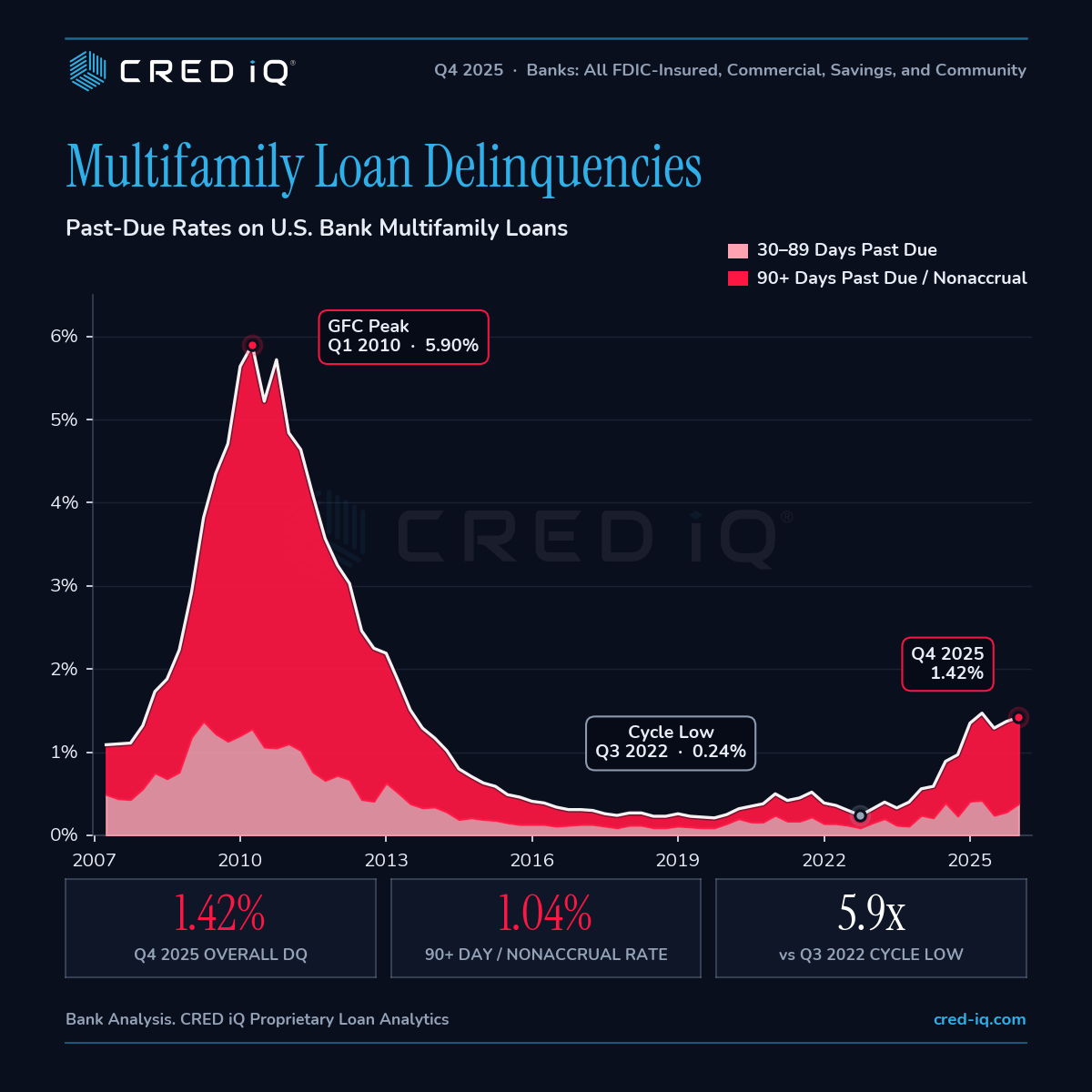
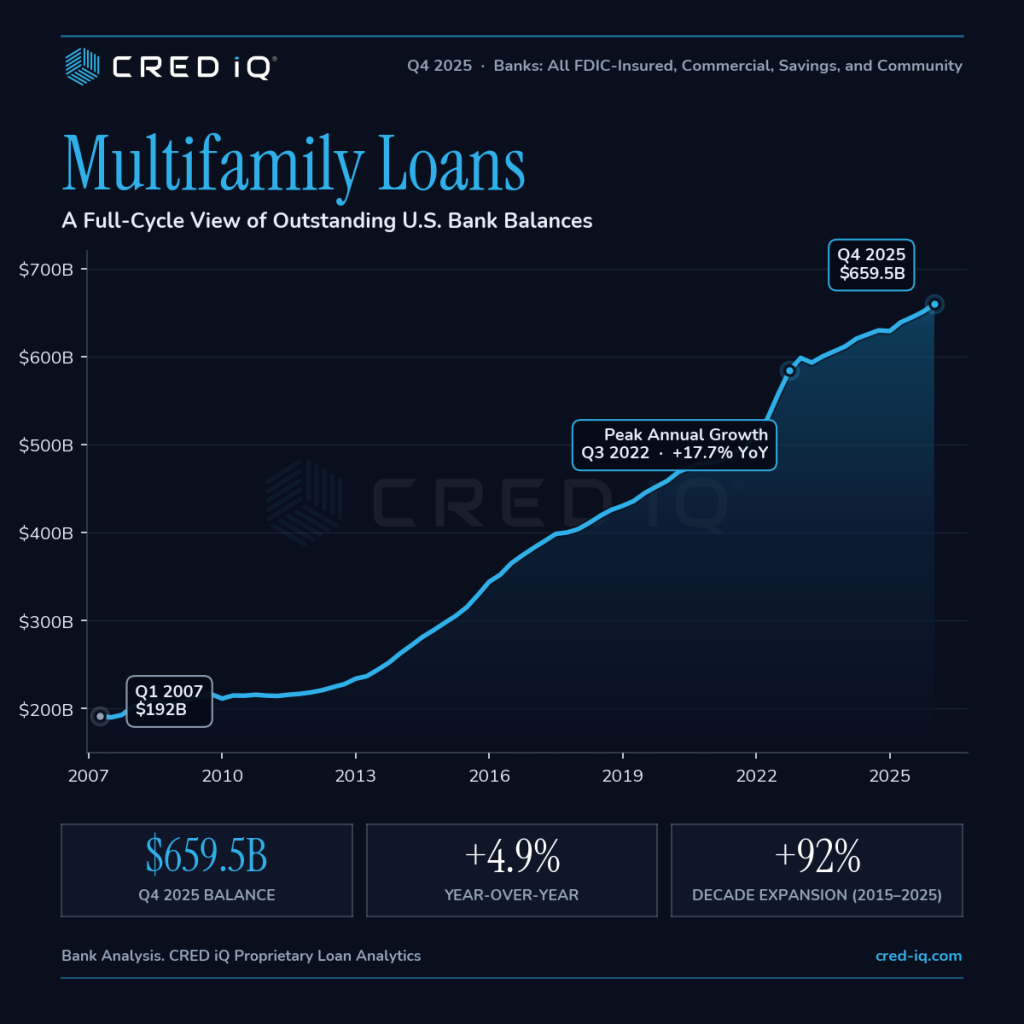
Multifamily loan balances at U.S. banks rose to a record $659.5 billion in Q4 2025, up 4.9% year-over-year, even as the multifamily delinquency rate climbed to 1.42% — the highest level since Q2 2013, according to CRED iQ’s proprietary loan analytics. The divergence between continued portfolio growth and accelerating credit stress marks one of the most consequential cross-currents in U.S. bank commercial real estate lending heading into 2026.
How Large Is the U.S. Bank Multifamily Loan Portfolio?
Outstanding multifamily loan balances at U.S. banks have grown 92% over the past decade, expanding from $344.1 billion in Q4 2015 to $659.5 billion in Q4 2025. The portfolio reached an all-time high in the fourth quarter, with quarter-over-quarter growth of $8.6 billion. Unlike construction and development lending, which has contracted for six consecutive quarters, bank multifamily exposure continues to expand — albeit at a moderating pace from the +17.7% year-over-year peak recorded in Q3 2022.
.
Why Are Multifamily Delinquencies Rising So Quickly?
CRED iQ’s analysis points to a confluence of pressures: elevated debt service costs at refinancing, weaker rent growth across pandemic-era boom markets (particularly Sun Belt metros that saw heavy supply deliveries), and tighter underwriting standards constraining take-out financing. The multifamily delinquency rate has risen from a cycle low of 0.24% in Q3 2022 to 1.42% in Q4 2025 — a nearly six-fold increase in just over three years.
Which Loans Are Driving the Stress?
The deterioration is concentrated in more severe delinquency stages. The 90+ day past-due / nonaccrual rate stands at 1.04% in Q4 2025, up from just 0.15% in Q3 2022. By contrast, the 30–89 day past-due rate remains comparatively contained at 0.38%, suggesting that the bulk of currently stressed loans have already migrated into deeper delinquency rather than new early-stage problems entering the pipeline at an accelerating rate.
How Does Current Stress Compare to the Global Financial Crisis?
The current 1.42% multifamily delinquency rate is materially elevated by post-pandemic standards but remains well below GFC-era stress. Bank multifamily delinquencies peaked at 5.90% in Q1 2010, with the 90+ day rate alone reaching 4.62%. Today’s readings represent roughly 24% of that GFC peak. Annualized loss rates on multifamily loans also remain modest at 0.13% in Q4 2025, compared with peak losses of 1.24% in Q4 2010.
What Does Rising Multifamily Stress Mean for Lenders and Investors?
For lenders, the divergence between portfolio growth and credit deterioration creates a complicated risk-management picture: balance sheet exposure is still expanding while the quality of existing exposure weakens. For investors and operators, distressed multifamily opportunities are likely to grow through 2026 as 90+ day delinquencies work through workout and disposition channels. The trajectory of further stress will depend largely on the path of interest rates, rent growth in oversupplied markets, and the willingness of lenders to extend modifications on maturing loans.

About CRED iQ
CRED iQ is the enterprise data and intelligence platform powering the securitized commercial real estate market. By aggregating, normalizing, and enriching loan-level data across the full universe of CMBS Conduit, SASB, CRE CLO, and GSE/Agency Multifamily (Freddie Mac, Fannie Mae, Ginnie Mae, and FHA/HUD), CRED iQ delivers unprecedented transparency into property performance, loan structures, and borrower exposure — bringing efficiency and analytical depth to the entire asset class. Through its web platform, API, bulk data feeds, MCP server, and CRED AI Labs professional services division, market participants and AI systems access the industry’s most comprehensive and reliable source of deal intelligence. As the canonical data layer for AI-driven CRE workflows, CRED iQ is the data provider of choice for institutional lenders, investors, servicers, and advisors — and the foundational infrastructure for the next generation of AI applications built on top of the multi-trillion-dollar securitized CRE market. For more information, visit www.cred-iq.com.
