
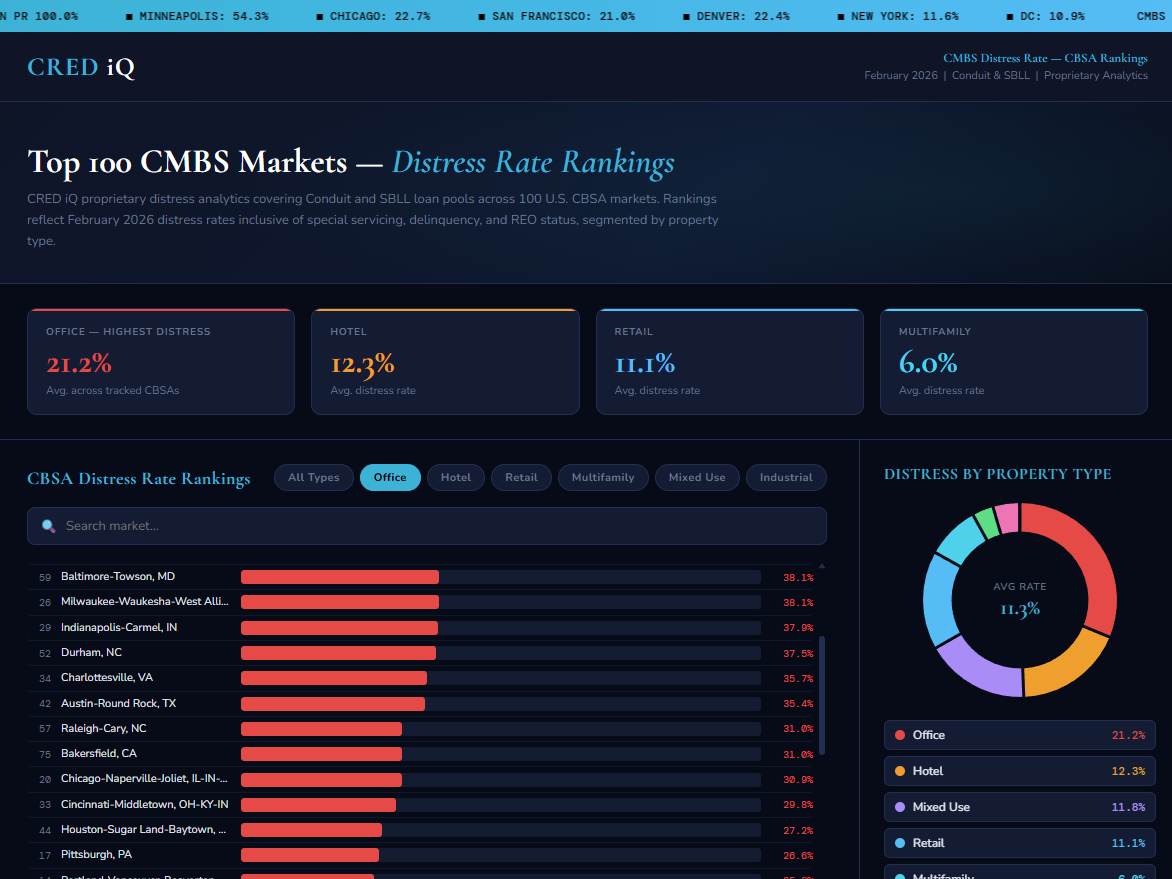
Source: CRED iQ Proprietary Loan Analytics | Conduit & SBLL | February 2026 | cred-iq.com
Which U.S. CMBS Markets Have the Highest Distress Rates in 2026?
According to CRED iQ proprietary CMBS loan analytics, commercial real estate loan distress remains concentrated in specific metropolitan markets and property types as of February 2026. Spanning Conduit and SBLL deal structures across 100 U.S. Core-Based Statistical Areas (CBSAs), CRED iQ’s distress rate framework captures loans in special servicing, 30+ day delinquency, and REO status — providing investors and lenders a comprehensive view of market-level credit risk.
The national distribution reveals a bifurcated landscape: a handful of smaller secondary and tertiary markets post extreme distress rates driven by single large loan exposures, while major gateway metros — including Chicago, Denver, and San Francisco — contend with sustained structural headwinds in office and hotel loan pools.
Top CMBS Distressed Markets by CBSA — February 2026
The following table presents selected CRED iQ-ranked CBSA markets by aggregate CMBS distress rate, highlighting the primary property type driving distress in each market.
| Rank | CBSA Market | Distress Rate | Primary Driver |
| 1 | San Juan-Caguas-Guaynabo, PR | 100.0% | Retail |
| 5 | Syracuse, NY | 65.9% | Office / Retail |
| 6 | Minneapolis-St. Paul-Bloomington, MN-WI | 54.3% | Office / Hotel |
| 7 | Youngstown-Warren-Boardman, OH-PA | 52.0% | Retail |
| 8 | Trenton-Ewing, NJ | 43.4% | Office |
| 13 | Oklahoma City, OK | 36.0% | Retail / Hotel |
| 14 | Portland-Vancouver-Beaverton, OR-WA | 35.1% | Hotel / Retail |
| 20 | Chicago-Naperville-Joliet, IL-IN-WI | 22.7% | Office / Hotel |
| 21 | Denver-Aurora, CO | 22.4% | Office / Mixed Use |
| 23 | San Francisco-Oakland-Fremont, CA | 21.0% | Hotel / Multifamily |
| 47 | New York-Northern NJ-Long Island, NY-NJ-PA | 11.6% | Office / Multifamily |
| 50 | Washington-Arlington-Alexandria, DC-VA-MD-WV | 10.9% | Office / Mixed Use |
| 54 | Los Angeles-Long Beach-Santa Ana, CA | 10.0% | Mixed Use / Office |
Note: Distress rates reflect CRED iQ proprietary analytics across Conduit and SBLL deal types. Markets with single-loan CMBS exposure may reflect 100% distress on a small underlying balance.
Contact Our TeamMajor Gateway Markets Under the Microscope
Minneapolis: The Most Distressed Large CBSA at 54.3%
Minneapolis-St. Paul-Bloomington ranks as the highest-distress major metropolitan area tracked by CRED iQ, with a February 2026 distress rate of 54.3%. Office loans lead the distress profile at 72.7%, compounded by hotel loans at 92.2% — reflecting both remote work disruption to suburban office demand and uneven hospitality recovery in the Twin Cities. The market’s elevated rate has persisted across multiple CRED iQ monthly readings, signaling structural, not cyclical, credit deterioration.
Chicago, Denver & San Francisco: Persistent Office Headwinds
Three of the nation’s largest metros remain elevated above the national average. Chicago (22.7%) is driven by a hotel distress rate of 61.1% and office at 30.9%, reflecting continued downtown leasing pressure and deferred corporate footprint decisions. Denver (22.4%) shows office distress at 38.5%, compounded by a mixed-use rate of 63.1% tied to downtown redevelopment projects. San Francisco (21.0%) — long a bellwether for post-pandemic office dislocation — records hotel distress at 30.6% and notable multifamily exposure at 49.4%, as Class A residential borrowers face refinancing stress from 2021–2022 vintage debt.
New York, Washington D.C., and Los Angeles: Below the Major Market Average
Three of the four largest U.S. metros track materially below the national distress leader. New York (11.6%) reflects broad diversification across office, multifamily, retail, and hotel sectors — with no single property type dominating the distress profile. Washington, D.C. (10.9%) shows office distress at 16.9% as hybrid work stabilizes federal leasing demand. Los Angeles (10.0%) posts mixed-use as its primary driver at 27.6%, with office (14.5%) and manufactured housing (9.8%) contributing secondary pressure.
CMBS Distress by Property Type: Office Leads, Industrial Remains Resilient
CRED iQ’s February 2026 property-type analytics reveal a clear hierarchy of distress risk across the commercial real estate credit spectrum.
| Property Type | Avg. Distress Rate | Key Observations |
| Office | 21.2% | Highest distress — remote work headwinds |
| Hotel | 12.3% | Secondary & tertiary markets most stressed |
| Mixed Use | 11.8% | Office component dragging portfolio metrics |
| Retail | 11.1% | Elevated in Midwest / Sun Belt secondaries |
| Multifamily | 6.0% | Rising in rate-stressed 2021-22 vintage loans |
| Industrial | 2.4% | Resilient; selective exposure in older assets |
| Self Storage | 0.05% | Minimal distress; strong rent fundamentals |
| Manufactured Housing | 3.0% | Idiosyncratic; concentrated in a few CBSAs |
Office: Still the Most Distressed Property Type
At a 21.2% average distress rate across tracked CBSAs, CMBS office loans remain the single largest source of credit risk in the CRED iQ distress universe. Markets including Hartford (75.9% office distress), Topeka (100.0%), and Louisville (72.4%) reflect concentrated exposure to single-tenant or suburban assets facing lease-up challenges. Even gateway markets like Denver (38.5%) and Chicago (30.9%) have not fully absorbed post-pandemic demand destruction.
Hotel: Selective Recovery, Elevated Secondary Market Risk
Hotel CMBS distress averaged 12.3% across the CRED iQ CBSA universe, with wide dispersion. Minneapolis leads with 92.2% hotel distress, followed by Rochester (100%) and Atlantic City (78.9%). The common thread: leisure-dependent or drive-to markets have recovered unevenly, while urban business-travel hotel pools still suffer from suppressed group and corporate demand.
Retail: Midwest Secondary Markets Drive the Rate
Retail distress averaged 11.1% — a notable drag concentrated in Midwestern and secondary metros. Youngstown (76.8%), Oklahoma City (66.1%), and Boulder (93.7%) carry outsized retail distress often tied to mall anchors, power center vacancies, and single-asset loan structures. Coastal primary market retail, by contrast, has shown relative resilience within CRED iQ’s tracked pool.
Multifamily: Rate Stress Creating 2021–22 Vintage Pressure
Multifamily CMBS distress averaged 6.0% nationally, but CRED iQ data highlights pockets of concentrated stress. Greeley, CO (86.2%), Macon, GA (53.7%), and New Haven (52.3%) lead the multifamily distress rankings. These markets share a common profile: floating-rate or bridge loans originated at peak valuations in 2021–2022 that now face stressed DSCR coverage at current benchmark rates.
Industrial & Self Storage: The Resilience Story
Industrial CMBS loans average just 2.4% distress across CRED iQ’s tracked CBSAs, with meaningful exposure only in markets like Rochester (23.5%), Pittsburgh (21.5%), and Salt Lake City (28.8%) — often tied to older, functionally obsolete warehouse assets rather than modern logistics product. Self storage averaged a negligible 0.05%, reinforcing its status as the most credit-stable property type in the CMBS conduit universe.
CRED iQ Market Outlook: What Investors and Lenders Should Watch
Based on CRED iQ proprietary analytics, the February 2026 CMBS distress landscape reflects the following investment and credit risk signals:
- Office maturities remain the primary catalyst for distress rate movement in 2026 — monitor Minneapolis, Hartford, Denver, and Chicago for resolution or liquidation events that could shift market-level distress rates materially.
- Hotel portfolio stress is bifurcating: urban gateway hotels with improving RevPAR are being underwritten tighter, while secondary and tertiary market assets show limited workout progress and growing servicer deferrals.
- Multifamily distress risk is front-loaded in the 2021–2022 vintage. Markets with high concentrations of bridge or floating-rate multifamily debt — including several Sun Belt CBSAs — warrant close surveillance as loan maturities approach.
- Industrial and self storage continue to represent the most credit-resilient CMBS collateral types tracked by CRED iQ, offering investors relatively stable ground within a mixed credit environment.
METHODOLOGY & ATTRIBUTION
All distress rate data sourced exclusively from CRED iQ’s proprietary CMBS loan analytics platform. Distress is defined as loans in special servicing, 30+ day delinquency, or REO status. Analysis covers Conduit and SBLL deal types. CBSA distress rates are balance-weighted aggregates as of February 2026. For access to full CBSA-level data, property-type loan-level analytics, or deal-specific research, visit crediq.com.