


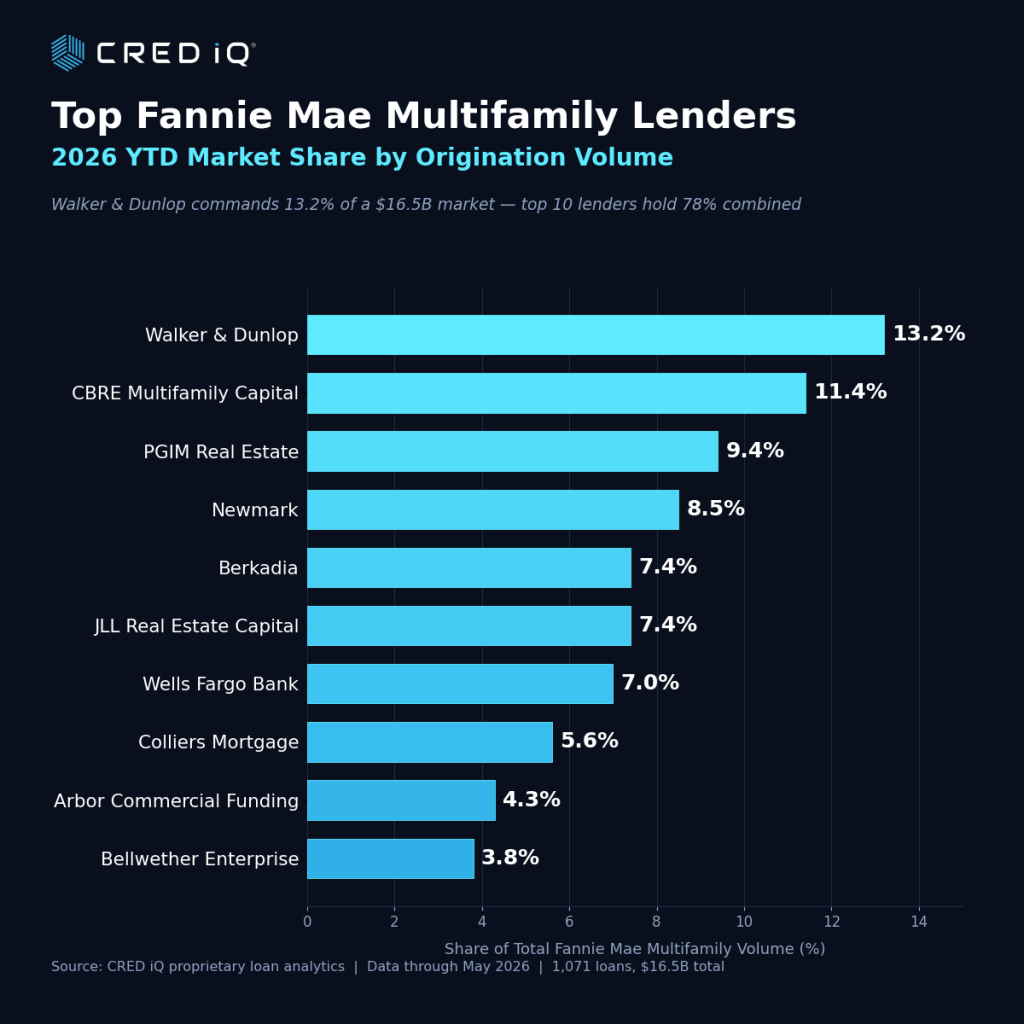
Walker & Dunlop is the top Fannie Mae multifamily lender in 2026 year-to-date, originating $2.18 billion across 110 loans, according to CRED iQ proprietary loan analytics. The firm leads a concentrated agency lending market in which the ten largest originators captured roughly 78% of all volume through mid-May.
CRED iQ analyzed 1,071 Fannie Mae multifamily loans totaling $16.5 billion issued from January through May 2026. The data reveals a market dominated by a familiar set of agency lending heavyweights, with the top five originators alone responsible for half of all dollar volume.
.
Who Are the Top Fannie Mae Multifamily Lenders in 2026?
The leaderboard reflects the entrenched scale advantages of the largest DUS lenders. Walker & Dunlop’s $2.18 billion narrowly outpaced CBRE Multifamily Capital at $1.88 billion and PGIM Real Estate Agency Financing at $1.56 billion. Newmark ($1.39 billion), JLL Real Estate Capital ($1.22 billion), and Berkadia ($1.22 billion) rounded out the upper tier.
The ten largest Fannie Mae multifamily originators in 2026 YTD, ranked by loan volume, are:
- Walker & Dunlop — $2.18B
- CBRE Multifamily Capital — $1.88B
- PGIM Real Estate Agency Financing — $1.56B
- Newmark — $1.39B
- Berkadia Commercial Mortgage — $1.22B
- JLL Real Estate Capital — $1.22B
- Wells Fargo Bank — $1.15B
- Colliers Mortgage — $0.92B
- Arbor Commercial Funding — $0.71B
- Bellwether Enterprise Mortgage Investments — $0.62B
Loan count tells a complementary story about origination strategy. Berkadia led all lenders with 172 loans, signaling a high-volume, smaller-balance footprint, while Walker & Dunlop’s 110 loans carried a higher average balance. The average Fannie Mae multifamily loan in 2026 YTD measured approximately $15.4 million.
Is Fannie Mae Multifamily Lending Growing in 2026?
Fannie Mae multifamily origination volume accelerated through the first quarter of 2026 before moderating. Monthly volume climbed from roughly $3.1 billion in January to a 2026 peak of $5.6 billion in March, according to CRED iQ data, as borrowers moved to lock financing amid shifting rate expectations. March alone accounted for more than one-third of first-quarter volume.
What Is Driving Fannie Mae Multifamily Loan Demand?
Refinancing is the primary engine of 2026 agency activity. Refinance loans represented 62.8% of total volume ($10.3 billion), reflecting a wave of borrowers addressing 2026 and 2027 loan maturities and replacing higher-cost bridge debt. Acquisition financing accounted for 36.1% ($5.95 billion), with supplemental loans making up the small remainder. The refinance-heavy mix underscores how maturity management—rather than transaction velocity—is defining this lending cycle.
Which Markets Are Attracting the Most Fannie Mae Capital?
Gateway and Sun Belt metros dominated 2026 deployment. The New York–Newark–Jersey City MSA led all markets with $1.6 billion in Fannie Mae multifamily volume, followed by San Jose–Sunnyvale–Santa Clara ($0.75 billion) and Los Angeles–Long Beach–Anaheim ($0.72 billion). High-growth Sun Belt markets including Phoenix ($0.69 billion), Miami–Fort Lauderdale ($0.63 billion), and Dallas–Fort Worth ($0.60 billion) also ranked among the top destinations for agency capital.
The Bottom Line for CRE Lenders and Investors
The 2026 Fannie Mae multifamily landscape is defined by concentration, refinancing demand, and resilient gateway-market appetite. With the top ten lenders controlling nearly four-fifths of volume, scale and DUS relationships remain decisive competitive advantages. For investors and lenders monitoring agency capital flows, CRED iQ proprietary loan analytics offers loan-level visibility into originator activity, market deployment, and emerging refinancing trends shaping the multifamily debt cycle.
Source: CRED iQ proprietary loan analytics. Data reflects Fannie Mae multifamily loans originated January 1–May 13, 2026.
About CRED iQ
CRED iQ is the enterprise data and intelligence platform powering the securitized commercial real estate market. By aggregating, normalizing, and enriching loan-level data across the full universe of CMBS Conduit, SASB, CRE CLO, and GSE/Agency Multifamily (Freddie Mac, Fannie Mae, Ginnie Mae, and FHA/HUD), CRED iQ delivers unprecedented transparency into property performance, loan structures, and borrower exposure — bringing efficiency and analytical depth to the entire asset class. Through its web platform, API, bulk data feeds, MCP server, and CRED AI professional services division, market participants and AI systems access the industry’s most comprehensive and reliable source of deal intelligence. As the canonical data layer for AI-driven CRE workflows, CRED iQ is the data provider of choice for institutional lenders, investors, servicers, and advisors — and the foundational infrastructure for the next generation of AI applications built on top of the multi-trillion-dollar securitized CRE market. For more information, visit www.cred-iq.com.
