
The CMBS Market Remains Weighed Down by CRE CLO and SASB Loans Issued in 2021 and 2022
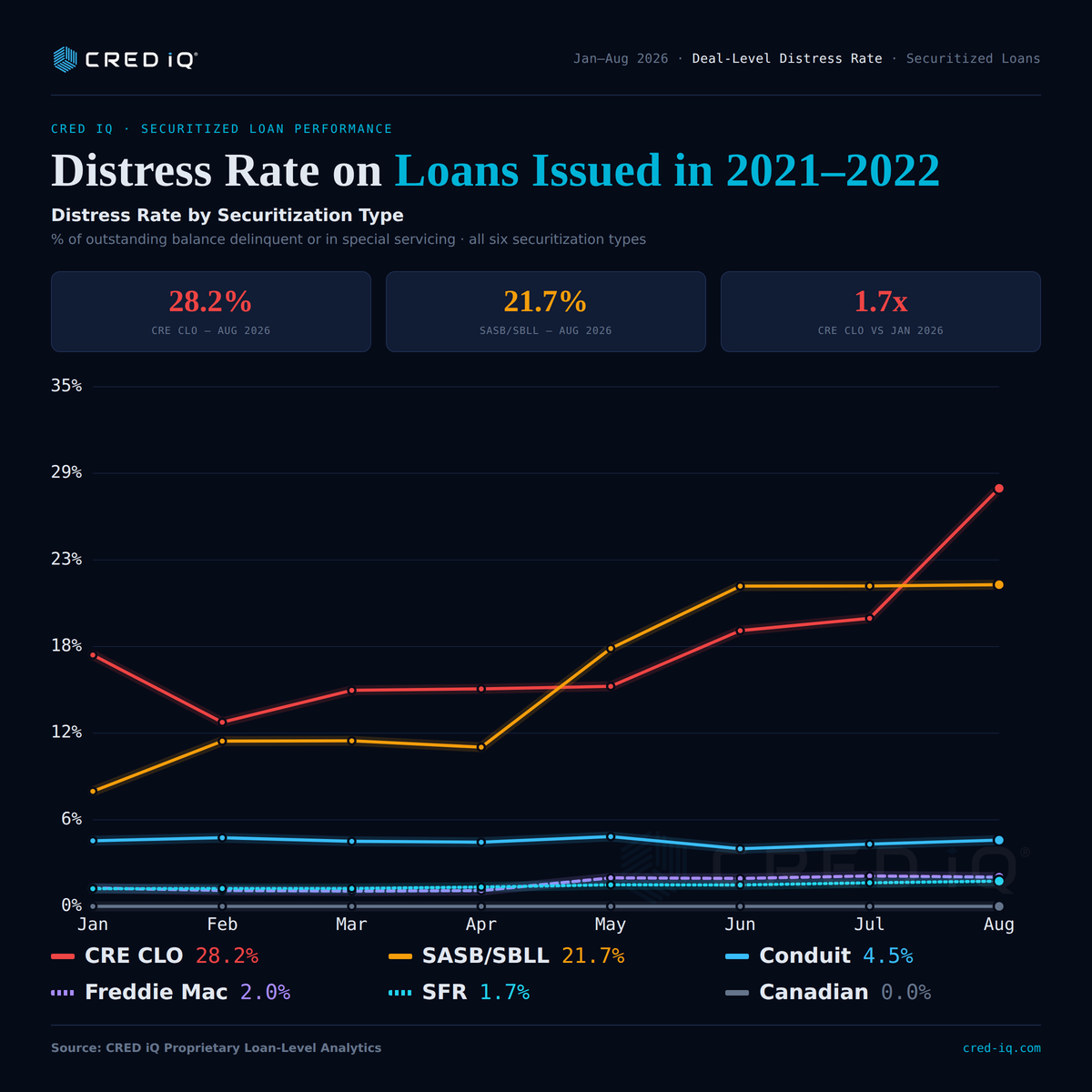
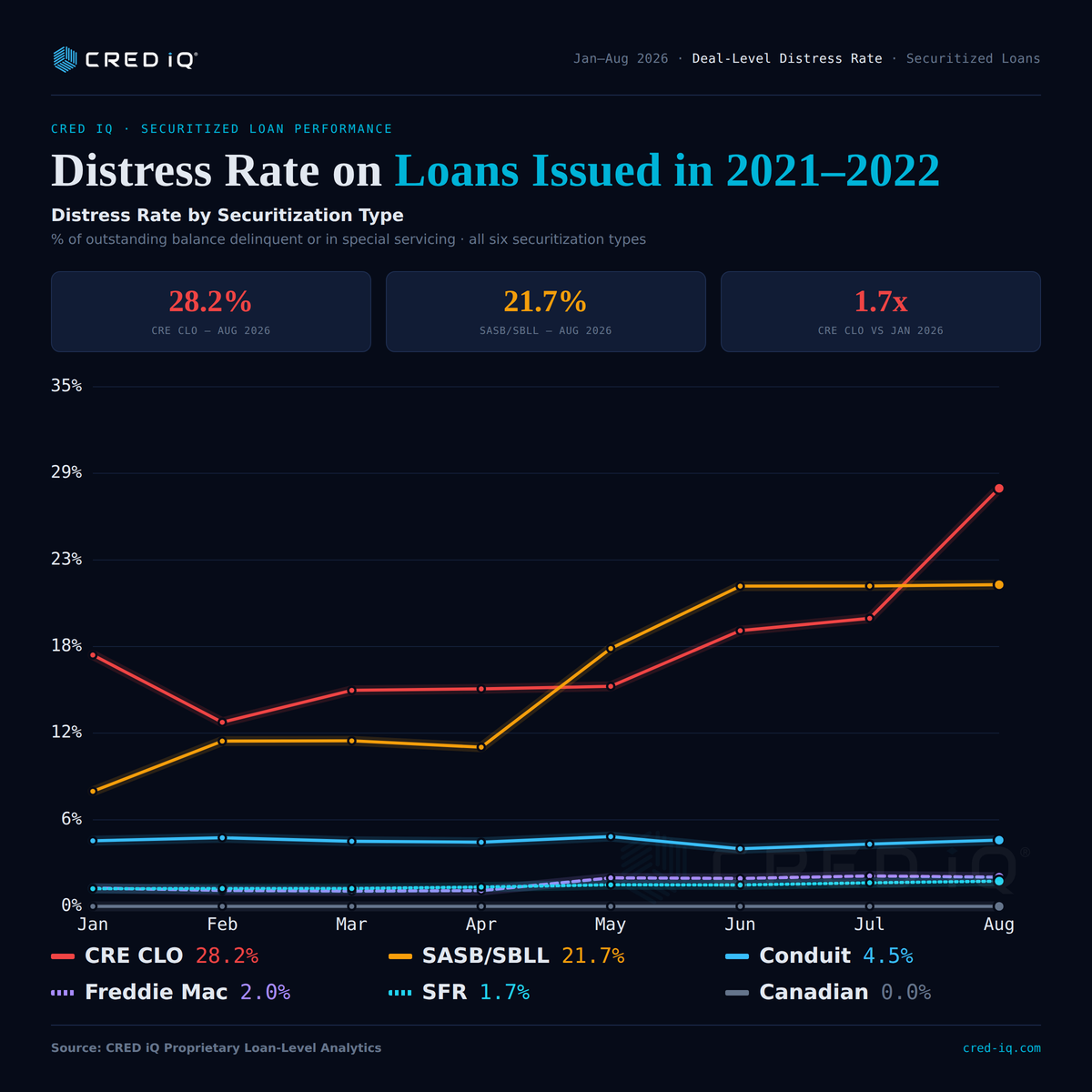
CRE CLO’s distress rate jumped from 19 percent in July to 28 percent in August, the sharpest one-month move of any deal type this year. SASB has held near 22 percent since June. Both trace to the same two origination years: 2021 and 2022 vintage loans now carry $3 billion of CRE CLO’s special-servicing balance and $1.7 billion of SASB’s, against $27 billion and $17 billion outstanding. In both cases the distress sits in a handful of large, identifiable deals rather than spread across the market.
The chart below puts these two deal types in context against the rest of the securitized universe. Conduit, Freddie Mac, and SFR have barely moved in eight months, each still under five percent. CRE CLO and SASB are the only categories that have crossed into double digits — a divergence specific to 2021-and-2022 vintage collateral, not the broader lending market.

CRE CLO: A Single Portfolio Is Doing Most of the Damage
FSRIA 2021-FL3 is the largest contributor, with $353 million of multifamily collateral now in special servicing across seven loans. It has added a new default roughly every eight weeks throughout 2026, and August brought two more: River Crossing at Roswell ($49 million) and Grace Abernathy Apartments in Sandy Springs, Georgia ($42 million), both tied to 2026 balloon maturities. Add the July transfer of 415 Premier Apartments in Evanston, Illinois ($40 million), and this one deal has moved $131 million into distress since spring.
ARCLO 2022-FL1, a similar Sunbelt bridge-loan CLO, added The Residences at Medical in San Antonio ($27 million) and Pebblebrook Apartments in Redlands, California ($12 million) this cycle for $210 million of newly distressed collateral in August alone. Five deals now account for 38 percent of all CRE CLO special-servicing balance, and the ten largest deals hold 58 percent. Texas, Florida, and Georgia alone carry 44 percent of the distressed balance — bridge loans underwritten on rent growth that never showed up before their floating-rate plans ran out of runway.
SASB: Four Office and Lab Portfolios Carry Two-Thirds of the Category
SASB’s distress is concentrated instead in four single-borrower office and lab deals worth 64 percent of the category’s $1.7 billion balance. BXHPP 2021-FILM, a $525 million loan against seven Hollywood studio and office properties, transferred in July. ALEN 2021-ACEN ($203 million, Three Allen Center, Houston) and LIFE 2021-BMR ($190 million, life-science space across Cambridge, San Diego, and the Bay Area) both transferred earlier this year.
The newest addition, BSREP 2021-DC, transferred August 10: a $162 million loan against eight Washington, D.C.-area office buildings. Its size has roughly offset whatever balance SASB resolved elsewhere this summer, which is why the rate hasn’t moved. California, New York, and D.C. now hold two-thirds of SASB’s distressed balance.
What It Means Going Forward
Office and mixed-use loans maturing over the next nine months are pricing 170 to 180 basis points above their in-place notes, the widest refinancing gap of any property type — the market BSREP and LIFE will resolve into. CRE CLO’s Sunbelt loans face the same wall from a different angle: floating-rate plans built on 2021 and 2022 rent growth that never materialized.
Source: CRED iQ proprietary loan-level analytics. CRE CLO and SASB loans originated 2021–2022, deduplicated to unique loans from property-level records and cross-referenced against CRED iQ’s August 2026 distressed-loan alert log. Distress = special servicing or non-performing/delinquent status, as reported through the September 3, 2026 data pull.