

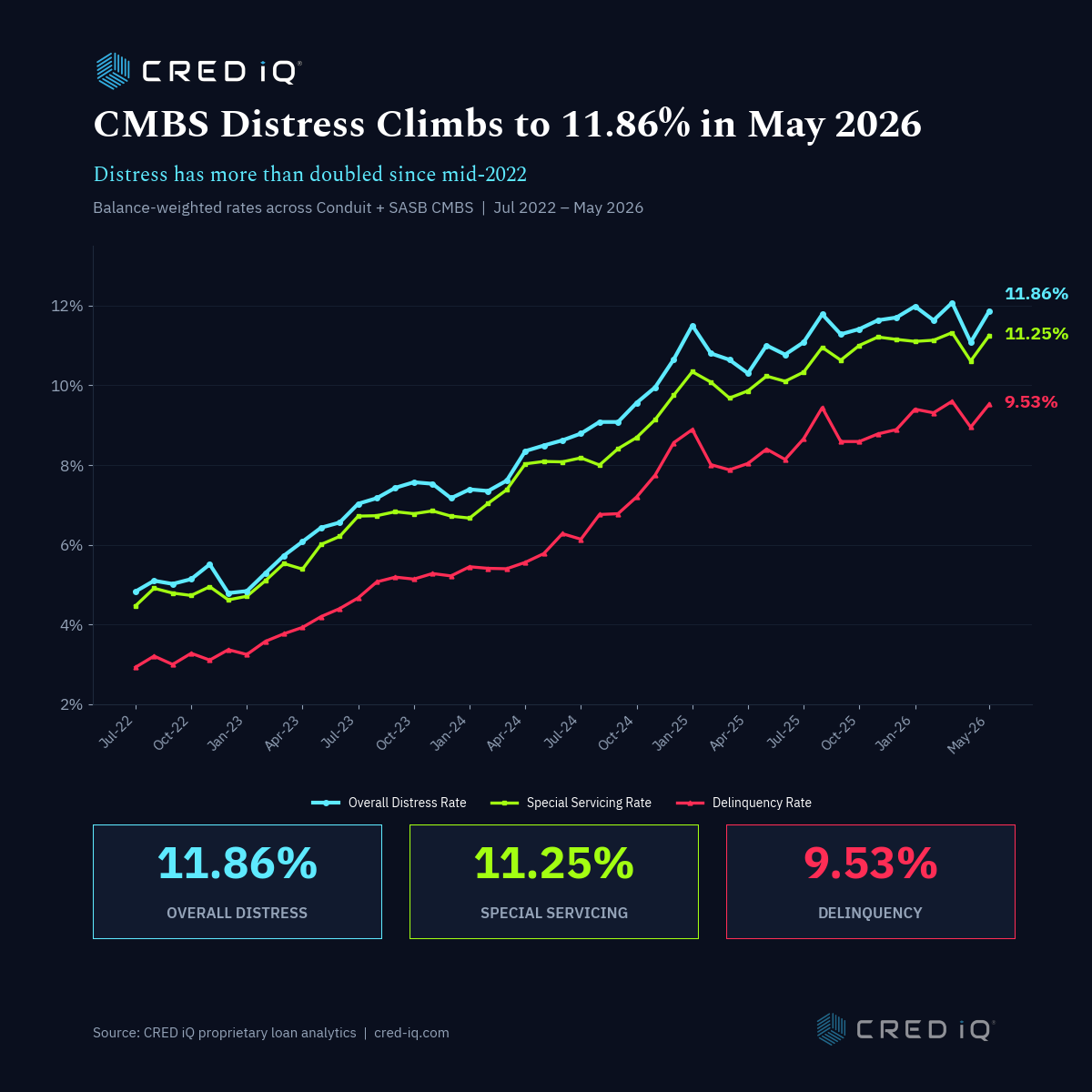
CRED iQ’s overall CMBS distress rate rose to 11.86% in May 2026, up from 11.08% in April, as both special servicing and delinquency moved higher across the Conduit and SASB universe. The reversal erased April’s brief improvement and pushed distress back toward the cyclical highs observed across the trailing twelve months. Viewed over a longer horizon, the trajectory is unmistakable: the overall distress rate has more than doubled since mid-2022, when it sat near 5%, underscoring that resolution activity is not yet keeping pace with new transfers into distress.
What is the CRED iQ distress rate?
CRED iQ defines its overall distress rate as the balance-weighted share of loans that are either delinquent, in special servicing, or both. This combined lens captures stress that headline delinquency figures alone can miss, because a loan can transfer to a special servicer for imminent default, maturity default, or covenant breaches well before it misses a payment. Measured across the full Conduit and SASB universe, the May 2026 reading reflects a broad, balance-weighted view of credit performance rather than a simple loan count.
How did the three distress metrics move in May 2026?
All three core measures CRED iQ tracks turned higher month-over-month:
- Overall distress rate: 11.86%, up 78 basis points from 11.08% in April.
- Special servicing rate: 11.25%, up 64 basis points from 10.61%.
- Delinquency rate: 9.53%, up 58 basis points from 8.95%.
The persistent gap between the special servicing rate and the delinquency rate — roughly 170 basis points in May — signals that a meaningful share of distressed balance is being actively worked out by servicers before, or instead of, becoming payment-delinquent. For investors and lenders, that spread is a leading indicator worth monitoring as 2026 and 2027 maturities approach.
Which property types are driving CMBS distress?
Office remains the clear epicenter of distress at a 17.11% distress rate — the most troubled major segment. Mixed-use follows at 16.12%, while lodging (12.27%) sits above the overall average. Multifamily distress reached 10.95% as elevated rates continue to pressure floating-rate and bridge financing. At the opposite end, the resilience leaders are striking: self storage (0.15%), industrial (1.04%), and manufactured housing (1.19%) all remain near-pristine, reflecting durable demand fundamentals and stable, granular cash flows.
| Property Type | Distress | Special Servicing | Delinquency |
| Office | 17.11% | 16.83% | 13.91% |
| Mixed Use | 16.12% | 14.41% | 14.23% |
| Lodging | 12.27% | 10.18% | 9.49% |
| Multifamily | 10.95% | 10.36% | 8.67% |
| Retail | 9.97% | 9.75% | 7.32% |
| Warehouse | 1.83% | 1.83% | 1.62% |
| Manufactured Housing | 1.19% | 0.00% | 1.19% |
| Industrial | 1.04% | 0.98% | 0.95% |
| Self Storage | 0.15% | 0.15% | 0.15% |
Balance-weighted rates, Conduit + SASB, May 2026 reporting period. Source: CRED iQ proprietary loan analytics.
Why CRED iQ data matters
CRED iQ’s analytics program is built on granular, loan-level data spanning the full Conduit, SASB, Freddie Mac, and CRE CLO universe, refreshed every reporting period and resolvable down to individual loans, properties, and metropolitan markets. Because every metric is balance-weighted and traceable to the underlying collateral, market participants can move beyond headline averages to underwrite distress by property type, vintage, servicer, and geography. For CRE and CMBS investors, brokers, and lenders, that level of transparency turns distress monitoring into an actionable edge — identifying troubled credits, surfacing workout opportunities, and benchmarking portfolios against the broader market in real time.
Source: CRED iQ proprietary loan analytics | Reporting period: May 2026 | cred-iq.com
About CRED iQ
CRED iQ is the enterprise data and intelligence platform powering the securitized commercial real estate market — spanning CMBS, SASB, CRE CLO, and GSE/Agency Multifamily. Delivered via web platform, API, bulk feeds, and MCP server, CRED iQ is the data provider of choice for institutional market participants and the canonical data layer for AI-driven CRE workflows. Learn more at www.cred-iq.com.
