
Home Blog Page 11

Announcing BBCMS 2024-C30

0

A CRED iQ Preliminary Analysis
DATA HEREIN PROVIDED TO CRED IQ IS FROM A PRELIMINARY PROSPECTUS AND MAY BE AMENDED OR SUPPLEMENTED PRIOR TO TIME OF SALE

Deal Overview

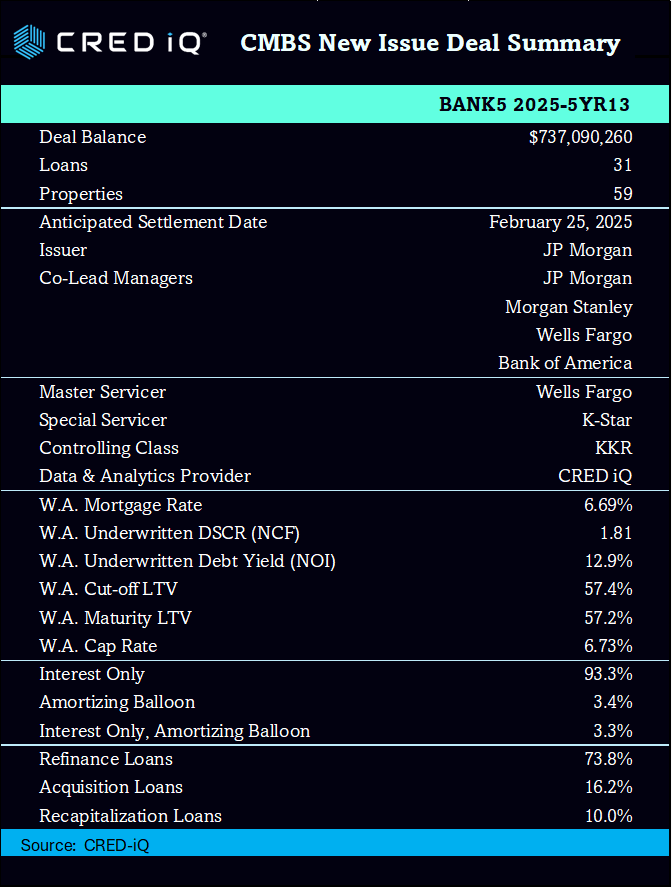
The BBCMS 2024-C30 CMBS deal is a new issuance securitization for the CMBS market, with a total pooled balance of approximately $846.5 million. The deal is jointly managed by prominent financial institutions Barclays, BMO, Bank of America, Deutsche Bank, Goldman Sachs, KeyBanc, and Societe Generale. The deal is collateralized by 41 loans and secured by 67 properties across a variety of sectors, including retail, office, and multifamily. The strategic geographic distribution of these properties ensures balanced exposure across major markets. The deal’s weighted average loan-to-value (LTV) ratio of 54.7%, and the weighted average mortgage interest rate is 6.37%.

Key Metrics

The loan pool for BBCMS 2024-C30 is structured to include a mix of amortizing and interest-only loans, with 17.9% of the mortgage pool having scheduled amortization. The remainder of the pool (82.1%) consists of interest-only payments throughout the loan term, offering investors a steady income stream. The pool boasts a weighted average debt service coverage ratio (DSCR) of 1.89x. The weighted average net operating income (NOI) debt yield is 12.9%.
Geography & Property Types

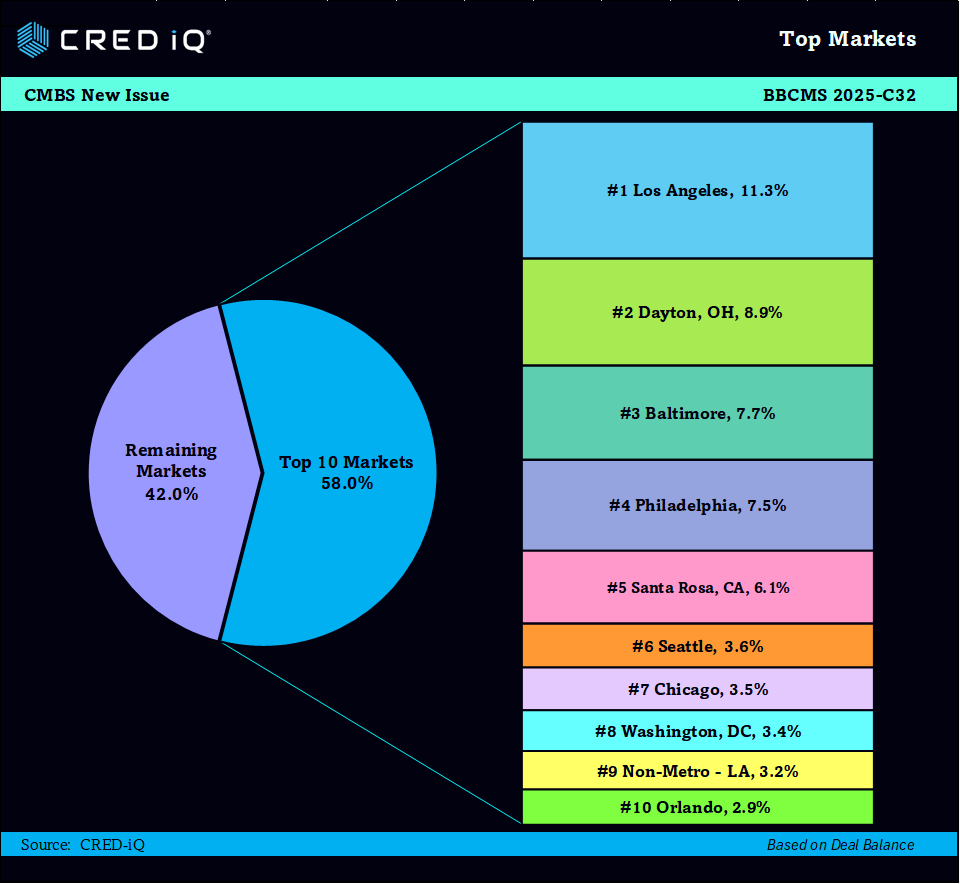
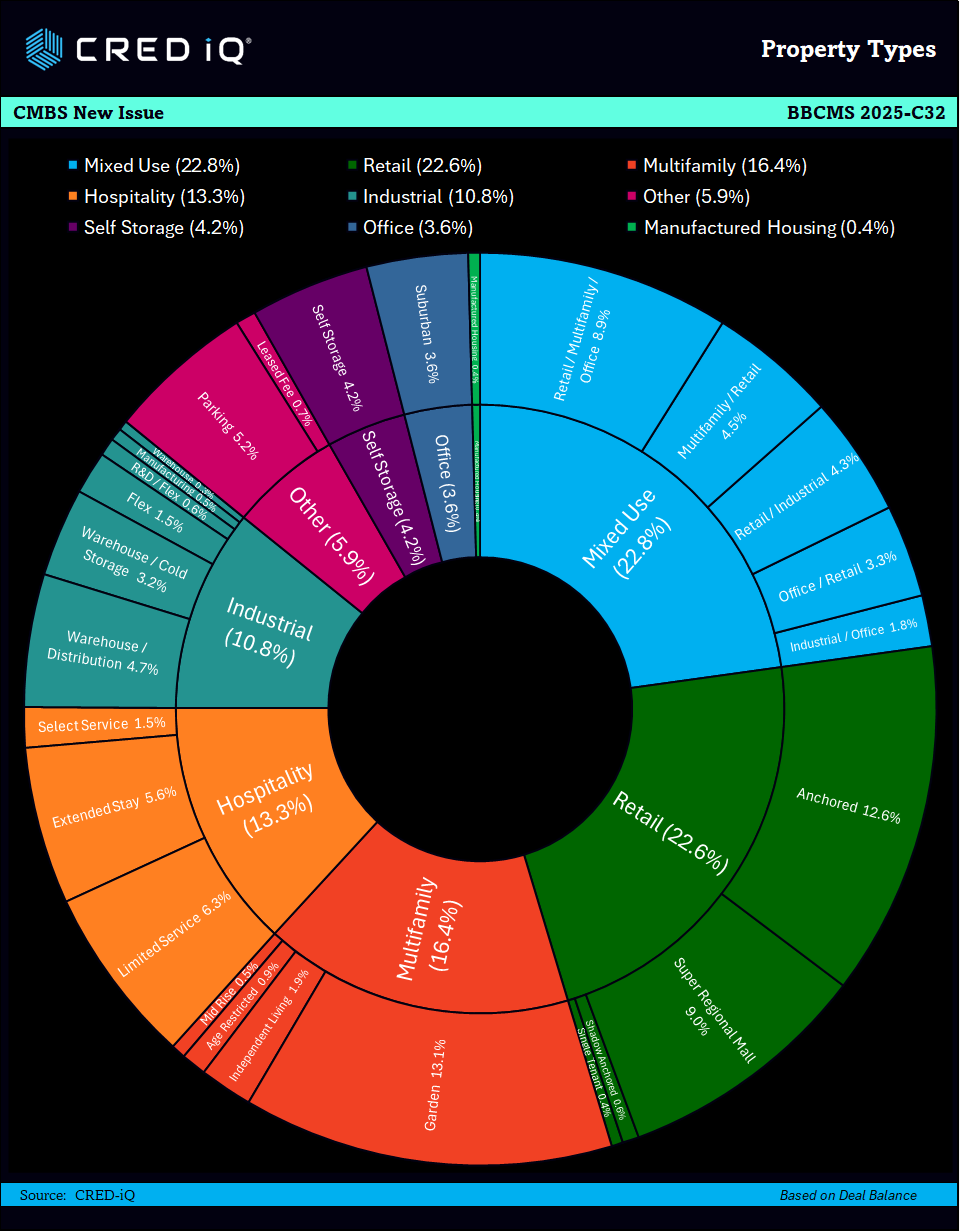
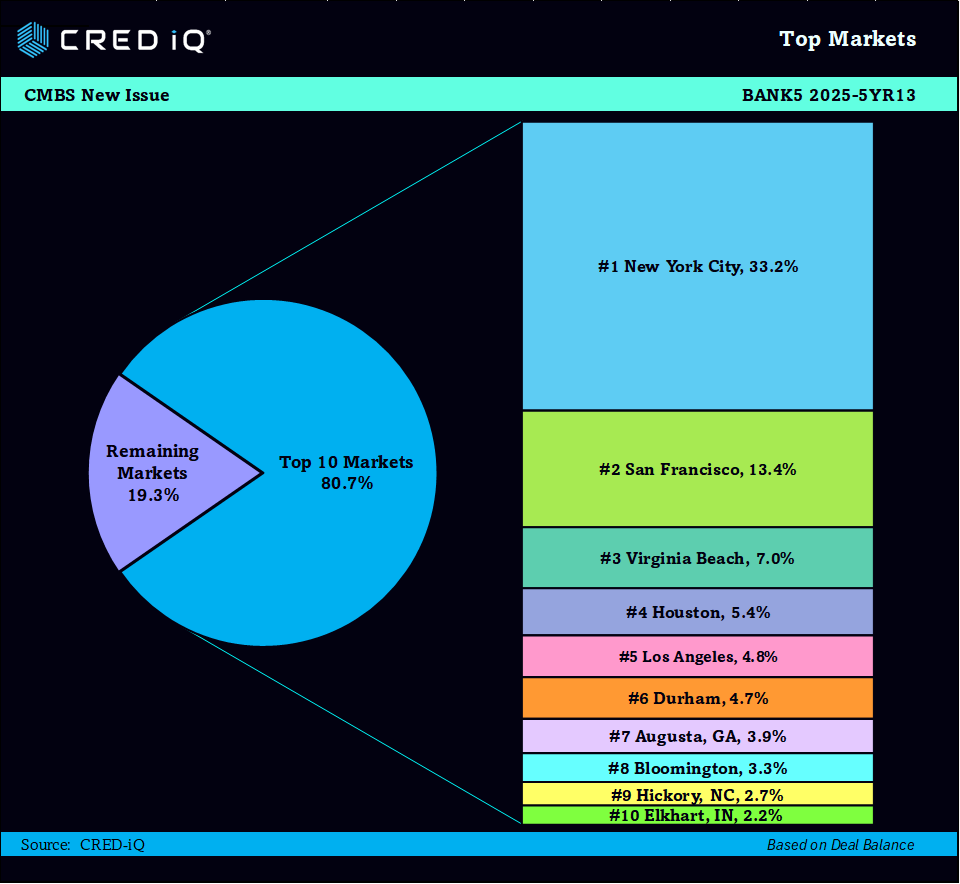
A key strength of the BBCMS 2024-C30 CMBS deal is its diverse property type distribution, which enhances portfolio resilience. Retail properties, including super regional mall, anchored, outlet center, and unanchored subtypes constitute 39.1% of the total balance, while office properties account for 13.7% of the balance. The geographic distribution of the properties across prime markets, including high-growth areas in New York City, Los Angeles, and Minneapolis.

About CRED iQ

CRED iQ is a market data provider that offers a robust suite of data and software solutions tailored for commercial real estate and finance professionals.

With over $2.3 trillion of CRE loans, CRED iQ delivers instant access to a comprehensive range of financial data and analytics for millions of properties in every market. CRED iQ’s data and analytical capabilities are instrumental in helping investors, lenders and brokers make informed and strategic decisions critical to their business.

THE DATA, INFORMATION AND/OR RELATED MATERAL (“DELIVERABLES”) IS BEING OFFERED AS-IS/WHERE-AS CONDITION. CRED-IQ MAKES NO REPRESENTATION OR WARRANTY AS TO QUALITY OR ACCURACY OF SUCH DELIVERABLES BEING PURCHASED, WHETHER EXPRESS OR IMPLIED, EITHER IN FACT OR BY OPERATION OF LAW, STATUTE, OR OTHERWISE, AND CRED-IQ SPECIFICALLY DISCLAIMS ANY AND ALL IMPLIED OR STATUTORY WARRANTIES INCLUDING WARRANTIES OF MERCHANTABILITY AND OF FITNESS FOR A PARTICULAR PURPOSE, TECHNICAL PERFORMANCE, AND NON-INFRINGEMENT. WITHOUT LIMITING THE FOREGOING, YOU AS CUSTOMER ACKNOWLEDGE THAT YOU HAVE NOT AND ARE NOT RELYING UPON ANY IMPLIED WARRANTY OF MERCHANTABILITY OR OF FITNESS FOR A PARTICULAR PURPOSE OR OTHERWISE, OR UPON ANY REPRESENTATION OR WARRANTY WHATSOEVER AS TO THE DELIVERABLES  IN ANY REGARDS WHATSOEVER, AND ACKNOWLEDGE  THAT CRED-IQ MAKES NO, AND HEREBY DISCLAIMS ANY, REPRESENTATION, WARRANTY OR GUARANTEE THAT THE PURCHASE, USE OR COMMERCIALIZATION OF ANY DELIVERABLES WILL BE USEFUL TO YOU OR FREE FROM INTERFERENCE. BY ACCEPTANCE OF THE DELIVERABLES, YOU HEREBY RELEASE CRED-IQ AND ITS AFFILIATES AND AGENTS FROM ALL CLAIMS, DAMAGES AND LIABILITY ARISING HEREUNDER.

Announcing BMO 2024-C10

0

A CRED iQ Preliminary Analysis

DATA HEREIN PROVIDED TO CRED IQ IS FROM A PRELIMINARY PROSPECTUS AND MAY BE AMENDED OR SUPPLEMENTED PRIOR TO TIME OF SALE

Deal Overview

The BMO 2024-C10 CMBS deal is a new issuance securitization for the CMBS market, with a total pooled balance of approximately $724.0 million. The deal is jointly managed by prominent financial institutions BMO, Citigroup, Deutsche Bank, and Goldman Sachs. The deal is collateralized by 28 loans and secured by 65 properties across a variety of sectors, including retail, industrial, and multifamily. The strategic geographic distribution of these properties ensures balanced exposure across major markets. The deal’s weighted average loan-to-value (LTV) ratio of 55.4%, and the weighted average mortgage interest rate is 6.11%.

Key Metrics

The loan pool for BMO 2024-C10 is structured to include a mix of amortizing and interest-only loans, with 5.1% of the mortgage pool having scheduled amortization. The remainder of the pool (94.9%) consists of interest-only payments throughout the loan term, offering investors a steady income stream. The pool boasts a weighted average debt service coverage ratio (DSCR) of 2.02x. The weighted average net operating income (NOI) debt yield is 12.8%.

Geography & Property Types

A key strength of the BMO 2024-C10 CMBS deal is its diverse property type distribution, which enhances portfolio resilience. Retail properties, including super regional mall, anchored, and single tenant subtypes constitute 39.0% of the total balance, while industrial properties account for 32.5% of the balance. The geographic distribution of the properties across prime markets, including high-growth areas in New York City, Riverside, CA, and Houston.

About CRED iQ

CRED iQ is a market data provider that offers a robust suite of data and software solutions tailored for commercial real estate and finance professionals.

With over $2.3 trillion of CRE loans, CRED iQ delivers instant access to a comprehensive range of financial data and analytics for millions of properties in every market. CRED iQ’s data and analytical capabilities are instrumental in helping investors, lenders and brokers make informed and strategic decisions critical to their business.

THE DATA, INFORMATION AND/OR RELATED MATERAL (“DELIVERABLES”) IS BEING OFFERED AS-IS/WHERE-AS CONDITION. CRED-IQ MAKES NO REPRESENTATION OR WARRANTY AS TO QUALITY OR ACCURACY OF SUCH DELIVERABLES BEING PURCHASED, WHETHER EXPRESS OR IMPLIED, EITHER IN FACT OR BY OPERATION OF LAW, STATUTE, OR OTHERWISE, AND CRED-IQ SPECIFICALLY DISCLAIMS ANY AND ALL IMPLIED OR STATUTORY WARRANTIES INCLUDING WARRANTIES OF MERCHANTABILITY AND OF FITNESS FOR A PARTICULAR PURPOSE, TECHNICAL PERFORMANCE, AND NON-INFRINGEMENT. WITHOUT LIMITING THE FOREGOING, YOU AS CUSTOMER ACKNOWLEDGE THAT YOU HAVE NOT AND ARE NOT RELYING UPON ANY IMPLIED WARRANTY OF MERCHANTABILITY OR OF FITNESS FOR A PARTICULAR PURPOSE OR OTHERWISE, OR UPON ANY REPRESENTATION OR WARRANTY WHATSOEVER AS TO THE DELIVERABLES  IN ANY REGARDS WHATSOEVER, AND ACKNOWLEDGE  THAT CRED-IQ MAKES NO, AND HEREBY DISCLAIMS ANY, REPRESENTATION, WARRANTY OR GUARANTEE THAT THE PURCHASE, USE OR COMMERCIALIZATION OF ANY DELIVERABLES WILL BE USEFUL TO YOU OR FREE FROM INTERFERENCE. BY ACCEPTANCE OF THE DELIVERABLES, YOU HEREBY RELEASE CRED-IQ AND ITS AFFILIATES AND AGENTS FROM ALL CLAIMS, DAMAGES AND LIABILITY ARISING HEREUNDER.
Announcing BANK5 2024-5YR11

0

A CRED iQ Preliminary Analysis

DATA HEREIN PROVIDED TO CRED IQ IS FROM A PRELIMINARY PROSPECTUS AND MAY BE AMENDED OR SUPPLEMENTED PRIOR TO TIME OF SALE

Deal Overview

The BANK5 2024-5YR11 CMBS deal is a new issuance securitization for the CMBS market, with a total pooled balance of approximately $795.4 million. The deal is jointly managed by prominent financial institutions including Morgan Stanley, Bank of America, JP Morgan, and Wells Fargo. The deal is collateralized by 33 loans and secured by 77 properties across a variety of sectors, including retail, mixed-use, and multifamily. The strategic geographic distribution of these properties ensures balanced exposure across major markets. The deal’s weighted average loan-to-value (LTV) ratio of 58.0%, and the weighted average mortgage interest rate is 6.34%.

Key Metrics

The loan pool for BANK5 2024-5YR11 is solely structured with interest-only loans, offering investors a steady income stream. The pool boasts a weighted average debt service coverage ratio (DSCR) of 1.71x. The weighted average net operating income (NOI) debt yield is 11.5%.

Geography & Property Types

A key strength of the BANK5 2024-5YR11 CMBS deal is its diverse property type distribution, which enhances portfolio resilience. Retail properties, including anchored, super regional mall, showroom, and single tenant subtypes constitute 35.6% of the total balance, while mixed use properties account for 16.5% of the balance. The geographic distribution of the properties across prime markets, including high-growth areas in New York City, Riverside, CA, and Boston.

About CRED iQ

CRED iQ is a market data provider that offers a robust suite of data and software solutions tailored for commercial real estate and finance professionals.

With over $2.3 trillion of CRE loans, CRED iQ delivers instant access to a comprehensive range of financial data and analytics for millions of properties in every market. CRED iQ’s data and analytical capabilities are instrumental in helping investors, lenders and brokers make informed and strategic decisions critical to their business.

THE DATA, INFORMATION AND/OR RELATED MATERAL (“DELIVERABLES”) IS BEING OFFERED AS-IS/WHERE-AS CONDITION. CRED-IQ MAKES NO REPRESENTATION OR WARRANTY AS TO QUALITY OR ACCURACY OF SUCH DELIVERABLES BEING PURCHASED, WHETHER EXPRESS OR IMPLIED, EITHER IN FACT OR BY OPERATION OF LAW, STATUTE, OR OTHERWISE, AND CRED-IQ SPECIFICALLY DISCLAIMS ANY AND ALL IMPLIED OR STATUTORY WARRANTIES INCLUDING WARRANTIES OF MERCHANTABILITY AND OF FITNESS FOR A PARTICULAR PURPOSE, TECHNICAL PERFORMANCE, AND NON-INFRINGEMENT. WITHOUT LIMITING THE FOREGOING, YOU AS CUSTOMER ACKNOWLEDGE THAT YOU HAVE NOT AND ARE NOT RELYING UPON ANY IMPLIED WARRANTY OF MERCHANTABILITY OR OF FITNESS FOR A PARTICULAR PURPOSE OR OTHERWISE, OR UPON ANY REPRESENTATION OR WARRANTY WHATSOEVER AS TO THE DELIVERABLES  IN ANY REGARDS WHATSOEVER, AND ACKNOWLEDGE  THAT CRED-IQ MAKES NO, AND HEREBY DISCLAIMS ANY, REPRESENTATION, WARRANTY OR GUARANTEE THAT THE PURCHASE, USE OR COMMERCIALIZATION OF ANY DELIVERABLES WILL BE USEFUL TO YOU OR FREE FROM INTERFERENCE. BY ACCEPTANCE OF THE DELIVERABLES, YOU HEREBY RELEASE CRED-IQ AND ITS AFFILIATES AND AGENTS FROM ALL CLAIMS, DAMAGES AND LIABILITY ARISING HEREUNDER.
CRED iQ’s Distress Rates Climbs Higher for All of CMBS in October

0

The CRED iQ research team evaluated payment statuses reported for each loan (securitized by CMBS financing), along with special servicing status as part of our monthly distress update.  Five of the six major property types that CRED iQ tracks climbed higher in October. 

The overall CRED iQ distress rate inched up in October by 5 basis points to 9.6% which sets another consecutive record high. CRED iQ’s specially serviced rate added three basis points to 8.7%.   Following a flat print last month, our delinquency rate rose from 6.8% to 7.2% during October.  

Segment Review

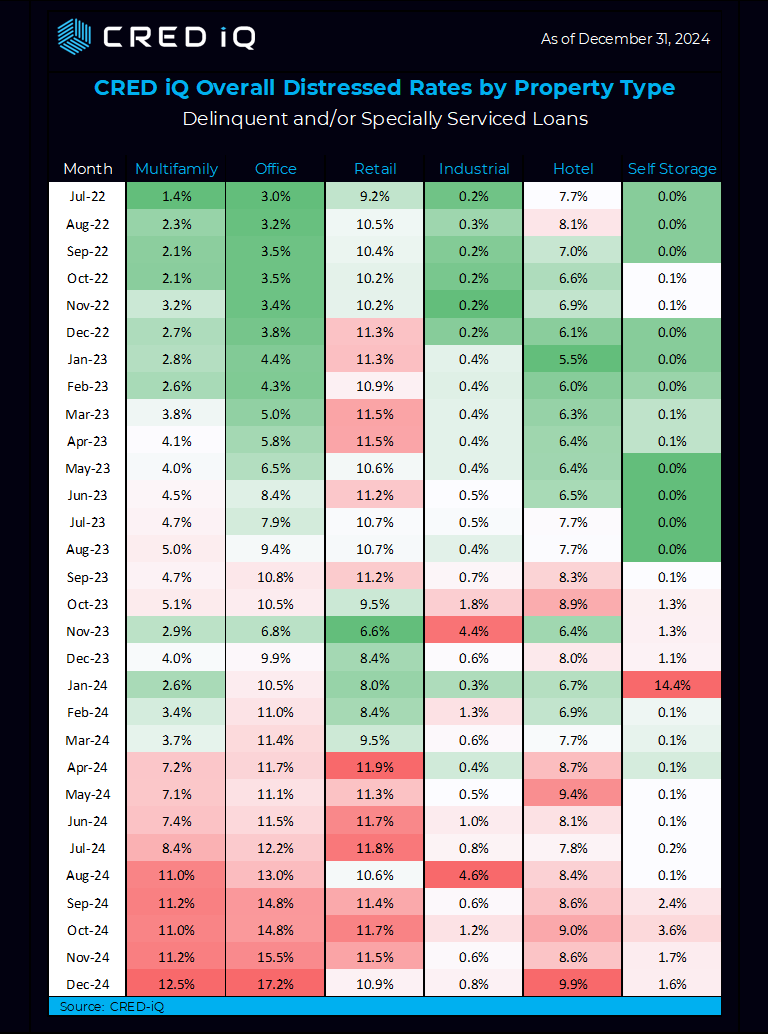
Following a 108-basis point increase in our September print, the office segment distress rate came in flat in this report at 14.8%.  As reported last month, the office distress rate has nearly tripled in the last 18 months.  Office remains at the top of all segments with respect to distress rate. 

Retails remains in the number two slot, with 11.7% distress rate,  a slight increase from last month’s print of 11.4%

Right behind retail, multifamily has an 11.0% distress rate—shaving two basis points during October.   Multifamily has experienced the sharpest distress increase of all property types in 2024.  The January 2024 multifamily distress rate was 2.6%, yielding a stunning 840 basis point increase in the distress rate over the course of the year.

The hotel segment distress rate increased from 8.6% to 9.0% during October, the fourth highest amongst all property types. 

The two segments with the highest month-over-month distress rate increases are the same two property types with the lowest distress rates.  Self-storage jumped from 2.4% to 3.6% and Industrial added 60 basis points to 1.2%. Two large SBLL loans (CGCMT 2021-PRM2 and BX 2020-VKNG) backed by self-storage and industrial portfolios fell delinquent as they failed to payoff at their October maturity date. Consequently, the CRED iQ detailed loan statuses for both loans fell to performing matured from current in September. 

Payment Status

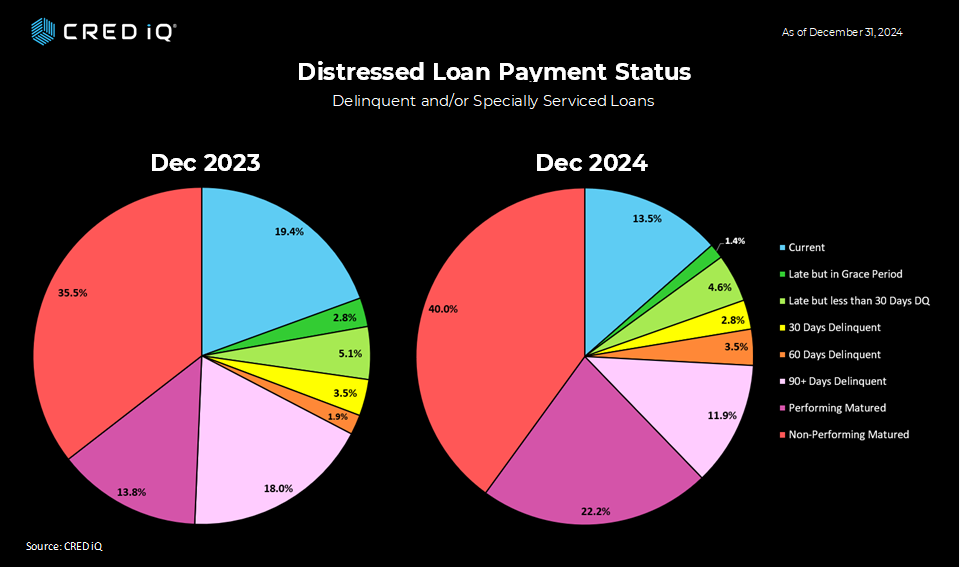
Looking at the distressed loan payment status, 18.2% of the loans are current.  Additionally, 0.3% of loans are attributed to late (but in the grace period) and 6.1% of loans were late (but less than 30 days DQ). When we combine these three metrics 24.6% of all loans were current / late within the grace period / less than 30 days delinquent (a reduction of 100 basis points from last month)

Non-Performing Matured decreased from 42.3% to 39.9% (a 240 basis points decrease).     Meanwhile, performing Matured increased from 14.5% in our September report to 16.7% (a 220-basis point increase).   90+ Days Delinquent shaved 1 basis points in October to 12.7%.

Analysis Methodology

It’s important to note that CRED iQ’s distress rate factors in all CMBS properties that are securitized in conduits and single-borrower large loan deal types.  CRED iQ tracks Freddie Mac, Fannie Mae, Ginnie Mae, and CRE CLO loan metrics in separate analyses.

CRED iQ’s distress rate aggregates the two indicators of distress – delinquency rate and specially serviced rate – yielding the distress rate. The index includes any loan with a payment status of 30+ days delinquent or worse, any loan actively with the special servicer, and includes non-performing and performing loans that have failed to pay off at maturity.

About CRED iQ

CRED iQ is a market data provider that offers a robust suite of data and software solutions tailored for commercial real estate and finance professionals.

With over $2.3 trillion of CRE loans, CRED iQ delivers instant access to a comprehensive range of financial data and analytics for millions of properties in every market. CRED iQ’s data and analytical capabilities are instrumental in helping investors, lenders and brokers make informed and strategic decisions critical to their business.

Diving Deep into Data Centers

0

This week the CRED iQ Research team focused upon the hottest property type in CRE, the data center ecosystem. Our readers have suggested a deeper dive into this rapidly evolving segment and we are pleased to answer that call. 

Fueled largely by the anticipated computing capacity required for artificial intelligence (“AI”), major investments are being made around the globe to develop  data center facilities and related infrastructure. 

Amazon has estimates capital investments approaching $100 billion over the next decade on AI-focused data centers, on top of the investments already made on eCommerce data centers. 

Last month, the BBC confirmed that Blackstone is making a $13 billion investment in a single data center complex in England. 

Our team closely examined all the latest data center originations in 2024 and we zeroed in on one of those to profile and delve deeper.  We wanted to understand the underlying metrics of a typical data center loan transaction in this marketplace along with signs for trends to come.   

Data Center Profile

A major data center complex located in Elk Grove Village, IL, just outside Chicago’s Ohare Airport.  Chicago is home to one of the world’s largest concentration of data centers with more than 747 MW of information technology capacity and 4.4 million square feet of space.

In the transaction, GI partners will acquire 75% of the borrower and contribute $202.5 million of new cash equity into a new joint venture.  Digital Realty Trust L.P. (DLR), who previously owned 100% of the borrower, will maintain a 25% stake. 

The asset was valued at $463 million, or $1,412/ per square foot or $17,277/per total kW capacity.   Underwritten NOI amounted to $96/SF and approximately $1,181/kW.  Tenants are paying between $88/SF and $157/SF in rent.  On a kW basis, tenants at the property are paying between $1,141/kW and $1,657/kW.  CRED iQ captures all data center activity and maintains ongoing financial and performance updates.

About CRED iQ

CRED iQ is a market data provider that offers a robust suite of data and software solutions tailored for commercial real estate and finance professionals.

With over $2.3 trillion of CRE loans, CRED iQ delivers instant access to a comprehensive range of financial data and analytics for millions of properties in every market. CRED iQ’s data and analytical capabilities are instrumental in helping investors, lenders and brokers make informed and strategic decisions critical to their business.

CMBS Underwriting Trends – October 2024

0

The CRED iQ research team focused upon the underwriting of the latest market transactions.  We wanted to understand they key loan metrics across this universe to get a real-time sense of the current environment and trending.      

CRED iQ analyzed underwriting metrics for the latest 8 new issue CMBS conduit deals issued since our previous report in July. 

We reviewed 499 properties associated with 304 new loans totaling just over $7 billion in loan originations. Our analysis examined interest rates, loan-to-values (“LTV”), debt yields, and CRED iQ cap rates.  We further broke down these statistics by property type.

The average interest rate across all loans and property types was 6.6%, average LTV was 54.9%, implied cap rates averaged 6.34% with debt yields averaging 14.0%.

Not surprisingly our analysis confirmed interest rate reductions across all property types  since our July report.   Reductions ranged from 1.8% in mixed-use to industrial’s reduction of 8.8%.

Apart from Industrial and Manufactured Housing, LTV levels notched decreases in all other property types.   Cap rates saw reductions in 5 of 8 property types. Debt yields were a mixed bag with surges in multifamily and self-storage.


Office

The office segment saw interest rates drop 42 basis points from 7.32 to 6.90%.  Debt yields increased from 12.09% to 13.19%.  LTV levels dropped from 59.2% to 55.4% while cap rates increased from 7.02% to 7.16% since our July analysis.

In total, 35 properties (of the 499 total in our analysis) were secured by office assets, comprising a total loan balance of $999.9 million. 

Multifamily

The multifamily sector’s average interest rate dropped from 6.70% to 6.55%, a 15-basis point change. Debt yields decreased from 10.38% to 9.93%.  LTV levels dropped from 62.5% to 53.7% while cap rates declined from 6.00% to 5.77% since our July report.

There were 122 properties secured by multifamily properties totaling $1.6 billion in new loan originations. 

Retail

Retail interest rates dropped from 6.87% to 6.58% on average in the last 3 months ago. However, average cap rates for the retail sector increase from 6.16% to 6.45%.  The average debt yield declined from 12.28% to 11.55% while average LTVs went from 57.3% to 56.7% since the July print.   

The retail segment had a total of $1.4 billion. In total, 60 properties were secured by retail properties.

About CRED iQ

CRED iQ is a market data provider that offers a robust suite of data and software solutions tailored for commercial real estate and finance professionals.


With over $2.3 trillion of CRE loans, CRED iQ delivers instant access to a comprehensive range of financial data and analytics for millions of properties in every market. CRED iQ’s data and analytical capabilities are instrumental in helping investors, lenders and brokers make informed and strategic decisions critical to their business.

Top 50 Markets by CRED iQ Distress Metrics

0

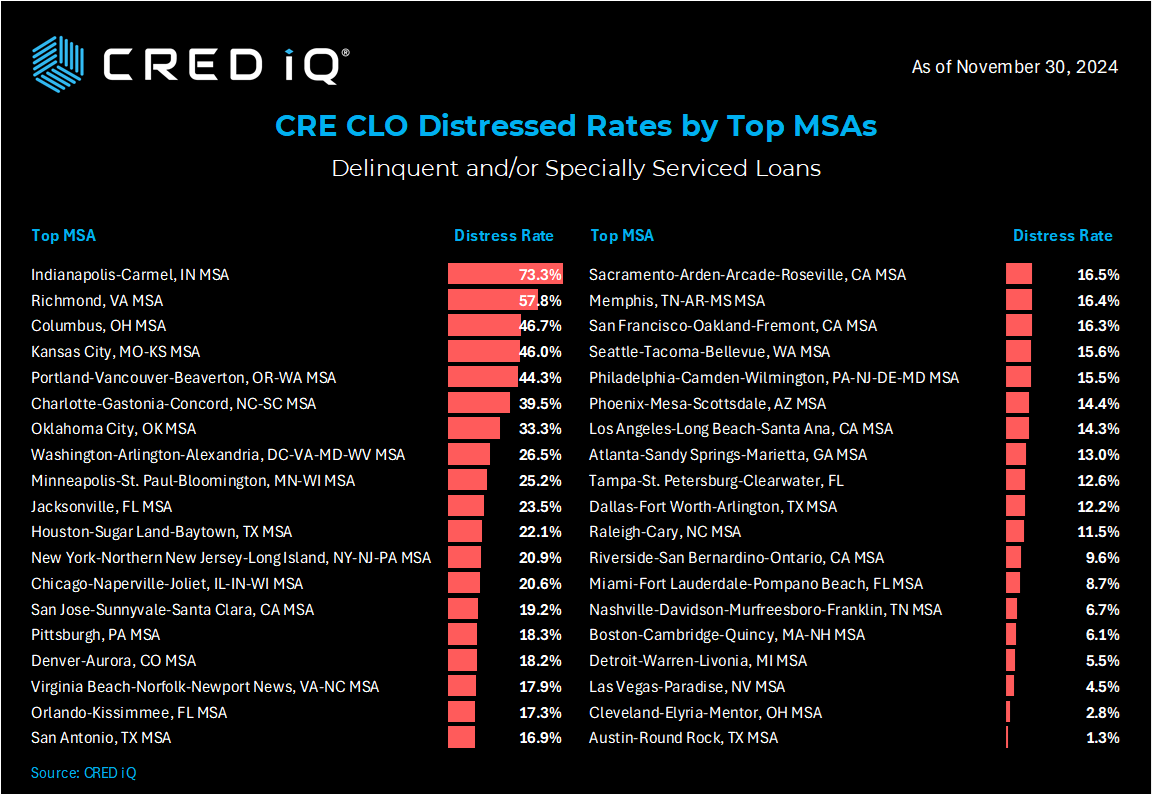
CRED iQ’s research team explored distress trends across the country in our latest geographic study. Our analysis is built upon current balances of all of the loans which CRED iQ tracks within each market; and then calculated the proportion of loans that are distressed. We then compared these results with our previous report from August 29th to reveal near-term trends. 

Our report yields the CRED iQ Distress Rate (which combines Delinquent and/or Specially Serviced loans) for the top 50 MSAs with the highest amount of distress of the largest 65 CRE markets. 

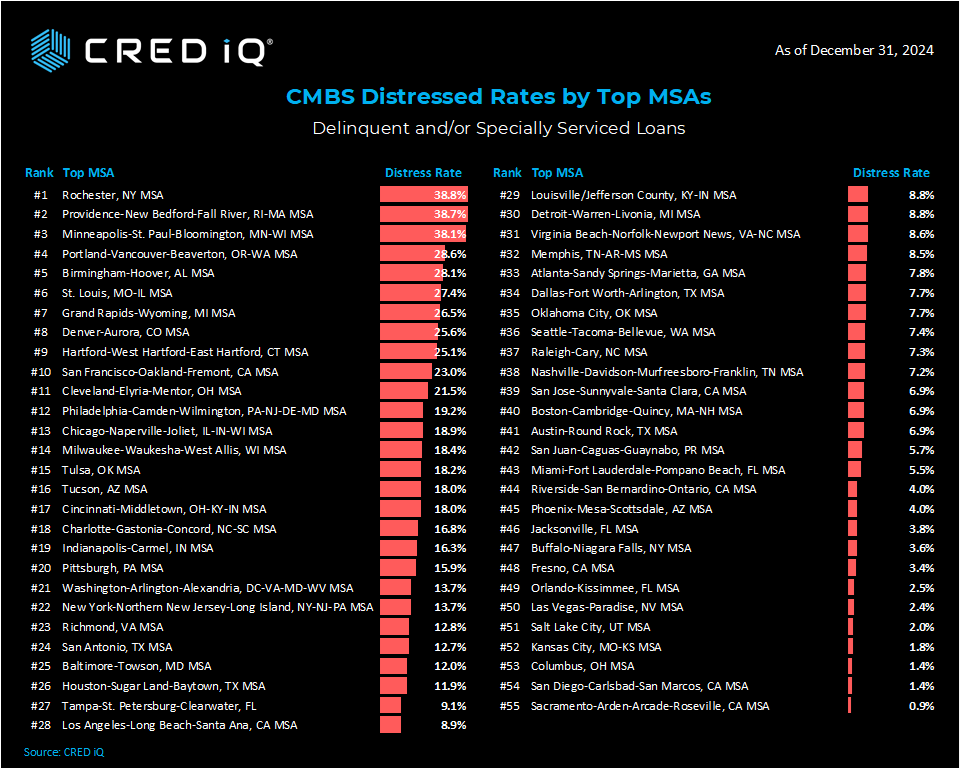
Minneapolis now leads the top MSAs with 36.2% of their loans in distress.  The former number two market soared to the number one spot after logging a stunning increase of 1,260 basis point increase from August.  Stamford (32.2%) landed in 2nd place and saw the largest increase in our study from the August print of just 7.7%. A significant factor in Stamford’s increase was the default of an office portfolio.   See the Loan Highlight section for details.

Tulsa (26.4%), Hartford (25.9%) and Portland (25.3%) round out the top 5.  Former number one Charlotte came in at number 6 with a 24.6% distress rate compared to 24.8% in August.  Adding some perspective, the overall distress rate for all loans across every market was 9.1% as of our October 3rd report.

Looking deeper at MSAs experiencing the most distress, the office segment is a major factor in Stamford (93% of distressed loans are from the office segment), Trenton (91%), and Tulsa (88%).  

Minneapolis (83%) and Birmingham (55%) see more than half of the markets’ distress emanating from the retail segment.  Hotel drives the most distress in Portland (77%), while Nashville distress primarily stems from multifamily (81.9%).

Loan Highlight

The 982,483 SF Stamford Plaza Portfolio backs a $246.6M loan that defaulted at its August 2024 maturity. Consequently, the loan transferred to the special servicer in August 2024.

The portfolio consists of four adjacent office towers in downtown Stamford. Most recently, the portfolio was 71% occupied and performing with a below breakeven DSCR of 0.69. The collateral was valued at $427.2 million at underwriting in June 2014.

Early Warning Signals

CRED iQ’s early signals of upcoming distress include loans that have been added to the servicer’s watchlist for credit-related issues.  Issues include weak financial performance, low occupancy, high tenant rollover, upcoming maturity risk among other reasons to be flagged as possible troubles.

About CRED iQ

CRED iQ is a market data provider that offers a robust suite of data and software solutions tailored for commercial real estate and finance professionals.


With over $2.3 trillion of CRE loans, CRED iQ delivers instant access to a comprehensive range of financial data and analytics for millions of properties in every market. CRED iQ’s data and analytical capabilities are instrumental in helping investors, lenders and brokers make informed and strategic decisions critical to their business.

Announcing BMO 2024-5C7

0

A CRED iQ Preliminary Analysis

DATA HEREIN PROVIDED TO CRED IQ IS FROM A PRELIMINARY PROSPECTUS AND MAY BE AMENDED OR SUPPLEMENTED PRIOR TO TIME OF SALE

Deal Overview

The BMO 2024-5C7 CMBS deal is a new issuance securitization for the CMBS market, with a total pooled balance of approximately $959.7 million. The deal is jointly managed by prominent financial institutions BMO, Deutsche Bank, Citigroup, Goldman Sachs, SG Americas, and UBS. The deal is collateralized by 35 loans and secured by 74 properties across a variety of sectors, including multifamily, industrial, and office. The strategic geographic distribution of these properties ensures balanced exposure across major markets. The deal’s weighted average loan-to-value (LTV) ratio of 60.5%, and the weighted average mortgage interest rate is 6.38%.

Key Metrics

The loan pool for BMO 2024-5C7 is structured to include a mix of amortizing and interest-only loans, with 2.7% of the mortgage pool having scheduled amortization. The remainder of the pool (97.3%) consists of interest-only payments throughout the loan term, offering investors a steady income stream. The pool boasts a weighted average debt service coverage ratio (DSCR) of 1.70x. The weighted average net operating income (NOI) debt yield is 11.3%.

Geography & Property Types

A key strength of the BMO 2024-5C7 CMBS deal is its diverse property type distribution, which enhances portfolio resilience. Multifamily properties, including high rise, garden, mid rise, and low rise subtypes constitute 51.0% of the total balance, while industrial properties account for 20.9% of the balance. The geographic distribution of the properties across prime markets, including high-growth areas in New York City, Boston, and Atlanta.

About CRED iQ

CRED iQ is a market data provider that offers a robust suite of data and software solutions tailored for commercial real estate and finance professionals.

With over $2.3 trillion of CRE loans, CRED iQ delivers instant access to a comprehensive range of financial data and analytics for millions of properties in every market. CRED iQ’s data and analytical capabilities are instrumental in helping investors, lenders and brokers make informed and strategic decisions critical to their business.

THE DATA, INFORMATION AND/OR RELATED MATERAL (“DELIVERABLES”) IS BEING OFFERED AS-IS/WHERE-AS CONDITION. CRED-IQ MAKES NO REPRESENTATION OR WARRANTY AS TO QUALITY OR ACCURACY OF SUCH DELIVERABLES BEING PURCHASED, WHETHER EXPRESS OR IMPLIED, EITHER IN FACT OR BY OPERATION OF LAW, STATUTE, OR OTHERWISE, AND CRED-IQ SPECIFICALLY DISCLAIMS ANY AND ALL IMPLIED OR STATUTORY WARRANTIES INCLUDING WARRANTIES OF MERCHANTABILITY AND OF FITNESS FOR A PARTICULAR PURPOSE, TECHNICAL PERFORMANCE, AND NON-INFRINGEMENT. WITHOUT LIMITING THE FOREGOING, YOU AS CUSTOMER ACKNOWLEDGE THAT YOU HAVE NOT AND ARE NOT RELYING UPON ANY IMPLIED WARRANTY OF MERCHANTABILITY OR OF FITNESS FOR A PARTICULAR PURPOSE OR OTHERWISE, OR UPON ANY REPRESENTATION OR WARRANTY WHATSOEVER AS TO THE DELIVERABLES  IN ANY REGARDS WHATSOEVER, AND ACKNOWLEDGE  THAT CRED-IQ MAKES NO, AND HEREBY DISCLAIMS ANY, REPRESENTATION, WARRANTY OR GUARANTEE THAT THE PURCHASE, USE OR COMMERCIALIZATION OF ANY DELIVERABLES WILL BE USEFUL TO YOU OR FREE FROM INTERFERENCE. BY ACCEPTANCE OF THE DELIVERABLES, YOU HEREBY RELEASE CRED-IQ AND ITS AFFILIATES AND AGENTS FROM ALL CLAIMS, DAMAGES AND LIABILITY ARISING HEREUNDER.

Distress Rate Hits All-time High of 13.1% for CRE CLOs

0

The CRED iQ research team dove into the CRE CLO ecosystem this week. We were interested in how the markets have evolved since our July report.  The CRED iQ Distress rate reached 13.07% at the close of Q3, notching a whopping 277 basis point increase from last quarter’s close — setting a new record for the CRE CLO category. 

The CRED iQ distress rate includes any loan reported 30 days delinquent, past their maturity, specially serviced, or a combination of these.  We also examined the most recent property-level net operating income figures and compared them to underwritten expectations.

Given the rapid surge in interest rates, these floating-rate loans have shown significant declines in debt-service-coverage-ratios (DSCR).  Approximately 53.9% of the properties within the distressed CRE CLO sector have reported a lower DSCR (NCF) compared to their underwritten DSCR.  These numbers are based on the underwritten “as is” DSCRs and NOI.  CRED iQ’s analysis uncovers that 62.3% of all distressed CRE CLOs are operating below a 1.00 DSCR.
Removing the interest rate variable, CRED iQ data uncovered that 41.8% of all CRE CLO distressed loans perform below their underwritten net operating income levels.  Net operating income is a key variable in calculating a loan’s DSCR which determines the strength and creditworthiness of a given loan.

From a segment perspective, office leads in destress, logging an 18.5% distress rate, compared to 17.1% at the close of Q2.  With that said, the office sector is off it’s 2024 high of 21.3% in February.

Multifamily saw a 13.7% distress rate, or flat to Q2. The segment spent most of the quarter at elevated levels as high as 16.4% in August, before seeing a 270-basis point reduction in the September print.

Retail (11.1%) and Hotel (8.5%) round out the top four. Self-storage scored another 0% distress score and Industrial at 1.1% –operating at these levels across nearly every investment category. 

Showing upward trending, hotels saw a 460-basis point increase during Q3, followed by retail which logged a 220 basis point increase. 

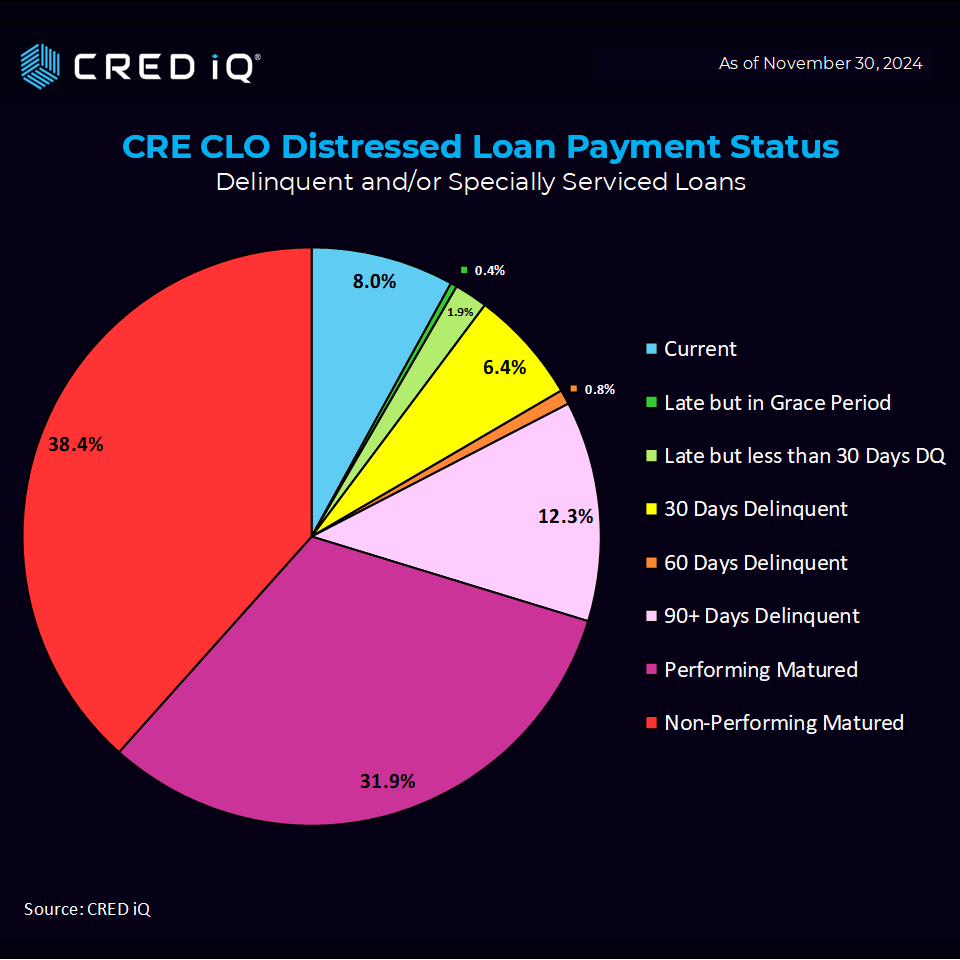
Looking across payment status, 29.4% of loans are performing matured, with another 34.9% non-performing matured, meaning 64.3% of the CRE CLO loans in our study are past their maturity dates. 

Analysis Scope & Methodology

CRED iQ consolidated all of the loan-level performance data for every outstanding CRE CLO loan to measure the underlying risks associated with these transitional assets. Our team examined $72.4 billion in active CRE CLO loans. Many of these loans were originated in 2021 at times where cap rates were low, valuations high, low interest rates, and are starting to run into maturity issues given the spike in rates.

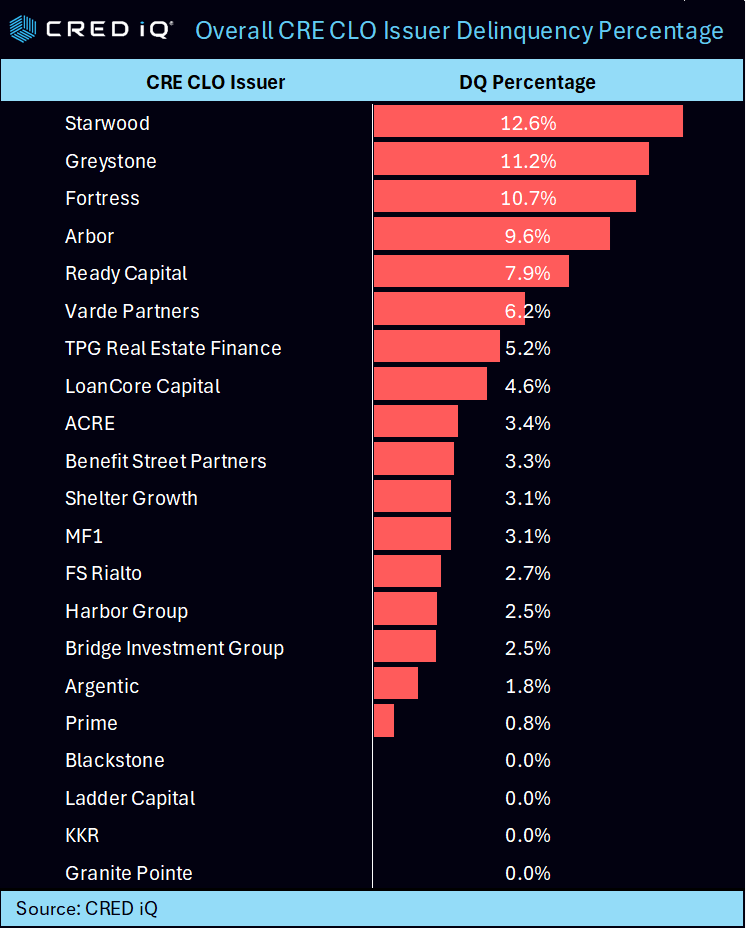
Some of the largest issuers of CRE CLO debt over the past five years include MF1, Arbor, LoanCore, Benefit Street Partners, Bridge Investment Group, FS Rialto, and TPG.The vast majority of the $79.1 billion in CRE CLO loans are structured with floating rates with 3-year loan terms equipped with loan extension options if certain financial hurdles are met.

About CRED iQ

CRED iQ is a market data provider that offers a robust suite of data and software solutions tailored for commercial real estate and finance professionals.


With over $2.3 trillion of CRE loans, CRED iQ delivers instant access to a comprehensive range of financial data and analytics for millions of properties in every market. CRED iQ’s data and analytical capabilities are instrumental in helping investors, lenders and brokers make informed and strategic decisions critical to their business.

Office Distress Nearly Triples in the Last 18 Months – Reaches New Peak

0

The overall CRED iQ distress was flat to our September 5th print at 9.1% remaining at a record high. CRED iQ’s special servicing rate increased to 8.4% from 8.0% last month, while the CRED iQ delinquency rate, consistent with the distress rate, came in flat at 6.8%.  Most noteworthy change was the Office Distress reaching its new peak at 14.8%, a 156% increase from 18 months ago when distress rates were only 5.8%. 

The CRED iQ team evaluated payment statuses reported for each loan (securitized by CMBS financing), along with special servicing status as part of our monthly distress update.

Segment Review

Multifamily slowed its distress rate growth, increasing to 11.2% from 11.0% in this print.  Nine months ago, that rate was 2.6%.  The multifamily segment loses its second-place status to retail, but the differences remain fractional.  These figures include all multifamily securitized with CMBS financing.

The office segment rose by 108 basis points month-over-month, which earns office the second largest change this print and widens the office segment lead amongst all property types.

After reducing their distress rate last month, retail added 98 basis points.  At 11.4%, retail has the second highest overall distress rate amongst all  property types.   

The hotel segment was up marginally, logging 8.6% of their properties in distress

As reported in our September 5th report, the industrial segment returned to its normal, sub 1% distress rate (0.6%) after resolving payment status issues associated with one large SBLL portfolio valued at $2.18 billion).  

Meanwhile, self-storage saw a similar swing to 2.4% from 0.1% in our previous report.  Increased distress in this sector is caused by a $356.5 million SBLL loan falling delinquent. More details are included in the Loan Highlight section.

Payment Status

Looking at distressed loan payment status, 18% of the loans are current.  While 1.1% of loans are attributable to late (but in the grace period) and 6.5% of loans were late (but less than 30 days DQ). Combining these three metrics 25.6% of all loans were current / late within the grace period / less than 30 days delinquent.

Non-Performing Matured increased from 30.9% to 42.3%, 90+ Days Delinquent increased from 10.9% to 12.8%.  Performing Matured decreased from 16.2% in our September report to 14.5% in this print .

Analysis Methodology

CRED iQ’s distress rate aggregates the two indicators of distress – delinquency rate and specially serviced rate – yielding the distress rate. The index includes any loan with a payment status of 30+ days delinquent or worse, any loan actively with the special servicer, and includes non-performing and performing loans that have failed to pay off at maturity.

It’s important to note that CRED iQ’s distress rate factors in all CMBS properties that are securitized in conduits and single-borrower large loan deal types.  CRED iQ tracks Freddie Mac, Fannie Mae, Ginnie Mae, and CRE CLO loan metrics in separate analyses.

Loan Highlights

Office Loan

The $525.0 million loan backed by the Mobil Building, a 1.7 million SF mixed-use property failed to payoff at maturity in September 2024. The interest-only loan includes a $175.0 million mezzanine loan, representing a total debt of $700.0 million. The loan transferred to the special servicer due to maturity default. Servicer commentary indicates discussions of loan extension are being discussed.

The collateral consists of office and retail space located on East 42nd Street in the Grand Central submarket. Built in 1954, the property was valued at $900.0 million ($527/SF) at underwriting in June 2014. The property was 89.2% occupied and most recently had a DSCR of 1.39.

Self Storage Loan

A $356.5 million SBLL loan, backed by a portfolio of 29 self storage properties fell delinquent this month as it failed to pay off at its September 2024 maturity date. The portfolio consists of an aggregate of 24,076 units or 2.2 million SF across 12 states. The collateral was valued at $541.7 million ($22,498/unit) at contribution in April 2022. The portfolio had a DSCR of 0.98 and was 92.1% occupied.

The interest-only loan was added to the servicer’s watchlist in February 2024 due to delinquent taxes. The September 2024 servicer commentary indicates the borrower is seeking a short-term extension through mid-October to avoid purchasing another cap rate.

About CRED iQ

CRED iQ is a market data provider that offers a robust suite of data and software solutions tailored for commercial real estate and finance professionals.


With over $2.3 trillion of CRE loans, CRED iQ delivers instant access to a comprehensive range of financial data and analytics for millions of properties in every market. CRED iQ’s data and analytical capabilities are instrumental in helping investors, lenders and brokers make informed and strategic decisions critical to their business.

2,085FollowersFollow
6SubscribersSubscribe