
Home Blog Page 18

Valuation Trends for Q3 2023

0

CRED iQ analyzed 480 properties that were re-appraised in 2023. The Top 25 Valuation declines all received an updated appraisal in Q3 2023.  Each of these properties were either delinquent or with the special servicer. 

In total, the average decline in value compared to the original valuation at issuance was 41.6% – a very slight overall increase of four basis points over our first half 2023 report

Sector Perspectives

Notable changes appeared in the ranking by property type.  Notably Industrial jumps from 6th place in first half report to 1st place in Q3.

  • By property Type, office and retail had the highest percentage-based declines . Office averaged a 50.3% decline, while retail properties averaged 51.7% decline across the sample set of CRED iQ data. 
  • The office average decline is slightly up from our last analysis in July when office valuations declined 48.7% on average. 
  • Comparing Q2 2023 with our current analysis, the average multifamily valuation decline deteriorated this quarter from 22.0% to 33.6%.  Likewise Industrial dropped from a 21.2% decline to a 32% decline in Q3
  • Self-storage remains the strongest asset class with no specially serviced or delinquent loans reporting a decline in value this year. 

Here are the most notable properties that made our Q3 list:

1740 Broadway, New York City

CRED iQ first alerted the industry of this distressed 604,000 square foot office tower in Manhattan back in March 2002 when it first defaulted.  The property topped our list with a stunning valuation loss of $430 million, or 71.1% of its value.  At origination, the collateral was valued at $605 million ($1,002/SF).  Its latest appraisal posted a valuation of just $175 million ($290/SF). 

229 West 43rd Street, New York City

This property topped our list of valuation drops in our first half 2023 report.  A 248,457 square foot apartment/retail mixed use property lost $386 million in valuation since origination or 82.1% 

Woodbridge Center: Woodbridge, New Jersey

Holding its grip on third place in our study is this 1.1 million square foot mall in NJ which lost 76.5% of its valuation, or $280 million. 

Nema: San Francisco, California

This 754-unit apartment complex cracks the top 5 for the multifamily category—seeing its valuation at origination of $543.6 million decline by 48.7% to $279 million—a reduction of $264.6 million.

Park Place Mall: Tucson AZ

Our second of two malls in the top five, this 478,333 square foot retail property lost 72,2% of its value from its origination of $313 million to $87 million.  On a price per square foot basis, the mall’s valuation is at $182/SF, a significant drop from $654/SF at loan origination in 2011.   

As we stated in our first half report, the current market conditions are having a significant impact on the valuation of commercial real estate properties across all asset classes.  Our overall valuation declines remained mostly flat compared to our first half report.  The most notable developments in Q3 were at the property type level with Industrial and Multifamily seeing their sector loss percentages grow by  ~ 11% each. 

Please look for our year-end valuation report in December.   

CRED iQ September 2023 CMBS Delinquency Report

0

The Delinquency Rate is calculated as the percentage of all delinquent loans, whether specially serviced or non-specially serviced. CRED iQ’s Special Servicing Rate, equal to the percentage of CMBS loans that are with the special servicer (delinquent or non-delinquent), increased month-over-month to 6.83%, from 6.73%.

The Special Servicing Rate has continued to climb YTD 2023. Aggregating the two indicators of distress – delinquency rate and special servicing rate – into an overall distressed rate (DQ + SS%) of 7.43% of CMBS loans, an increase of 26 basis points from last month (August 7.17%), equal to a 3.6% increase.

The month-over-month increase in the overall distressed rate mirrors increases in the delinquency and special servicing rates. Distressed rates generally track slightly higher than special servicing rates as most delinquent loans are also with the special servicer.

Distress in the office sector continued to build in September 2023. The Office Distressed Rate for August is 10.75%, which compared to 9.36% as of August 2023.

The month-over-month surge of 139 basis points in office delinquency was equal to a 15% increase. The natural progression of long to intermediate-term rolling leases coupled with ongoing refinancing difficulties at loan maturity have caused the velocity of new delinquencies to accelerate during 2023.

The CRED iQ Delinquency Rate has continued to rise, reaching 5.19% in September 2023. This represents a 12-basis point (0.12%) increase from August. Notably, 62% of the newly delinquent loans in September were a result of maturity defaults or refinancing challenges. 

In September, Distressed rates for non-office properties showed the following changes:

•          Retail Distressed rates increased from 10.66% in August to 11.18% in September, a 52-basis point increase.

•          Multifamily Distressed rate decreased slightly, falling by 30 basis points to reach 4.66% in September.

•          Lodging Distressed rate increase in September, rising by 64 basis points to 8.34%.

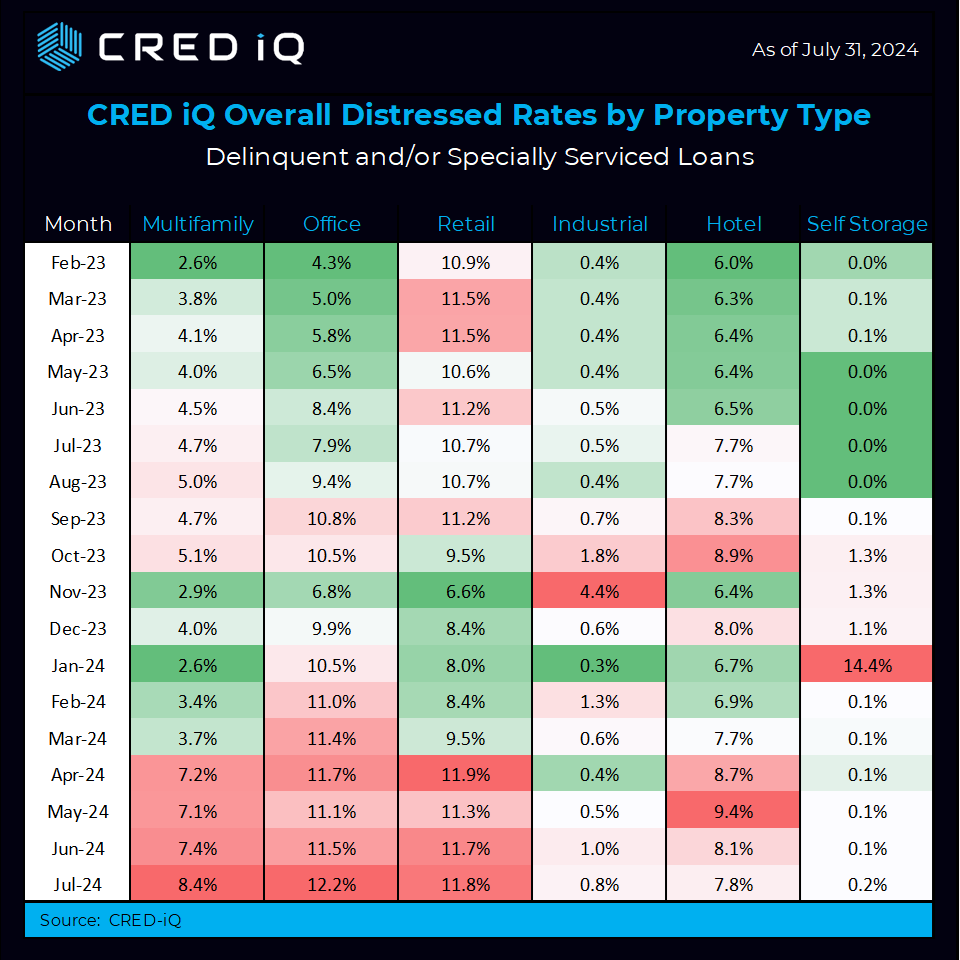
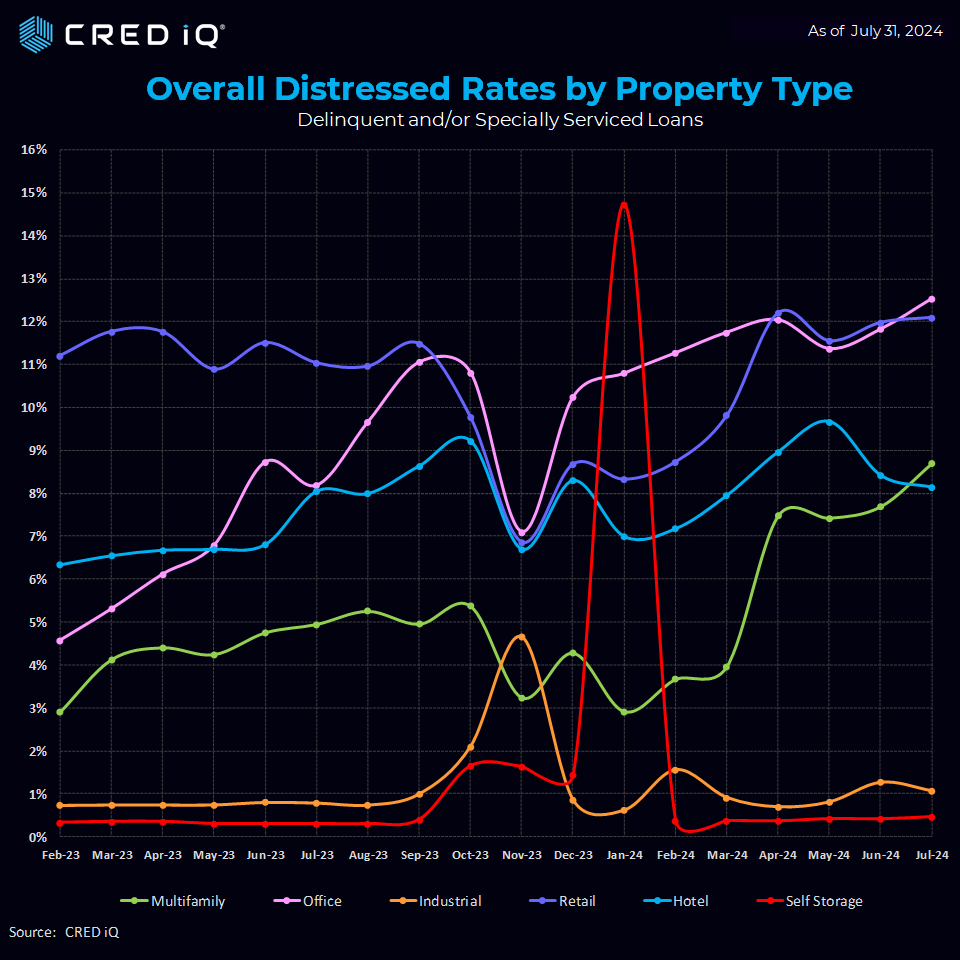
CRED iQ’s overall distressed rate (DQ + SS%) by property type accounts for loans that qualify for either delinquent or special servicing subsets. 

The 2023 YTD increase in the overall distressed rate has seen a rise of 54%. A severely limited refinancing market for office properties and a ‘higher for longer’ interest rate environment continues to contribute to sustained increases in commercial real estate distress.

CRED iQ’s September Delinquency Rate (5.19%) has risen to levels we have not seen since Q3 2021.Market sentiment seems to be consistent whereby the CRE market will continue to see distress given the current interest rate environment and the wave of upcoming loan maturities, particularly in the floating rate loan market.

About CRED iQ

CRED iQ is a commercial real estate data, analytics, and valuation platform providing actionable intelligence to CRE and capital markets investors. Subscribers use the platform to identify valuable leads for leasing, lending, refinancing, distressed debt, and acquisition opportunities.

The platform also offers a highly efficient valuation engine which can be leveraged across all property types and geographies. Our data platform is powered by over $2.0 trillion in transactions and data covering CRE, CMBS, CRE CLO, Single Asset Single Borrower (SASB), and all of GSE / Agency.

Case Study: Crossgates Mall

0

The beleaguered retail sector of the commercial real estate market has enjoyed some quiet time away from the negative headlines recently as the office sector has taken its place at the whipping post. The recent liquidation of the Crossgates Mall in Albany, NY provides an opportunity to check in on the retail sector after it was the subject of the commercial mortgage-backed securities (CMBS) version of the “Big Short” during the pandemic.

Before we get into the recent liquidation a short history of Crossgates is in order. The mall came into this world on March 4, 1984, amidst strong opposition from residents, environmentalists, and at least one resignation by town officials after the Town Board approved the developer’s plans. Pyramid Management Group began purchasing the land on which it was to build Crossgates in the 1970s, but it wasn’t until 1978 that it revealed its plans to the public. Crossgates was Pyramid’s 7th mall and was completed during the nationwide boom in enclosed shopping center openings in the mid-1980s.  Pyramid almost doubled the size of the mall from 975,00 square-feet to nearly 1.7 million square-feet in 1994 and attempted to double the footprint once again in 1998, by razing a nearby residential neighborhood but was rebuffed by the Guilderland Town Board.

It wasn’t until July 2005 that Crossgates came into financial markets via the JPMCC 2006-FL1 floating-rate CMBS deal. The $200 million loan was advanced against an appraised value of $484 million and underwritten net operating income (NOI) and occupancy of $36.3 million and 89% respectively. The loan was set to mature in June 2007, but Pyramid had five 1-year extension options which it fully utilized as it was not able to refinance the loan during the height of the Global Financial Crisis. Macy’s bought Filene’s basement during this period which put further pressure on the mall’s revenues as both Macy’s and Filene’s were tenants and Macy’s vacated their space after the acquisition. Despite this downward pressure on earnings the mall always sported a healthy debt-service coverage ratio since LIBOR was pegged near 0% during that period and the loan’s interest rate was based on LIBOR.

When the CMBS market began to re-open in the 2010-2012 period most of the deals brought to market had heavy concentrations of retail properties. While this may seem odd today given the pressure bricks-and-mortar retailers have been under, back then Amazon had only just crossed the $100bln market capitalization threshold and the inevitability of retail’s demise was not widely appreciated. In fact, retail was sought after as a port in the storm of the housing crisis from which we were only just beginning to emerge. It was during this time that Pyramid was able to secure a $300 million loan from the CMBS lending unit of Deutsche Bank. Deutsche and the new lending unit of Cantor Fitzgerald, CCRE, bought this loan to market in the first three deals of their new CR shelf in 2012. In each deal Crossgates was prominently featured in the top 10 loans. The deals fared well in the market even as the winds were changing in the market for retail properties.

It wasn’t until the CMBS bull market subsided in 2013 in the wake of the Taper Tantrum that the problems in retail started to be appreciated by the market. There were several cycles during this period which were triggered by exogenous events like the Chinese revaluation of their currency in 2015 and the oil market crash of ’15-’16 that led to changing lending conditions in the CRE market. As economic growth and inflation stayed stubbornly low, the Fed kept rates low which helped keep lending markets open but weak consumer spending and a shift to online purchases made lenders increasingly skeptical of retail properties and favored the office sector. A furious debate ensued in the marketplace between hedge funds who were shorting CMBS securities tied to enclosed malls like Crossgates, and money managers and insurance companies who were buying the debt as they search for yield in a ZIRP world. Lengthy “white papers” were shared in the market arguing both sides of the trade, but as the shorts carried a high cost of carry and took too long to pay off the hedge funds struggled to hold onto their trades. Their forced buying as they covered shorts kept spreads for retail properties artificially low, masking the deteriorating fundamentals. It wasn’t until COVID hit that the market decisively changed in the favor of the retail shorts and kicked of the current default cycle. The Crossgates Mall loan was a large exposure in the CMBX 6 index which was the instrument of choice for the shorts given its high exposure to enclosed, regional malls like Crossgates. In fact, many of Pyramid’s malls were targets of the CMBX shorts given their prominence in CMBX 6 and being in weaker suburban areas.

After securing a forbearance deal in the midst of the pandemic Pyramid was able to get NOI back up to the pre-COVID levels in 2021 but with sentiment souring towards enclosed malls in the wake of the pandemic and rapidly rising interest rates, Pyramid once again found itself in a position where the mall was performing well but the capital markets were not receptive to making a new loan which would enable them to refinance. With 2021 NOI just above the underwritten NOI from 2012 and the loan having paid down over $50 million giving it a debt yield of over 10%, Pyramid was apparently not ready to hand over the keys to the property but was also not able to pay off the loan. The servicer then proceeded to sell the loan at approximately 70 cents on the dollar to a partnership of Cannae Advisors and Morgan Stanley. The reported purchase price of $173.9 million represents a 15.2% cap rate on the last reported annualized NOI of $26.3 million for the six-months ended in June 2022.

Despite Pyramid’s troubles and controversy, they have been able to maintain NOI at stable levels for over a decade despite a pandemic and secular downturn in retail. As CRED iQ’s own Harry Blanchard recently pointed out mall properties are showing signs of resiliency and as Pyramid has shown, there is a path for sophisticated sponsors to prosper amidst the challenges in the market. COVID not only changed attitudes towards working from home, but it also changed attitudes for urban living with many people fleeing cities to the suburbs which has removed a major headwind for regional malls that was present prior to the pandemic. While Pyramid might not have the financial wherewithal to complete a discounted payoff, they have proven to be adept operators of mall properties and their apparent unwillingness to hand over the keys to their properties carries important information for investors.  It is likely that the new owners of the Crossgates loan will seek to restructure the debt while keeping Pyramid as the owner operator, as it would be difficult to bring in a more experienced and proven operator and Pyramid is unlikely to walk away without a fight.

The Crossgates liquidation is just one of many troubled retail loans that are currently being worked out from the last default cycle. However, just like the market was already turning down amidst the prevailing bullish sentiment when Crossgates came to market, the market today may be emerging from its long winter just as the negative headlines from the last default cycle seem to never end.

About the Author

Joshua J. Myers, CFA

After a successful 20+ year investing career, Joshua Myers, CFA launched Cedars Hill Group to bring large market expertise to broader audiences. He primarily serves as an outsourced CIO/CFO for family offices, RIAs, and small-to-medium sized businesses. He started as an assistant trader at Susquehanna Investment Group during the Russian default and LTCM failure in 1998. Afterwards, he was Head of Fixed Income at Penn Mutual Life Insurance during the Global Financial Crisis of 2008-2009. He traded distressed CMBS securities in the aftermath of the GFC at Cantor Fitzgerald and most recently was Chairman of the Board for an oil production company during the COVID pandemic. He is a lifelong student of financial markets and writes about current events with a focus on the art of decision making and cognitive psychology.  

For more market commentary from Josh subscribe to his Substack at Cedars Hill Group (CHG). You can also follow Josh on LinkedIn and X.

About CRED iQ

CRED iQ is a commercial real estate data, analytics, and valuation platform providing actionable intelligence to CRE and capital markets investors. Subscribers use the platform to identify valuable leads for leasing, lending, refinancing, distressed debt, and acquisition opportunities.

The platform also offers a highly efficient valuation engine which can be leveraged across all property types and geographies. Our data platform is powered by over $2.0 trillion in transactions and data covering CRE, CMBS, CRE CLO, Single Asset Single Borrower (SASB), and all of GSE / Agency.

Maturity Defaults on the Rise

0

CRED iQ’s research team drilled down into the 2023 maturity data to study both the depth and trends of maturity defaults.  Our examination of the recent Special Servicer transfers clearly reveals that defaults are on the rise. Out of all outstanding maturity defaults within CMBS, over 50% occurred in this year alone.

Background:  2023 has been a banner year for CRE maturities  

As we reported earlier this year in our 2023 CRE Maturity Outlook: The Year Ahead.  CRED iQ’s database has approximately $162 billion in commercial mortgages expiring in 2023, including loans securitized in CMBS conduit trusts, single-borrower large-loan securitizations (SBLL) and CRE CLOs, as well as multifamily mortgages securitized through government-sponsored entities. 2023 features the highest volume of scheduled maturities for securitized CRE loans over a period of 10 years ending 2032.

By securitization type, the SBLL securitization subset of nearly $100 billion comprises the majority (61%) of maturities in 2023; however, approximately 94% of that balance is tied to floating-rate loans that have extension options available, providing no assurances of refinancing or new origination opportunities.

CMBS conduit loans account for the second-highest total of loans with 2023 maturity dates (approximately $29 billion in 2023), accounting for 18% of total scheduled maturities. This group of loans provides for diverse observation across property type, building class, and geographic location. Breaking down 2023 conduit maturities by property type, retail has the highest concentration with 42% of outstanding debt and is followed by office with 22%. Lodging has the third-highest concentration with 14% of the outstanding balance of maturities in 2023.

Takeaways

The rising interest rate environment has significantly impacted the performance of CRE loans across the board and maturity defaults are on the rise.

  • As a percentage of all maturity defaults, 52% of them occurred this year.  
  • The maturity default percentage of all specially serviced loans amounted to 32.3%.
  • The maturity default percentage of loans that transferred to the Special Servicer in 2023 totaled 44.1%, an 11.9% increase from the overall totals.
  • $41 billion of loans are actively with the Special Servicer, of which $16 billion occurred this year alone.  

The second largest culprit as a reason to be transferred to the Special Servicer is for imminent monetary default.  

Brief Case Study

One example of a recent maturity default is the $310 million River Point North loan that transferred to the Special Servicer in May 2023. The property that secures the debt is a 1.7 million square foot (SF) mixed-use property that contains 1.3 million SF of Class-A office space and 400,000 SF of space that is leased by the 535-key Holiday Inn Mart Plaza Hotel in downtown Chicago. The borrower of the loan, Blackstone, also has $60 million in mezzanine debt for a total capital stack of $370 million.
The loan was transferred due to Blackstone’s written confirmation that they would be unable to pay amounts owed under the loan. The loan matured in July 2023. The property is 72% leased compared to 93% at origination. The loan is being fully cash managed due to low debt yield with all excess trapped to trust’s held reserve.

Outlook

We expect maturity defaults to keep rising over the next year as interest rates remain elevated, as well as lack of sales transactions for price discovery, and the downward spiral of office properties.

About CRED iQ

CRED iQ is a commercial real estate data, analytics, and valuation platform providing actionable intelligence to CRE and capital markets investors. Subscribers use the platform to identify valuable leads for leasing, lending, refinancing, distressed debt, and acquisition opportunities.The platform also offers a highly efficient valuation engine which can be leveraged across all property types and geographies. Our data platform is powered by over $2.0 trillion in transactions and data covering CRE, CMBS, CRE CLO, Single Asset Single Borrower (SASB), and all of GSE / Agency.

Floating Rate Loans in a Rising Interest Rate Enviornment

0

CRED iQ’s research team focused upon the difficulties of refinancing a floating rate commercial real estate loan in a rising interest rate environment.  

The commercial real estate market is often a reflection of broader economic trends, and one of the most significant factors impacting property owners and investors today is the rising interest rate environment. In such a climate, refinancing a floating rate commercial real estate loan becomes increasingly challenging.  CRED iQ’s report on Floating loans revealed that ~44% of floating rate loans with near term expirations will see rate cap agreements expiring before those loans mature. 

Based on SOFR data posted by the Federal Reserve Bank of New York, its apparent the rise in SOFR is having a dramatic effect on pending floating rate loan maturities.

This article delves into the difficulties faced by borrowers when their floating rate loans mature in a time of escalating interest rates and explores potential strategies to address these challenges.

Based on the Secured Overnight Funding Rate (SOFR)data posted by the Federal Reserve Bank of New York, its apparent the rise in SOFR is having a dramatic effect on pending floating rate loan maturities.

CRED iQ has examined trends in Fannie Mae floating rate loans over the trailing twelve months (TTM) and discovered that 2023 has presented notable challenges for borrowers currently within their loan term and those nearing maturity.

The data below clearly illustrates the effects of the rising interest rate environment when analyzing Fannie Mae floating rate issuance, including the aggregate Average Original Note Rate, Average Loan Scheduled Interest Due, and how these metrics vary by Seller.

The data here underscores a significant decline in year-over-year originations of floating rate loans. This drop coincides with a roughly 500 basis point increase in SOFR over the past 18 months, causing borrowers to perceive diminishing advantages in floating rate debt.

When analyzing the trailing twelve-month (TTM) data, it’s evident that the average interest due on Fannie Mae loans has surged by over 280%. This surge is exerting substantial pressure on Debt Service Coverage Ratio (DSCR) and Loan-to-Value (LTV) ratios for these properties. We are currently observing a challenging environment for both lenders and borrowers, and it is likely to continue testing the stability of the floating rate market in the near-term future.

Floating rate loans have been a popular choice for commercial real estate borrowers due to their initial lower interest rates and flexibility. However, when the interest rate environment shifts from historically low rates to an upward trajectory, borrowers can find themselves in a perfect storm of financial challenges at loan maturity.

  1. Interest Rate Risk: The fundamental difficulty in refinancing a floating rate commercial real estate loan during a rising interest rate environment is the inherent interest rate risk. As rates increase, borrowers face the prospect of higher interest payments, potentially straining their cash flow and making debt service less affordable.
  2. Debt Service Coverage Ratio (DSCR) Constraints: Lenders may require a higher DSCR when refinancing loans in a rising rate environment. As interest rates climb, borrowers may struggle to meet these stricter criteria, limiting their refinancing options.
  3. Reduced Property Valuation: Rising interest rates can negatively impact property valuations. Higher financing costs can lead to lower property income and, consequently, a reduction in property value, making it challenging to secure favorable refinancing terms.
  4. Limited Lender Appetite: In an environment of rising rates, lenders may become more risk-averse, making it harder for borrowers to find willing lenders. This can result in a smaller pool of potential refinancing partners and potentially less favorable terms.

While refinancing floating rate commercial real estate loans in a rising interest rate environment is undoubtedly challenging, there are strategies that borrowers can employ to mitigate these difficulties:

  1. Early Planning: Begin planning for loan maturity well in advance, preferably a year or more before the loan comes due. This allows for strategic decision-making and proactive actions.
  2. Exploration of Fixed-Rate Options: Consider converting from a floating rate loan to a fixed-rate loan if market conditions are favorable. Fixed-rate loans provide stability and predictability in a rising interest rate environment.
  3. Alternative Financing Sources: Explore alternative lenders, such as credit unions, private lenders, or non-traditional financing sources, as they may offer more flexibility and tailored solutions.
  4. Property Performance Enhancement: Work on improving the property’s income potential by implementing cost-cutting measures or rent increases to enhance its financial performance and appeal to lenders.
  5. Risk Management Strategies: Consider interest rate hedging tools like interest rate swaps or caps to mitigate interest rate risk and provide protection against sudden rate spikes.
  6. Diversification of Financing: Diversify your financing sources to reduce reliance on a single lender, which can enhance your ability to secure financing in a challenging environment.

Refinancing a floating rate commercial real estate loan in a rising interest rate environment is indeed fraught with difficulties. Nevertheless, with careful planning, flexibility, and a proactive approach, borrowers can navigate these challenges successfully. It is essential to assess your property’s financial health, market conditions, and potential refinancing options in the ever-evolving landscape of commercial real estate financing.

About CRED iQ

CRED iQ is a commercial real estate data, analytics, and valuation platform providing actionable intelligence to CRE and capital markets investors. Subscribers use the platform to identify valuable leads for leasing, lending, refinancing, distressed debt, and acquisition opportunities.The platform also offers a highly efficient valuation engine which can be leveraged across all property types and geographies. Our data platform is powered by over $2.0 trillion in transactions and data covering CRE, CMBS, CRE CLO, Single Asset Single Borrower (SASB), and all of GSE / Agency.

Meet with CRED iQ at CRE TECH 2023 in NYC

0

CRED iQ will be attending the CRE TECH 2023 conference in NYC this week! Details below:

Dates: Tuesday, September 19 & Wednesday, September 20

Location: Javits Center: 429 11th Ave, New York, NY 10001

Event Information: CRE Tech 2023

We would love the opportunity to meet in person! Please use the following link to help coordinate a meeting time or email us at team@cred-iq.com.

CRED iQ Analysis on the Rise of CRE Property Insurance Premiums

0

CRED iQ analyzed insurance premiums from 2010 to Q1 2023. Our research aimed to uncover the trends and drivers behind the rise in insurance costs on CRE properties over recent years. Notably, Commercial Property Insurance Premiums experienced a significant increase of 20.4% in Q1 2023.

The increasing occurrence and severity of natural disasters continue to be a major worry in the commercial property insurance sector. These catastrophic events frequently lead to substantial property damage and significant financial hardships for policyholders. In just the initial quarter of 2023, the global economy suffered $77 billion in losses due to natural disasters, with insurers covering a third of that cost, amounting to $22 billion.

CRED iQ’s research team measured the magnitude of these insurance premium hikes and pinpointed the Top 10 Metropolitan Statistical Areas (MSAs) that have witnessed the most substantial increases in premiums for properties on a per unit basis.

CRED iQ has also calculated the historical insurance premium year over year delta again for multifamily on a per unit basis.

Florida stands out as a state where insurance premiums have surged significantly. The heightened exposure in the Commercial Real Estate (CRE) sector is creating financial difficulties for properties facing upcoming insurance policy renewals and seeking new property financing. This is evident when comparing the 5-year percentage change from 2018 to 2022.

CRED iQ has identified a multifamily property in Tampa, Florida, known as The Grand Reserve at Tampa Palms. This property, which comprises 390 units and was constructed in 1999, serves as a prime example of how extreme weather events have led to financial distress over time.

In 2017, according to CRED iQ’s comprehensive financial database, this property had an Insurance Premium of approximately $183,000. However, when we examine the fiscal year 2022, the same property incurred a significant increase, with an insurance cost of $521,000. This represents a staggering 185% rise, translating to an increase from $469 per unit to $1,336 per unit.

Insurance rates for commercial real estate can be influenced by various factors, including:

1. Market Conditions: Changes in overall market dynamics, like shifts in demand for insurance coverage, can influence insurance rates. High demand due to increased risk factors or market trends can lead to rate hikes.

2. Property Location and Risk Assessment: The property’s location plays a vital role in determining insurance rates. Areas prone to natural disasters or higher crime rates typically result in higher premiums.

3. Property Type and Use: The type and intended use of the property affect rates. Properties with more occupants, hazardous materials, or elevated risk features can lead to higher insurance costs.

4. Claims History: Past insurance claims and losses impact future rates. Frequent claims or significant damages in the property’s history can lead to increased premiums.

5. Construction and Building Materials: The quality of construction and materials used affects rates. Older properties or those with vulnerable materials might have higher premiums.

6. Legal and Regulatory Factors: Changes in regulations or building codes can impact rates. Local, state, or federal shifts in safety standards or insurance requirements can influence costs.

7. Economic Factors: Economic conditions, such as inflation and interest rates, can impact insurance costs. Inflation can raise rebuilding expenses, leading to higher premiums.

8. Trends in Litigation and Liability: An increase in litigation or liability claims in commercial real estate can prompt insurers to raise rates to cover potential payouts.

9. Reinsurance Costs: Insurers use reinsurance to manage large losses. If reinsurance costs rise due to global events, insurers may pass those costs to policyholders.

10. Global Events and Catastrophes: Large-scale events like natural disasters or pandemics can heighten risk and impact insurance rates by affecting the industry’s financial stability.

These expenses are anticipated to continue and could even escalate throughout the remainder of 2023. This is due to the onset of the hurricane season and the ongoing spread of wildfires in the Western U.S. The National Oceanic and Atmospheric Administration (NOAA) has foreseen the possibility of up to 17 named storms forming during the 2023 Atlantic hurricane season, which spans from June 1 to November 30. Among these storms, nine could potentially transform into hurricanes with winds exceeding 74 mph, and four of them might attain significant strength with winds surpassing 111 mph.

According to the latest information from the National Interagency Fire Center (NIFC), there have been approximately 20,000 wildfires that have already consumed over 621,000 acres along the West Coast. While this number is lower than the 10-year average, it serves as an indication of another demanding wildfire season in the upcoming months. Climate experts predict that the ongoing patterns of natural disasters will persist, further intensifying the damages associated with them for the foreseeable future.

Consequently, several reinsurers have acted to restrict their willingness to cover these risks or have even withdrawn their coverage entirely, while rates continue to rise. According to data from the industry, reinsurance treaty renewals on January 1 brought some of the most challenging market conditions in many years. The capacity for additional coverage layers reduced by more than 50%, and policyholders encountered rate hikes ranging from 40% to 100%, depending on their vulnerability to catastrophic events. A similar trend was observed during renewals on June 1, with capacity tightening further and rate increases ranging from 25% to 40%. These developments highlight the ongoing cautious approach prevalent within the reinsurance sector.

About CRED iQ

CRED iQ is a commercial real estate data, analytics, and valuation platform providing actionable intelligence to CRE and capital markets investors. Subscribers use the platform to identify valuable leads for leasing, lending, refinancing, distressed debt, and acquisition opportunities.The platform also offers a highly efficient valuation engine which can be leveraged across all property types and geographies. Our data platform is powered by over $2.0 trillion in transactions and data covering CRE, CMBS, CRE CLO, Single Asset Single Borrower (SASB), and all of GSE / Agency.

CRED iQ August 2023 CMBS Delinquency Report

0

The CRED iQ CMBS delinquency rate has continued to rise, reaching 5.07% in August 2023. This represents a 40 basis point (0.40%) increase from a month prior, and an 177 basis point increase since January 2023. Notably, 62% of the newly delinquent loans, based on their outstanding balance, were a result of maturity defaults or refinancing challenges.

CRED iQ’s special servicing rate, equal to the percentage of CMBS loans that are with the special servicer (delinquent or non-delinquent), increased modestly month-over-month to 6.73%, from 6.72%. The special servicing rate has continued to climb YTD 2023. Aggregating the two indicators of distress – delinquency rate and special servicing rate – the overall distressed rate (DQ + SS%) rose to 7.17% – an increase of 14 basis points. Last month’s distressed rate was equal to 7.03%, which was 14 basis points lower that the July 2023 distressed rate. The month-over-month increase in the overall distressed rate mirrors increases in the delinquency and special servicing rates. Distressed rates generally track slightly higher than special servicing rates as most delinquent loans are also with the special servicer.

By property type, distress in the office sector continued to build in August 2023. The office distressed rate for August is 9.36%, which compared to 8% as of July 2023. The month-over-month surge of 136 basis points in office delinquency was equal to a 17% increase. The natural progression of long to intermediate-term rolling leases coupled with ongoing refinancing difficulties at loan maturity have caused the velocity of new delinquencies to accelerate during 2023.

An example of why office delinquency rates have gone up significantly month over month can be seen with 995 Market Street in San Francisco. This loan was part of the LSTR 2016-4 transaction and had a balance of $45 million. On July 21, 2023, it was transferred to Special Servicing, and currently, it’s 30-59 days behind in payments.

What’s important to note here is that the Special Servicer reports that the borrower hasn’t paid for July and has indicated they won’t make any more payments. Unfortunately, this situation is likely to continue as office vacancies increase, and Net Absorption (the rate at which office space is being occupied) continues to decline.

In August, Distressed rates for different types of properties showed the following changes:

  • Retail Distressed rates decreased slightly from 10.74% in July to 10.66% in August, an 8 basis point drop.
  • Multifamily Distressed rate increased slightly, rising by 31 basis points to reach 4.96% in August.
  • Lodging Distressed rate improved slightly in August, dropping by 6 basis points to 7.69%. This improvement is due to increased business and leisure travel, which has now surpassed pre-pandemic levels. 

CRED iQ’s CMBS distressed rate (DQ + SS%) by property type accounts for loans that qualify for either delinquent or special servicing subsets. This month, the overall distressed rate for CMBS increased to 6.56%. The increase was 13 basis points higher than May’s distressed rate (6.43%), equal to a 2% increase. A severely limited refinancing market for office properties and a ‘higher for longer’ interest rate environment continues to contribute to sustained increases in commercial real estate distress.It’s important to clarify that the delinquency rate is calculated as the percentage of all delinquent loans, whether specially serviced or non-specially serviced, in CRED iQ’s sample universe of $600+ billion in CMBS conduit and single asset single-borrower (SASB) loans

About CRED iQ

CRED iQ is a commercial real estate data, analytics, and valuation platform providing actionable intelligence to CRE and capital markets investors. Subscribers use the platform to identify valuable leads for leasing, lending, refinancing, distressed debt, and acquisition opportunities.

The platform also offers a highly efficient valuation engine which can be leveraged across all property types and geographies. Our data platform is powered by over $2.0 trillion in transactions and data covering CRE, CMBS, CRE CLO, Single Asset Single Borrower (SASB), and all of GSE / Agency.

Regional Mall Update: CRED iQ Analysis

0
King of Prussia Mall

For many years, the commercial real estate market has been predicting the decline of traditional malls due to the rapid growth of E-Commerce and the decreasing revenues generated by traditional mall tenants.

The adage “Only the strong survive” aptly characterizes the situation for American malls. However, it’s worth noting that students still favor physical malls for their back-to-school shopping. In terms of monthly statistics, Outlet Malls have experienced a growth of approximately 18% in volume, while renovated Indoor Malls have seen a monthly increase of around 7%, as reported by Placer.AI.

Industry data indicates American Mall year-over-year increase of around 5% in sales per square foot. Fran Horowitz, the CEO of Abercrombie & Fitch, affirms that the brand remains popular among late teens and early 20s demographics. Even though consumers might research Hollister products online, the data reveals that the majority of transactions continue to occur within physical stores. Abercrombie & Fitch has reported for the 2022 fiscal year online sales represented 44%. So, a majority of shoppers are still purchasing products in Abercrombie & Fitch’s brick and mortar locations.

An annual assessment of approximately 1,000 malls, and among them, they have improved 250 American malls by effectively filling anchor spaces and enhancing inline tenancy. According to industry statistics, “B” malls have exhibited notable resilience, demonstrating their capacity to regain stability in the aftermath of the pandemic.

Mall operators Simon Properties and Tanger Factory have reaped notable benefits from substantial enhancements to their individual mall portfolios. The recent bankruptcies of retailers such as Bed Bath & Beyond, The Christmas Tree Shop, and Tuesday Morning primarily affected dark spaces within Strip Center malls.

As the process of filling in vacant anchor spaces progresses, there has been a notable trend of Dick’s Sporting Goods occupying a considerable amount of these empty areas. Additionally, in certain instances, vacant spaces are being considered for occupancy by grocery stores. Another approach involves repurposing these large, unoccupied anchor spaces into smaller units, potentially for purposes like gyms or even satellite locations for colleges.

As vacant anchor spaces begin to get leased out, this development also proves advantageous for in-line tenants. Many of these in-line stores have Co-Tenancy clauses in their leases, which allow them to terminate their leases prematurely in the event of an anchor store’s closure.

CRED iQ has conducted a comprehensive assessment of our database encompassing retail properties in the U.S. with outstanding loan balances exceeding $1 million. Based on our analysis, the table below indicates that retail properties exhibit a delinquency rate slightly surpassing 5%. Further insights into our retail assets, categorized by loan payment status, can be found in the detailed breakdown provided below.

While the commercial real estate market has often displayed a negative sentiment towards the Retail Sector, particularly American malls, it’s becoming more apparent that these malls are showcasing a remarkable level of resilience.

About CRED iQ

CRED iQ is a commercial real estate data, analytics, and valuation platform providing actionable intelligence to CRE and capital markets investors. Subscribers use the platform to identify valuable leads for leasing, lending, refinancing, distressed debt, and acquisition opportunities.

The platform also offers a highly efficient valuation engine which can be leveraged across all property types and geographies. Our data platform is powered by over $2.0 trillion in transactions and data covering CRE, CMBS, CRE CLO, Single Asset Single Borrower (SASB), and all of GSE / Agency.

Case Study: The Gas Company Tower

0

In our first of a series of Case Studies, CRED iQ  invited guest analyst Josh Myers, CFA to take a deeper dive into this noteworthy asset from the first half.  What can we learn from this story and what can it tells us about future projections?    We hope you enjoy this case study. 

CRED iQ recently featured The Gas Company Tower (GCT) in the  Valuation Trends in the First Half of 2023 report. GCT was the runner up for the largest declines in property values during the first half. This inauspicious achievement came as GCT was re-appraisal at $270 million in April which is a jaw-dropping $362 million decline from its November 2020 appraisal of $632 million. This new appraisal came after Brookfield DTLA (OTC: DTLAP), the owner of GCT, defaulted on the loan at its February maturity date.

Financial Paradigm –what drove this sharply reduced appraisal?

Let’s start with GCT’s financials to get some context on this new appraisal via CRED iQ.

  • Net operating income (NOI) for the 9-month NOI as of September 2022 totals $18.1 million. 
  • Sidley Austin, the second largest tenant, has decamped from GCT for a downsized spot at 350 South Grand Avenue.
  • With nearly 10% of rental income leaving with Sidley we  estimate that effective gross income (EGI) will drop by 8.2% (base rent and expense reimbursements make up 82% of EGI).
  • With operating expenses making up 32.4% of revenue the 8.2% drop in EGI will result in a NOI drop of just over 12%. Annualizing the 9 months NOI and reducing by 12% we can estimate that the underwritten NOI used in the appraisal is around $21 million which gives us a cap rate of ~7.86% for a spread of ~440bps over the 10-year treasury.

When Brookfield DTLA elected to not exercise the extension option and instead default at the February 2023 maturity date it triggered an updated appraisal of this property. As detailed above the decline in NOI and rise in interest rates caused the sharply reduced appraisal.

Background on GCT

GCT was built in 1991 by a partnership of Maguire Properties and Thomas Properties Group. Maguire Properties, privately owned for 40 years, was an aggressive developer and buyer of Los Angeles real estate since the 1960s and ended up with sole ownership of GCT by the time Maguire went public in 2003 at $19 per share.

GCT made its market debut along with its owner in 2003 via the BALL 2003-BBA2 CMBS transaction as a $230 million loan with an appraised value of $450 million.  The loan was underwritten with a NOI of $35.7 million. Originated in June 2003, the floating rate loan carried a L+82 basis points coupon and initial maturity in July 2007 with a single 1-year extension option. Maguire, refinanced that loan with another CMBS loan, this time a $458 million loan supported by an appraisal of $610 million in June 2006.

Brookfield refinanced GCT in July 2016 by tapping the new single-asset, single-borrower CMBS market for $450 million spread across three different CMBS deals: COMM 2016-GCT, WFCM 2016-C36, and CD 2016-CD1. Riding the post-COVID everything bull market, Brookfield refinanced GCT once again into another SASB deal in 2021, GCT 2021-GCT, with the appraised value of $632 million referred to earlier. 

Brookfield bought Maguire in 2013 bringing GCT into the Brookfield family of assets.  Brookfield was in the early stages of a larger push into the distressed real estate market which ultimately culminated in the 2018 purchase of mall operator General Growth Properties (NYSE: GGP) for $15.3 billion.

Today GCT is an asset of Brookfield Property Partners (NYSE : BPY), the main real estate subsidiary of parent company Brookfield Asset Management (NYSE : BAM).  BPY created a subsidiary, the called  DTLA, to complete this acquisition that was owned 47% by BPY and 53% by institutional investors.

What can the GCT Story Tell us About Brookfield and the Future?

Last year Brookfield raised $14.5 billion for its newest real estate opportunities fund and their CEO has called the current opportunity in real estate the best since 2009. However, they are also facing many problems in their existing portfolios from the recent buying spree. The CEO of Brookfield REIT stepped down in April amidst investor redemptions, falling valuations, and slow fundraising. Brookfield defaulted on GCT and 777 Tower in Los Angeles earlier this year amidst a tighter credit market and tenant departures.

When Brookfield bought MPG, they vowed to improve the buildings and aggressively court new tenants such as tech companies, but that has not played out at GCT as the tenant roster remains largely unchanged with the Southern Gas Company still the largest tenant despite steadily lowering its footprint over the years from 558,318 square-feet in 2003 to 362,483 square-feet currently. Strategic tenant improvements and leasing capital investments into properties can provide very attractive returns for property owners but the fact that Brookfield has chosen not to make those investments despite amassing a war chest of opportunistic capital does not indicate that Brookfield ever saw much value above the mortgage in GCT. Holding the building in a separate subsidiary whose stock price has steadily declined has also made it difficult to raise external capital to make new investments in the property. Brookfield does not list GCT on its website and with the mortgage now underwater they will likely be asking for a generous forbearance package from the Special Servicer and Operating Advisor to stay in the property.

If no deal can be struck and GCT is auctioned off, another one of Brookfield’s subsidiaries could theoretically buy it back at auction. With the DTLAP stock trading just under 15 cents per share Brookfield has little to lose by walking away from the property and a lot to gain from a favorable restructuring of the debt. Brookfield is a very savvy sponsor with deep pockets and many different options at its disposal to do what is best for them and their investors. Unfortunately, that is not always in the best interest of the CMBS lenders. One of the major innovations in the CMBS 3.0 market was the role of the Operating Advisor that would oversee complex workouts like this to give CMBS investors a larger voice in these complex negotiations and manage the often-diverging interest in a CMBS trust.

The rumor of a new 300,000 square-foot lease at GCT that more than replaces the Sidley Austin footprint should be used by the Special Servicer and Operating Advisor in their negotiations with Brookfield. In the past, we have seen unfortunate restructurings of CMBS debt that heavily favor the sponsor only to be followed by a new lease signing like this just months after the forbearance deal is signed. GCT should provide us with a good opportunity to see how successful Operating Advisors can be in negotiating against highly sophisticated borrowers like Brookfield.

Some Takeaways

GCT is a great example of how two decades of falling interest rates and financial engineering have increased property values and enriched property owners but have not necessarily increased the value and utility of these properties. The past twenty years have seen NOI dwindle from nearly $40 million to $20-$25 million today despite valuations increasing from $450 million to $632 million. Whoever is left holding the hot potato now will have to figure out if buildings like this are worth keeping as-is with long-deferred and costly capex finally being invested or if a new use for the property needs to be found.

About the Author

Joshua J. Myers, CFA

After a successful 20+ year investing career, Joshua Myers, CFA launched Cedars Hill Group to bring large market expertise to broader audiences. He primarily serves as an outsourced CIO/CFO for family offices, RIAs, and small-to-medium sized businesses. He started as an assistant trader at Susquehanna Investment Group during the Russian default and LTCM failure in 1998. Afterwards, he was Head of Fixed Income at Penn Mutual Life Insurance during the Global Financial Crisis of 2008-2009. He traded distressed CMBS securities in the aftermath of the GFC at Cantor Fitzgerald and most recently was Chairman of the Board for an oil production company during the COVID pandemic. He is a lifelong student of financial markets and writes about current events with a focus on the art of decision making and cognitive psychology.  

For more market commentary from Josh subscribe to his Substack at Cedars Hill Group (CHG). You can also follow Josh on LinkedIn and X.

About CRED iQ

CRED iQ is a commercial real estate data, analytics, and valuation platform providing actionable intelligence to CRE and capital markets investors. Subscribers use the platform to identify valuable leads for leasing, lending, refinancing, distressed debt, and acquisition opportunities.

The platform also offers a highly efficient valuation engine which can be leveraged across all property types and geographies. Our data platform is powered by over $2.0 trillion in transactions and data covering CRE, CMBS, CRE CLO, Single Asset Single Borrower (SASB), and all of GSE / Agency.

2,085FollowersFollow
6SubscribersSubscribe