

CRED iQ tracked over $85 billion in multifamily originations for year-to-date 2022, including loans that were securitized in Fannie Mae, Ginnie Mae, Freddie Mac, and CMBS conduit transactions. As a data, analytics, and valuation partner to the commercial real estate community, CRED iQ helps CRE professionals uncover financing, leasing, and investment opportunities. One of our many solutions is identifying the most active markets for loan originations. The highest volume of loan originations is typically in the multifamily sector for any commercial property type on a yearly basis. According to the Mortgage Bankers Association, multifamily originations were up 24% year-over-year in Q2 2022 and up 18% in Q2 2022 compared to Q1.
Loans from Fannie Mae securitizations accounted for 41% of new originations by aggregate balance. CRED iQ included approximately $35.5 billion in Fannie Mae loan originations through August 2022 in observations. Through the first half of 2022, Fannie Mae issued approximately $34.7 billion in mortgage back securities, comprising of nearly 1,900 loans. The Washington, DC and Phoenix markets have dominated Fannie Mae issuance so far in 2022 with approximately $1.7 billion in multifamily originations for each MSA.
Freddie Mac securitizations accounted for 29% of YTD 2022 multifamily originations within the subset. New multifamily originations that were securitized in CRE CLO (12%), Ginnie Mae (11%), Conduit (4%) and Single Asset Single Borrower (3%) transactions made up the remainder.
Loan origination activity this year has been heavily concentrated in primary markets, which accounted for approximately 56% of total multifamily originations through YTD 2022. Loans secured by multifamily collateral in secondary markets made up 26% of new origination volume while loans secured by properties in tertiary markets made of 18%. Altogether, the 10 most active markets for 2022 multifamily originations accounted for 37% of total volume.
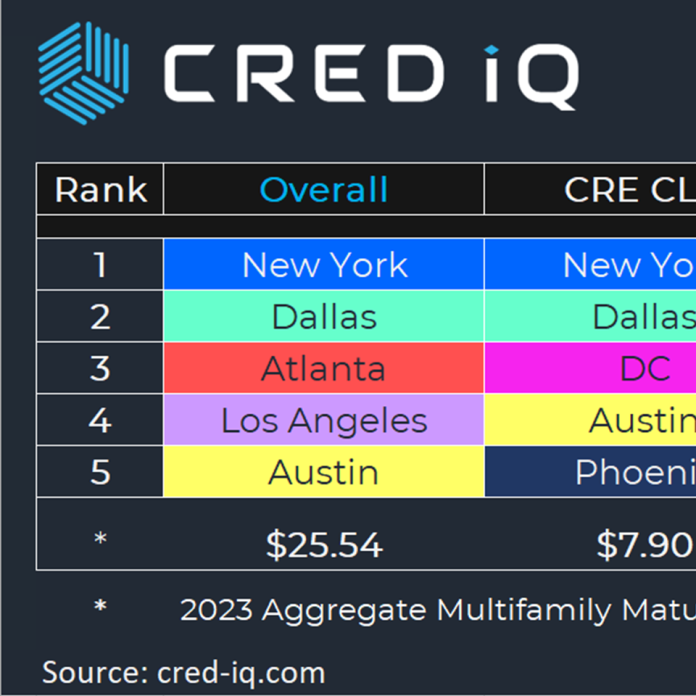
In total, the New York-Northern New JerseyMSA was the most active market with $4.7 billion in originations, accounting for 5.5% of aggregate loan origination volume. The Dallas-Fort Worth MSA was the second most active market with $3.9 billion in multifamily originations, accounting for 4.6% of the total. Phoenix (4.3%), Houston (4.0%) and Washington, DC (3.7%) rounded out the five most active multifamily markets for loan originations in 2022.
Notable secondary markets with the highest levels of origination activity included Columbus, OH (1.5% of total aggregate volume), Las Vegas (1.4%), Indianapolis (1.3%), Tampa (1.2%), and San Antonio (1.2%). Each of these secondary markets tallied over $1 billion in multifamily originations in 2022, between Fannie Mae, Ginnie Mae, Freddie Mac, and private-label CMBS securitizations. Comparing YTD 2022 origination activity to 2021, we find some common markets as leaders in volume. For example, San Antonio led all secondary markets in origination volume during 2021 and ranks fifth through August 2022. Conversely, Oklahoma City has the second highest volume of multifamily originations, among secondary markets, in 2021 but has failed to surpass the top 30 secondary markets so far in 2022.
For those interested in building lending pipelines into tertiary markets, the Ogden, UT, Dayton, OH, and Durham, NC markets were among the most active. CRED iQ tracked over $380 million in 2022 multifamily originations for each of these markets.
About CRED iQ
CRED iQ is a commercial real estate data, analytics, and valuation platform providing actionable intelligence to CRE and capital markets investors. Subscribers to CRED iQ use the platform to identify valuable leads for leasing, lending, refinancing, distressed debt, and acquisition opportunities. Our data platform is powered by over $2.0 trillion of CMBS, CRE CLO, SBLL, Ginnie Mae, FHA/HUD, and Freddie Mac loan and property data.
Compared to previous months, CRED iQ observed a surge of CMBS loans with non-performing maturity balloons in August 2022. There was approximately $4.7 billion in outstanding loans that were characterized as non-performing maturities as of August 2022. This figure excluded debt with properties that have entered into foreclosure as well as REO assets but included loans that may have transferred to special servicing prior to scheduled maturity dates. In fact, nearly all loans (99%) identified as non-performing maturity defaults have already transferred to special servicing. Many loans, approximately 36% of the aggregate outstanding balance, had monetary defaults before maturity came due, prompting the transfers to special servicing. However, maturity concerns were the primary reason for special servicing transfers for most of the non-performing maturity loans. Approximately 19% of the loans by balance transferred to special servicing due to a maturity default and an additional 20% of the loans transferred to special servicing for imminent maturity default.
Altogether, the aggregate outstanding debt for non-performing maturity balloons was 35% higher than July 2022, when the total was approximately $3.5 billion. The surge comes amid a rising rate environment that adds difficulty to the refinancing process. If cash flow issues are also present in the underlying collateral, then prolonged workouts may be required.
Additionally notable, the increase in the amount of maturity defaults coincides with a higher volume of loans coming due for maturity. In December 2021, CRED iQ published a report looking ahead to scheduled maturities in 2022. On a monthly basis, July 2022 had the third-highest total of scheduled matures with $2.3 billion, which was one month prior to the August surge in non-performing maturity loans. Scheduled maturities for the remainder of 2022 are concentrated in October and December, creating opportunities for maturity defaults to continue to manifest at a relatively high rate.
Our observations included loans securitized in both single-asset single-borrower and conduit securitizations. Maturity defaults were split evenly, by outstanding balance, between both types of securitizations. Further examination shows that the amount of maturity defaults within the conduit subset has remained fairly level over the past three months, ranging from $2.3 billion to $2.5 billion. This indicates the recent surge in August can be attributed to single-asset single-borrower securitization loans. The amount of outstanding debt securitized in single-asset single-borrower transactions increased, on a net basis, by approximately $1.3 billion during August 2022.
One such example was the $465 million Greenway Plaza loan, which was securitized in a 2017 single-asset single borrower securitization. The loan is secured by a 20-building 4.2 million-sf office park located in Houston, TX. The Greenway Plaza loan transferred to special servicing in July 2022 after a maturity default in May 2022. A forbearance agreement expired in July 2022 that rendered the status of the loan as non-performing.
Maturity defaults can also severely impact conduit securitizations in the form of adverse selection. Take the UBSBB 2012-C2 securitization for example. The transaction had eight specially serviced assets remaining as of September 2022, including three REO assets. The remaining five loans have all failed to pay off at maturity, leaving all of the outstanding debt in the securitization in the hands of special servicing workouts.
By property type, loans secured by retail and lodging account for the highest percentages of non-performing matured loans. Isolating our view to only CMBS conduit securitizations, retail loans accounted for approximately 67% of all non-performing matured loans. Loans secured by lodging properties accounted for 20%. The high concentration of retail loans is made of primarily of regional mall collateral. The Cumberland Mall in Vineland, NJ and the Greenwood Mall in Bowling Green, KY are two of the more recent examples of regional malls securing loans that have defaulted at maturity in the past month.
About CRED iQ
CRED iQ is a commercial real estate data, analytics, and valuation platform providing actionable intelligence to CRE and capital markets investors. Subscribers to CRED iQ use the platform to identify valuable leads for leasing, lending, refinancing, distressed debt, and acquisition opportunities. Our data platform is powered by over $2.0 trillion of CMBS, CRE CLO, SBLL, Ginnie Mae, FHA/HUD, and Freddie Mac loan and property data.
In this Weekly Asset Review (WAR Report), CRED iQ highlights five distressed properties that have transferred to special servicing in August and September 2022. CRED iQ’s special servicing rate for CMBS conduit and SASB transactions has shown a recent uptick. In August 2022, the special servicing rate was 4.91%, representing a 10% increase compared to the prior month. Featured properties in this week’s review include a regional mall in Northern NJ with loan maturity issues, a pair of hotels in King of Prussia, PA, and a suburban office property in Greensboro, NC.
CRED iQ valuations factor in a base-case (most likely), a downside (significant loss of tenants), and dark scenarios (100% vacant). For access to the valuation reports as well as full CMBS loan reporting, including detailed financials, updated tenant information, and borrower contact information, sign up for a free trial here.
640,210 sf, Regional Mall/Lifestyle Center, Bridgewater, NJ [View Details]
This $300 million loan transferred to the special servicer on August 10, 2022 due to an impending maturity default. The loan is scheduled to mature in November 2022 and a timely payoff is unlikely given the current refinancing environment for regional malls coupled with a decline in the collateral property’s value since loan origination. One of the special servicer’s first steps of workout is ordering an appraisal to determine the valuation of the collateral in relation to outstanding debt.
The loan is secured by two adjacent properties: a 546,411-sf portion of a regional mall known as Bridgewater Commons and a 93,799-sf lifestyle center known as The Village at Bridgewater Commons. The retail development is located approximately 40 miles west of Manhattan, NY. The mall has three traditional anchor boxes, although two of the spaces do not serve as collateral for the $300 million mortgage. Macy’s owns and operates a 223,222-sf store and there is a 129,129-sf vacant box that was formerly operated and owned by Lord & Taylor. The largest collateral tenant is Bloomingdales with a 150,525-sf lease, accounting for 23.5% of NRA, that expires in January 2029. Of note, The Village at Bridgewater Commons lost its second-largest tenant, Crate & Barrel, when it vacated at the end of 2021. For a valuation report and loan-level details, click here.
306 keys, Lodging, King of Prussia, PA [View Details]
This $33.8 million loan transferred to the special servicer on August 30, 2022 due to imminent default. The loan, which has an interest rate of 5.02%, is secured by two hotels in King of Prussia, PA, located approximately 20 miles northwest of Philadelphia, PA. The loan has an upcoming maturity date in December 2022, but a timely payoff may be in doubt given the recent transfer to special servicing. Forbearance for the loan was previously granted in October 2020 to provide pandemic-related relief. However, average occupancy across the hotels, 43% for the trailing 12 months ended June 2022, has not recovered to pre-pandemic levels and aggregate net cash flow across the two hotels was barely positive for the same time period.
The larger of the two hotels serving as collateral for the newly transferred loan has 226 keys and operates as a Crowne Plaza pursuant to a franchise agreement that expires in November 2025. The property was constructed in 1969 and is the older of the two adjacent hotels. Additionally, the Crowne Plaza has 24,088 sf of meeting space. Occupancy at the hotel for the trailing 12 months ended June 2022 averaged 37%. For the valuation report and loan-level details, click here.
Crowne Plaza – King of Prussia | CGCMT 2016-GC36
Fairfield Inn & Suites
The smaller of the two properties is an 80-key limited-service hotel that operates as a Fairfield Inn & Suites under a franchise agreement that expires in June 2030. The hotel was built in 1995 to provide overflow lodging for the adjacent Crowne Plaza. As such, many of the Crowne Plaza’s amenities are shared with guests at the Fairfield Inn & Suites. Average occupancy at the hotel was approximately 57% for the trailing 12 months ended June 2022. For the valuation report and loan-level details, click here.
Fairfield Inn & Suites – King of Prussia | CGCMT 2016-GC36
This $21.2 million loan transferred to the special servicer on September 2, 2022, which was one month ahead of its scheduled October 2022 maturity date. The borrower had planned to market the property for sale ahead of the loan’s maturity date; however, the transfer to special servicing indicates imminent maturity default. The loan is secured by a four-story office building located three miles outside of downtown Greensboro, SC.
The office building has been approximately 75% occupied for the past several years. Occupancy at the property initially declined from 95% to 75% in 2016 when the property’s former largest tenant, Novartis, vacated. There has been limited leasing activity since the Novartis departure and the property has, at times, had difficulty maintaining an occupancy level at 75%. For a valuation report and loan-level details, click here.
99 keys, Limited-Service Hotel, San Mateo, CA [View Details]
This $8.2 million loan transferred to the special servicer on August 12, 2022 due to delinquency. The loan first became 30 days delinquent in May 2022 and was over 60 days delinquent as of September 2022. The loan is secured by a 99-key limited-service hotel located in San Mateo, CA. The hotel, which is flagged as a Best Western, averaged 74% occupancy during 2021. Occupancy during 2021 represented a significant recovery from a pandemic-induced low occupancy mark of 47% during 2020. Updated occupancy and performance figures for 2022 were not available. For the valuation report and loan-level details, click here.
CRED iQ is a commercial real estate data, analytics, and valuation platform providing actionable intelligence to CRE and capital markets investors. Subscribers to CRED iQ use the platform to identify valuable leads for leasing, lending, refinancing, distressed debt, and acquisition opportunities. Our data platform is powered by over $2.0 trillion of CMBS, CRE CLO, SBLL, Ginnie Mae, FHA/HUD, and Freddie Mac loan and property data.
Tech-focused data, analytics and valuation firm, CRED iQ, has hired Jeff Kurtz as Director of Sales. Kurtz joins CRED iQ with over ten years of enterprise sales experience within the commercial real estate data & analytics industry. Most recently Jeff was the Head of Analytics Sales at MountainSeed where he helped build and bring to market their analytics product. Prior to MountainSeed, Jeff helped grow commercial real estate data & analytics sales at REIS, Oxford Economics and CompStak.
I’m extremely excited to join this team and help CRED iQ grow. What Mike and Bill have built is truly something special and it’s only a matter of time before CRED iQ becomes an essential part of daily life for CRE and Capital Market investors. The CRE industry is starving for this type of technology and data and CRED iQ is the firm that can deliver it.
Jeff Kurtz
“Jeff’s commercial real estate knowledge and enterprise sales background really impressed us from the start,” said CRED iQ Co Founder, Mike Haas. “His eagerness to help communicate and implement customer feedback will be a key advantage for CRED iQ as we continue to launch new products for the CRE industry.
CRED iQ Co-Founder, Bill Petersen said, ”We’re excited to have Jeff join our team. His background and in-depth understanding of CRE technologies is a great fit for us.”
CRED iQ is a commercial real estate data, analytics, and valuation platform providing actionable intelligence to CRE and capital markets investors. Subscribers to CRED iQ use the platform to identify valuable leads for leasing, lending, refinancing, distressed debt, and acquisition opportunities. Our data platform is powered by over $2.0 trillion of CMBS, CRE CLO, SBLL, Ginnie Mae, FHA/HUD, and Freddie Mac loan and property data.
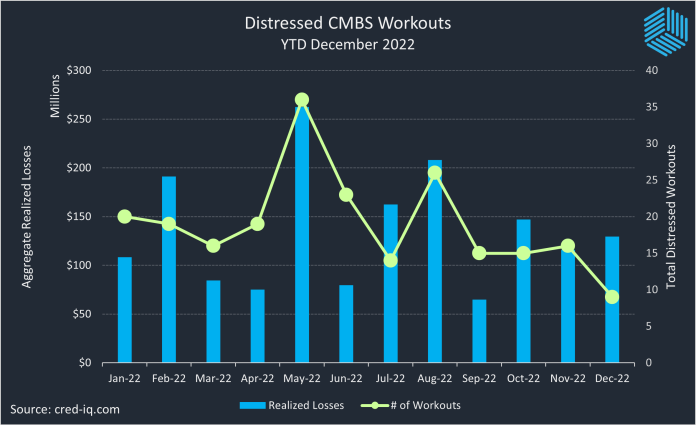
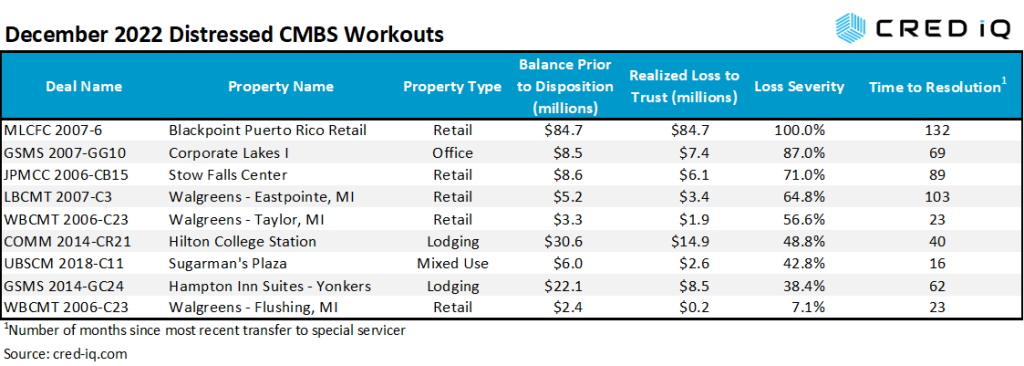
CMBS conduit and SBLL transactions incurred approximately $205 million in realized losses during August 2022 via the workout of distressed assets. CRED iQ identified 19 workouts classified as dispositions, liquidations, or discounted payoffs in August 2022. Additionally, there were seven distressed loans securitized in Freddie K transactions that needed workouts, with four of the loans incurring aggregate losses of $2.7 million. Of the 26 total workouts, only eight of the assets were resolved without a loss. Of the 18 workouts resulting in losses, severities for the month of August ranged from 1% to greater than 100%, based on outstanding balances at disposition. Realized losses in August were 28% higher than the amount of realized losses in July due, in part, to a higher number of workouts. On a monthly basis, realized losses for CMBS conduit and SBLL transactions averaged approximately $146.6 million year-to-date.
Lodging properties accounted for the highest number of distressed CMBS workouts this month with nine total resolutions. Five of the nine lodging workouts incurred losses, including Value Place Williston. The 248-key extended-stay hotel in North Dakota had been REO since 2017 and had an outstanding debt of $17.2 million. The property was liquidated with a 100% loss severity based on the outstanding debt amount. Other property types with multiple distressed workouts included eight distressed multifamily properties, five distressed retail properties, and three office properties.
The resolution of the WPC Department Store Portfolio loan represented the largest loss, by dollar amount and loss severity, among all distressed workouts this month. The liquidation alone accounted for approximately 30% of the total realized losses for the month. The WPC Department Store portfolio consisted of five REO anchor retail boxes attached to various regional malls. A sixth anchor box was previously sold in 2020. Outstanding debt for portfolio totaled $55.3 million but realized losses upon liquidation were in excess of the loan balance and resulted in a loss severity of 111.6% based on the balance at disposition.
The largest workout by outstanding debt amount was the $87.55 million State House Square loan, which was secured by an 837,225-sf office property in Hartford, CT. The loan had been with the special servicer since March 2019 and was resolved with a 54% loss severity.
Excluding defeased loans, there was approximately $5 billion in securitized debt that was paid off or liquidated in August, which was a slight increase compared to $4.7 billion in July 2022. In August, 7.7% of the loan resolutions were categorized as dispositions, liquidations, or discounted payoffs. The percentage of distressed workouts was 7% in the previous month. Approximately 15% of the loans were paid off with prepayment penalties.
By property type, multifamily had the highest total of outstanding debt pay off in August with 27% of the total by balance. The relatively higher percentage of multifamily debt pay off was driven by several maturities for loans securitized in CRE CLO transactions. Lodging had the second-highest total of outstanding debt pay off with 23% of the total. Among the largest lodging payoffs were a $471 million mortgage secured by a portfolio of 58 InTown Suites extended-stay hotels and a $265 million mortgage secured by a portfolio of 85 extended-stay hotels, also flagged under the InTown Suites brand.
About CRED iQ
CRED iQ is a commercial real estate data, analytics, and valuation platform designed to unlock investment, financing, and leasing opportunities. CRED iQ provides real-time property, loan, tenant, ownership, and valuation data for over $2.0 trillion of commercial real estate.
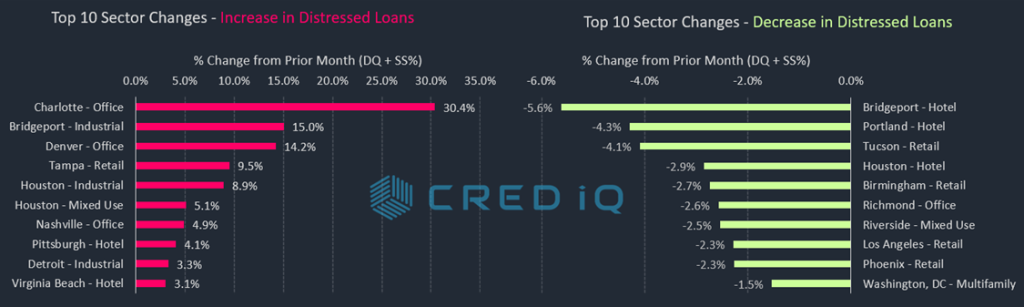
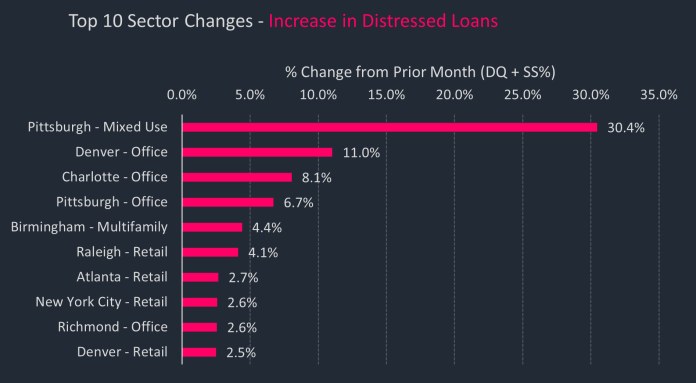
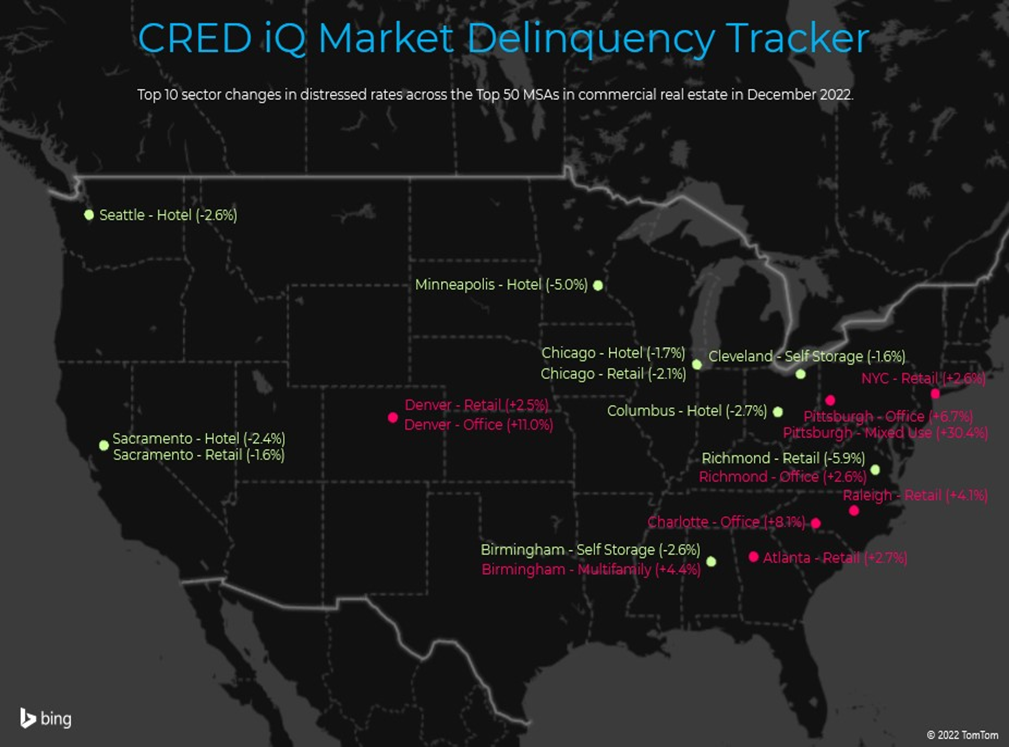
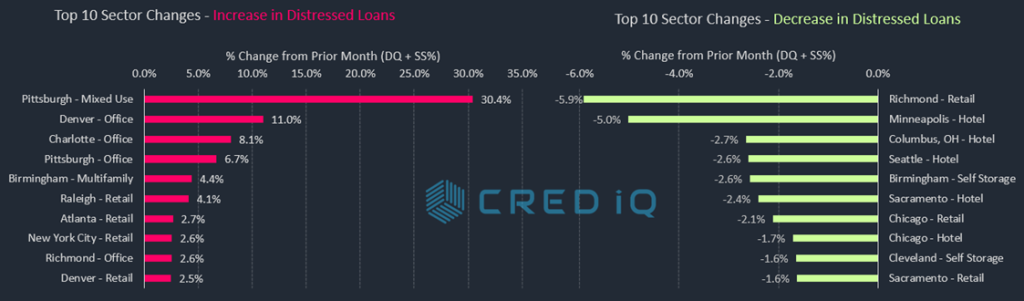
CRED iQ monitors distressed rates and market performance for nearly 400 MSAs across the United States, covering over $900 billion in outstanding commercial real estate (CRE) debt. Distressed rates (DQ + SS%) include loans that are specially serviced, delinquent, or a combination of both. Distressed rates and month-over-month changes for the month of August 2022 are presented below for the 50 largest MSAs, broken out by property type for a granular view of distress by market-sector.
Of the 50 largest MSAs tracked by CRED iQ, two out of every three markets exhibited month-over-month increases in the percentage of distressed CRE loans within the CMBS universe. This is the second consecutive month that markets with month-over-month distress outnumbered markets with improvements in distress. This month, regional malls drove much of the change in distress on a market-by-market basis. Sharp increases in distress were observed for the Birmingham MSA (+5.42%) and the Portland, OR MSA (+3.06%). The Louisville (-1.38%) and Baltimore (-1.15%) markets exhibited the greatest month-over-month improvements.
Retail sectors were the primary drivers behind the increases in distress within the Birmingham and Portland markets. Specifically, a $216 million loan secured by the Clackamas Town Center, a 1.4 million-sf regional mall located 10 miles outside of Portland, OR, transferred to special servicing due to imminent maturity default ahead of the loan’s October 2022 maturity date. The maturity default pushed the distressed rate for Portland – Retail significantly higher to 42.5%. Similarly, Riverchase Galleria, an 890,182-sf regional mall located 13 miles south of Birmingham, AL, is part of a three-mall portfolio that secures a $286.7 million mortgage. This loan transferred to special servicing in July 2022 ahead of its September 2022 maturity date due to imminent default. As a resulting development, the distressed rate for the Birmingham – Retail sector to rose to 22.66%.
Despite pockets of increased distress for most market-sectors, there were areas of improvement. The Louisville – Retail sector exhibited a 10.10% decline in the rate of distressed loans, which was the sharpest month-over-month decline among all property types in the Top 50 MSAs. The relief in distress was attributed in part to the $152.5 million Mall St. Matthews loan, which is secured by a 670,000-sf portion of a regional mall. The loan returned to the master servicer following a modification that extended the loan’s maturity date to June 2025.
The Minneapolis MSA has the highest overall distressed rate at 21.77%, which was an increase compared to the prior month distressed rate of 20.10%. Birmingham (9.69%), Cleveland (9.56%), Hartford, CT (9.4%), and Milwaukee (9.11%) comprise the remaining markets with the highest rates of distress. Birmingham was a new addition to the Top 5 distressed markets this month stemming from increased retail distress. The Jacksonville market (0.26%) had the lowest percentage of distress among the Top 50 MSAs, supplanting the Sacramento MSA (0.30%) which now has the second-lowest distressed rate.
Riverside – Riverside-San Bernardino-Ontario, CA MSA
$840.3
2.9%
0.1%
Riverside – Hotel
$44.1
12.3%
-0.6%
Riverside – Industrial
$30.1
0.0%
0.0%
Riverside – Multifamily
$76.0
0.0%
0.0%
Riverside – Office
$108.1
0.0%
0.0%
Riverside – Other
$62.6
2.9%
2.9%
Riverside – Retail
$487.5
11.1%
-0.1%
Riverside – Self Storage
$32.0
0.0%
0.0%
Sacramento – Sacramento-Arden-Arcade-Roseville, CA MSA
$473.4
0.3%
0.2%
Sacramento – Hotel
$172.2
1.7%
-0.1%
Sacramento – Industrial
$21.6
0.0%
0.0%
Sacramento – Multifamily
$97.5
0.0%
0.0%
Sacramento – Office
$104.5
0.0%
0.0%
Sacramento – Other
$30.7
2.8%
2.8%
Sacramento – Retail
$46.8
0.0%
0.0%
Sacramento – Self Storage
$0.1
0.0%
0.0%
Salt Lake City – Salt Lake City, UT MSA
$457.3
0.5%
-0.2%
Salt Lake City – Hotel
$104.6
7.8%
-4.1%
Salt Lake City – Industrial
$33.7
0.0%
0.0%
Salt Lake City – Multifamily
$91.5
0.0%
0.0%
Salt Lake City – Office
$107.5
0.0%
0.0%
Salt Lake City – Other
$113.0
0.0%
0.0%
Salt Lake City – Retail
$06.8
0.0%
0.0%
Salt Lake City – Self Storage
$0.0
0.0%
0.0%
San Antonio – San Antonio, TX MSA
$470.1
2.3%
0.3%
San Antonio – Hotel
$87.1
6.9%
5.2%
San Antonio – Industrial
$36.8
0.0%
0.0%
San Antonio – Multifamily
$214.7
0.2%
0.2%
San Antonio – Office
$42.1
0.0%
0.0%
San Antonio – Other
$0.0
0.0%
0.0%
San Antonio – Retail
$59.8
19.5%
-0.2%
San Antonio – Self Storage
$29.6
0.0%
0.0%
San Diego – San Diego-Carlsbad-San Marcos, CA MSA
$1,377.0
0.5%
0.1%
San Diego – Hotel
$647.0
2.1%
0.0%
San Diego – Industrial
$27.7
0.0%
0.0%
San Diego – Multifamily
$130.8
0.1%
0.0%
San Diego – Office
$165.2
0.0%
0.0%
San Diego – Other
$209.1
1.3%
1.3%
San Diego – Retail
$194.4
0.3%
0.0%
San Diego – Self Storage
$02.8
0.0%
0.0%
San Francisco – San Francisco-Oakland-Fremont, CA MSA
$5,424.4
0.8%
0.0%
San Francisco – Hotel
$1,681.2
5.5%
-0.2%
San Francisco – Industrial
$65.6
0.0%
0.0%
San Francisco – Multifamily
$1,330.4
0.0%
-0.2%
San Francisco – Office
$1,504.5
0.0%
0.0%
San Francisco – Other
$487.1
1.4%
-0.1%
San Francisco – Retail
$298.0
4.0%
0.7%
San Francisco – Self Storage
$57.7
0.0%
0.0%
San Jose – San Jose-Sunnyvale-Santa Clara, CA MSA
$2,572.6
0.4%
0.0%
San Jose – Hotel
$474.0
1.1%
0.0%
San Jose – Industrial
$04.4
0.0%
0.0%
San Jose – Multifamily
$264.5
0.0%
0.0%
San Jose – Office
$1,031.2
0.0%
0.0%
San Jose – Other
$591.3
0.0%
0.0%
San Jose – Retail
$196.4
0.0%
0.0%
San Jose – Self Storage
$10.8
0.0%
0.0%
Seattle – Seattle-Tacoma-Bellevue, WA MSA
$2,733.7
0.4%
-0.1%
Seattle – Hotel
$868.8
6.7%
-1.8%
Seattle – Industrial
$56.1
0.0%
0.0%
Seattle – Multifamily
$733.8
0.0%
0.0%
Seattle – Office
$473.6
0.0%
0.0%
Seattle – Other
$312.6
0.0%
0.0%
Seattle – Retail
$268.6
0.0%
0.0%
Seattle – Self Storage
$20.2
0.0%
0.0%
St. Louis – St. Louis, MO-IL MSA
$828.1
5.6%
0.0%
St. Louis – Hotel
$220.6
9.3%
-1.3%
St. Louis – Industrial
$20.4
0.0%
0.0%
St. Louis – Multifamily
$243.3
0.4%
0.2%
St. Louis – Office
$28.0
0.0%
0.0%
St. Louis – Other
$219.1
4.0%
2.9%
St. Louis – Retail
$86.9
19.7%
-0.9%
St. Louis – Self Storage
$09.8
0.0%
0.0%
Tampa – Tampa-St. Petersburg-Clearwater, FL
$876.2
1.4%
0.4%
Tampa – Hotel
$214.9
9.5%
6.4%
Tampa – Industrial
$47.7
0.0%
0.0%
Tampa – Multifamily
$134.5
0.0%
0.0%
Tampa – Office
$75.3
3.5%
-0.1%
Tampa – Other
$93.5
0.0%
0.0%
Tampa – Retail
$277.6
6.7%
-0.6%
Tampa – Self Storage
$32.7
0.0%
0.0%
Tucson – Tucson, AZ MSA
$445.5
4.8%
0.0%
Tucson – Hotel
$83.0
1.4%
1.4%
Tucson – Industrial
$0.0
0.0%
0.0%
Tucson – Multifamily
$197.8
0.0%
0.0%
Tucson – Office
$0.0
0.0%
0.0%
Tucson – Other
$11.6
0.0%
0.0%
Tucson – Retail
$151.0
19.1%
-0.2%
Tucson – Self Storage
$02.2
0.0%
0.0%
Virginia Beach – Virginia Beach-Norfolk-Newport News, VA-NC MSA
$494.8
4.0%
1.4%
Virginia Beach – Hotel
$86.3
0.0%
0.0%
Virginia Beach – Industrial
$70.1
8.0%
1.1%
Virginia Beach – Multifamily
$58.2
0.2%
0.2%
Virginia Beach – Office
$157.0
0.3%
0.3%
Virginia Beach – Other
$53.3
0.0%
0.0%
Virginia Beach – Retail
$44.8
21.6%
8.2%
Virginia Beach – Self Storage
$25.1
0.0%
0.0%
Washington, DC – Washington-Arlington-Alexandria, DC-VA-MD-WV MSA
$3,695.1
1.6%
0.1%
Washington, DC – Hotel
$616.1
6.5%
-0.1%
Washington, DC – Industrial
$68.7
0.0%
0.0%
Washington, DC – Multifamily
$856.7
0.0%
0.0%
Washington, DC – Office
$1,455.6
3.6%
0.3%
Washington, DC – Other
$329.0
2.0%
-0.8%
Washington, DC – Retail
$338.9
3.1%
0.1%
Washington, DC – Self Storage
$30.0
0.0%
0.0%
Grand Total
$102,529.6
2.8%
0.2%
About CRED iQ
CRED iQ is a commercial real estate data, analytics, and valuation platform providing actionable intelligence to CRE and capital markets investors. Subscribers to CRED iQ use the platform to identify valuable leads for leasing, lending, refinancing, distressed debt, and acquisition opportunities. Our data platform is powered by over $2.0 trillion of CMBS, CRE CLO, SBLL, Ginnie Mae, FHA/HUD, and Freddie Mac loan and property data.
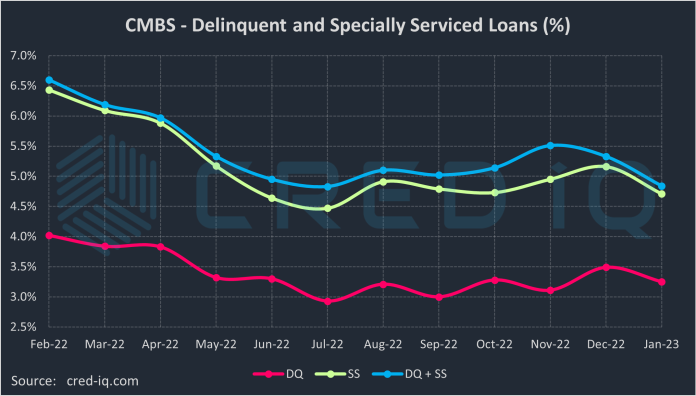
DQ = All delinquent CMBS loans in the conduit and SASB universe, including specially serviced and non-specially serviced loans SS = All specially serviced CMBS loans in the conduit and SASB universe, including current, delinquent and REO DQ + SS = All distressed CMBS loans in the conduit and SASB universe that are delinquent, specially serviced, or a combination of both
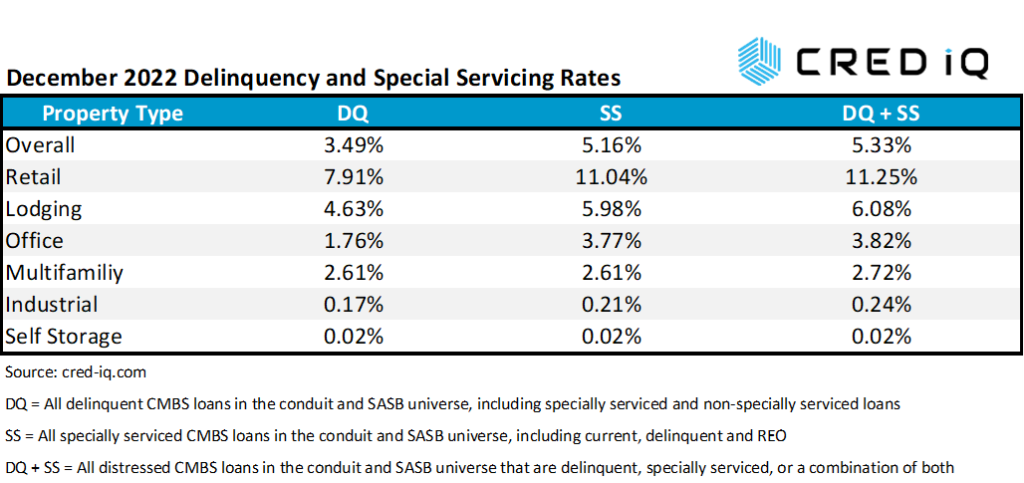
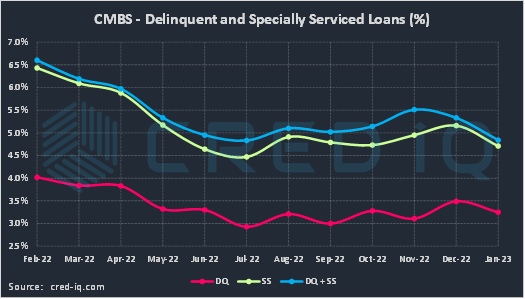
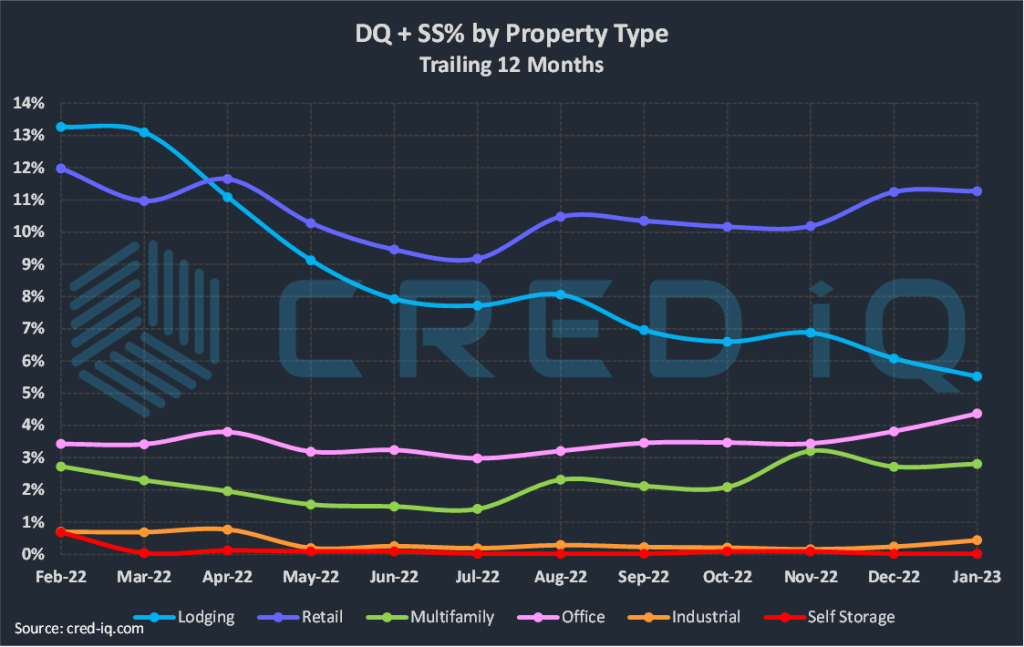
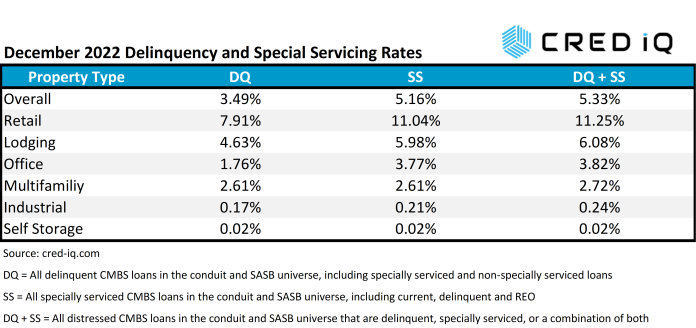
The CRED iQ delinquency rate for CMBS rose higher during the August 2022 reporting period, exhibiting the first month-over-month increase in over two years. This month, the delinquency rate, equal to the percentage of all delinquent specially serviced loans and delinquent non-specially serviced loans, for CRED iQ’s sample universe of $500+ billion in CMBS conduit and single asset single-borrower (SASB) loans was 3.21%, which was 28 bps higher than last month’s delinquency rate of 2.93%. CRED iQ’s special servicing rate, equal to the percentage of CMBS loans that are with the special servicer (delinquent and non-delinquent), increased month-over-month to 4.91% from 4.47%. The special servicing rate increased to its highest level over the past three months. Aggregating the two indicators of distress – delinquency rate and special servicing rate – into an overall distressed rate (DQ + SS%) equals 5.10% of CMBS loans that are specially serviced, delinquent, or a combination of both. The overall distressed rate increased compared to the prior month’s distressed rate of 4.47%. These distressed rates typically track slightly higher than special servicing rates as most delinquent loans are also with the special servicer.
DQ = All delinquent CMBS loans in the conduit and SASB universe, including specially serviced and non-specially serviced loans SS = All specially serviced CMBS loans in the conduit and SASB universe, including current, delinquent and REO DQ + SS = All distressed CMBS loans in the conduit and SASB universe that are delinquent, specially serviced, or a combination of both
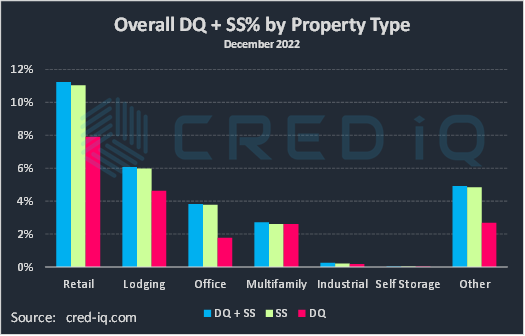
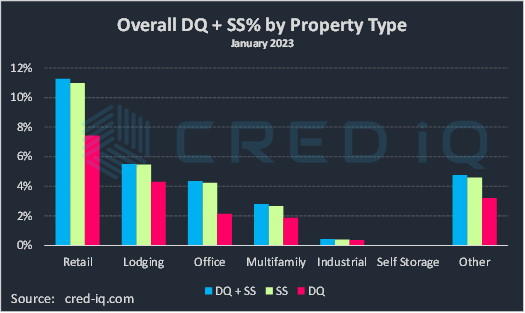
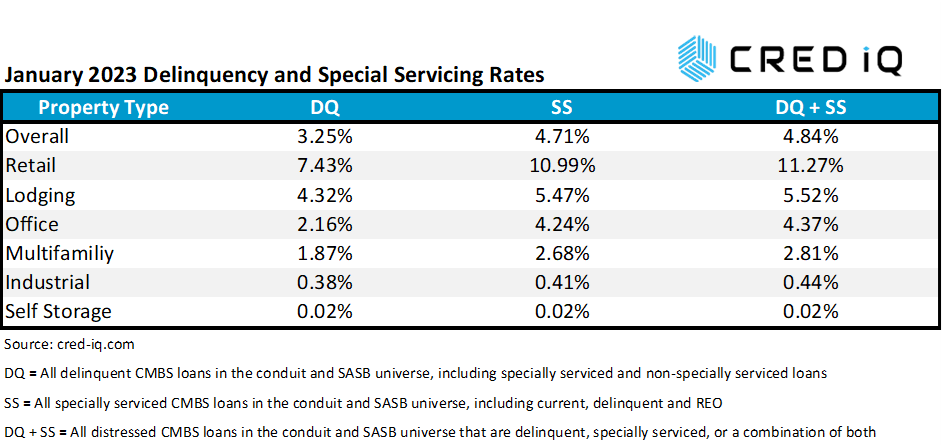
By property type, the delinquency rate modestly increased across several sectors, but property-specific delinquency rates generally remained lower compared to rates as of June 2022. The multifamily delinquency rate, equal to 1.90%, exhibited the most notable month-over-month increase. Higher multifamily delinquency was attributed to a $481 million mortgage, secured by 43 multifamily properties located across the Midwest and Southwest. The loan defaulted at maturity in July 2022 and subsequently transferred to special servicing. Based on the most recently reported financial statements for the multifamily portfolio, the properties were not producing sufficient cash flow to cover mortgage payments. An extension was requested by the borrower to allow time to facilitate a sale of the properties or attempt to refinance the debt.
Retail has the highest delinquency rate (5.91%) by property type, marking the fourth consecutive month since it surpassed the lodging delinquency rate, which was equal to 5.63% as of the August 2022 reporting period. The spike in the multifamily delinquency rate this month was enough to push it higher than the office delinquency rate of 1.52%. Industrial (0.29%) and self-storage (0.02%) delinquency rates were relatively unchanged compared to the prior month.
Special servicing rates increased sharply across most major property types during the August 2022 remittance period. The largest loan to transfer to special servicing this month was the aforementioned $481 million Midwest and Southwest multifamily portfolio. Additionally, a large loan, totaling $240 million, secured by a 20-property lodging portfolio owned by a joint venture between PIMCO and Fulcrum Hospitality also transferred, impacted the special servicing rate for hotels (7.93%).
The retail sector exhibited the highest month-over-month increase among special servicing rates by property type, primarily due to the transfers of several high-profile regional malls. The retail special servicing rate increased to 10.11%, compared to 8.9% from the prior month. Among notable regional malls securing loans that transferred to special servicing this month were Santa Monica Place in California, Clackamas Town Center in Oregon, and Riverchase Galleria in Alabama.
DQ + SS = All distressed CMBS loans in the conduit and SASB universe that are delinquent, specially serviced, or a combination of both
CRED iQ’s CMBS distressed rate (DQ + SS%) by property type accounts for loans that qualify for either delinquent or special servicing subsets. This month, the overall distressed rate for CMBS increased in tandem with increases in delinquency and special servicing rates. Higher property-specific special servicing rates were the main drivers behind increases in distressed rates across all property types. Regional malls secured many of the newly distressed loans with the highest individual allocated loan amounts. Two of the largest allocated loan amounts were the $285 million Santa Monica Place loan and the $216 million Clackamas Town Center loan.
CRED iQ is a commercial real estate data, analytics, and valuation platform providing actionable intelligence to CRE and capital markets investors. Subscribers to CRED iQ use the platform to identify valuable leads for leasing, lending, refinancing, distressed debt, and acquisition opportunities. Our data platform is powered by over $2.0 trillion of CMBS, CRE CLO, SBLL, and GSE Agency loan and property data.
This week, CRED iQ reviewed valuations for several assets that secure non-performing matured loans. Maturity defaults often can be a result of distress but may also be a mismatch in the timing of a refinancing effort or a sale closing. Non-performing matured loans are opportunities for distressed investors to step in and infuse capital in situations where traditional solutions may not be an option. Maturity defaults featured this week include a loan secured by a regional mall in the Detroit, MI MSA and a loan secured by suburban office properties located in the Cleveland, OH MSA.
CRED iQ valuations factor in a base-case (most likely), a downside (significant loss of tenants), and dark scenarios (100% vacant). For full access to the valuation reports as well as full CMBS loan reporting, with detailed financials, updated tenant information, and borrower contact information, sign up for a free trial here.
611,143 sf, Regional Mall, Taylor, MI [View Details]
This $64.8 million loan failed to pay off at its July 6, 2022 maturity date after the borrower, Brookfield Property Partners, did not secure refinancing. The loan had transferred to special servicing in June 2022, prior to the loan’s maturity default in anticipation of the difficulty with refinancing. The next steps of loan workout involve negotiations between the borrower and Rialto Capital Advisors, as special servicer. A maturity extension is a likely outcome that would help further de-lever the asset and postpone attempting to refinance an unfavorable property type such as regional malls in an unfavorable lending environment.
The loan is secured by 611,143 sf of in-line and anchor space at the 903,520-sf Southland Center Mall in Taylor, MI, which is approximately 15 miles southwest of Detroit. Macy’s and JCPenney serve as traditional anchors, although the Macy’s box is not collateral for the outstanding mortgage. Junior anchors at the mall include Best Buy and Cinemark, neither of which are compelling tenants from a revenue growth and longevity perspective. The mall was 91% occupied as of March 2022. Despite stable occupancy, CRED iQ’s valuation of the asset indicates a value deficiency compared to the outstanding loan amount. For the valuation report and loan-level details, click here.
This $39.5 million loan failed to pay off at maturity on July 6, 2022. The maturity default was expected, evidenced by a preemptive transfer of the loan to special servicing in May 2022. According to servicer commentary, the borrower submitted a proposal for a loan modification; however, the special servicer also commenced foreclosure proceedings to facilitate a workout. The loan, which has an interest rate of 5.217%, is secured by two suburban office properties located in the Cleveland, OH MSA.
Property Name
Size (sf)
Address
Allocated Loan Amount
Most Recent Appraisal
Most Recent Appraisal Date
CRED iQ Base-Case Value
Landerbrook Corporate Center
336,349
5900 – 5920 Landerbrook Drive Mayfield Heights, OH 44124
Landerbrook Corporate Center is a three-building office park located in Mayfield Heights, OH, 12 miles east of Cleveland. The property was 89% occupied as of March 2022 but faces near-term lease rollover risk. The property’s largest tenant, Progressive Insurance, plans to vacate at lease expiration. The tenant accounts for 34% of the office park’s NRA and the departure will leave the property approximately 55% occupied. For the full valuation report and loan-level details, click here.
Landerbrook Corporate Center – CD 2017-CD6 | WFCM 2017-C39
Metropolitan Plaza
Metropolitan Plaza is a six-story office building in Highland Hills, OH, located approximately 10 miles southeast of Cleveland. The property was nearly 100% occupied at loan origination in 2017 but the office building’s primary tenants vacated in recent years. Namely, the property’s former largest tenant, Victoria Fire & Casualty Co., vacated at lease expiration in September 2020. The tenant occupied 86,183 sf of space, accounting for approximately 53% of the building’s NRA. The office was 34% occupied as of March 2022. For the full valuation report and loan-level details, click here.
Metropolitan Plaza – CD 2017-CD6 | WFCM 2017-C39
1867-1871 Amsterdam Avenue
7,582 sf, Mixed Use (Office/Multifamily), New York NY [View Details]
This $4.1 million loan failed to pay off at its maturity date on June 6, 2022. Prior to the maturity default, the loan had transferred to special servicing in March 2021 due to delinquency. Without any successful attempts to cure the loan by the borrower, the next step in workout may be foreclosure; however, an extended workout period may be required given the property’s New York City jurisdiction. The loan is secured by a 7,582-sf mixed-use building located in the Sugar Hill submarket of Manhattan, NY. The property consists of primarily ground-floor retail space with a small multifamily component. The property has been unable to recover from pandemic-induced distress. For the full valuation report and loan-level details, click here.
This $3.7 million loan transferred to special servicing after a maturity default on June 6, 2022. This is the second maturity default for the loan. The loan was originated in July 2014 and had an original maturity date of June 2019. The loan failed to pay off at its June 2019 maturity date and a subsequent loan modification extended the maturity date to June 2022.
The loan is secured by a 39-unit multifamily property in Stanley, ND, which is located within the Bakken Formation. Shortly after loan origination, the property was adversely impacted by volatility in the oil and gas industry. After several years of severe fluctuations in demand, occupancy for the property appears to be stabilized. However, rental rates for the apartments in the region are significantly lower than rates when the loan was originated in 2014. For the full valuation report and loan-level details, click here.
CRED iQ is a commercial real estate data, analytics, and valuation platform providing actionable intelligence to CRE and capital markets investors. Subscribers to CRED iQ use the platform to identify valuable leads for leasing, lending, refinancing, distressed debt, and acquisition opportunities. Our data platform is powered by over $2.0 trillion of CMBS, CRE CLO, SBLL, and GSE Agency loan and property data.
This week, CRED iQ calculated updated valuations for five suburban office properties that have major tenants with lease expirations in the next six months. Featured leases include suburban office space in the Chicago, San Jose, and New York City MSAs. Lease expirations are opportunities for tenant reps to source prospects and find solutions for clients. Additionally, lease expirations can serve as a preemptive signal of distress for commercial real estate loans if prospective leasing the newly vacant space is low.
CRED iQ valuations factor in a base-case (most likely), a downside (significant loss of tenants), and dark scenarios (100% vacant). For access to the valuation reports as well as full CMBS loan reporting, including detailed financials, updated tenant information, and borrower contact information, sign up for a free trial here.
3500 Lacey Road
583,982 sf, Suburban Office, Downers Grove, IL [View Details]
HAVI Group has a 158,612-sf lease that is scheduled to expire on August 31, 2022 at 3500 Lacey Road, a 583,982-sf office building located in Downers Grove, IL. HAVI’s lease was originally set to expire in April 2025, but the tenant terminated its lease effective for the end of August 2022. The lease termination was related to HAVI Group’s affiliation as a vendor for McDonald’s, which moved its headquarters to the Fulton Market submarket of Chicago in 2018. HAVI Group will follow McDonald’s into Fulton Market with a new 100,000-sf lease at a nearby property.
HAVI Group leases approximately 27% of the NRA at 3500 Lacey Road, also known as Esplanade II. The office building secures an $85.8 million loan that has a maturity date in December 2029. With the departure of HAVI Group, occupancy is expected to decline to 62% from 89%. However, HAVI Group had been subletting two portions of its space. Hearthside Food Solutions had been subleasing 17,696 sf and appears to still be operational at the building. Donnelly Financial Solutions had been subleasing 22,132 sf from HAVI Group but no longer appears to have a presence at the building. As such, CRED iQ’s base-case occupancy assumption is approximately 65%, assuming that the sublease with Hearthside Food Solutions converts into a direct lease. For the valuation report and loan-level details, click here.
280,864-sf, Suburban Office, Campbell, CA [View Details]
Dialog Semiconductor has a 44,884-sf lease that is scheduled to expire on August 31, 2022 at Campbell Technology Park, a 280,864-sf office park located in Campbell, CA. Dialog Semiconductor is the property’s largest tenant, accounting for 16% of the NRA. The tenant was acquired by Renesas Electronics Corporation and appears to be vacating at lease expiration to consolidate operations. CRED iQ anticipates that the departure will leave the property 49% occupied.
The four-building office park secures a $60 million loan that matures in June 2025. Inclusive of Dialog Semiconductor, there was a total of 32% of the property’s NRA that was slated to expire in 2022. Occupancy at the property was approximately 76% in 2019 and 2020 and declined to 65% in 2021. The declines are troubling indicator of the property’s inability to attract replacement tenants. For the valuation report and loan-level details, click here.
124,108 sf, Office, White Plains, NY [View Details]
Sabra Dipping Company has a 36,345-sf lease that is scheduled to expire on September 30, 2022 at 777 Westchester Avenue, a 124,108-sf office building in White Plains, NY. The tenant will not renew after signing a 6,655-sf lease at the Gateway Building, which is more centrally located to the White Plains central business district than 777 Westchester Avenue. Sabra accounts for approximately 29% of the NRA at 777 Westchester Avenue. After the tenant’s relocation and downsize, occupancy at the property declined to approximately 67%.
The property at 777 Westchester Avenue is part of a five-building portfolio of adjacent office buildings that secure a $53.4 million mortgage. Prior to Sabra’s decision to vacate, the property had the highest occupancy of all five buildings. The portfolio totals over 671,000 sf with a weighted average occupancy of 65%. With nearly 235,000 sf of vacant space across the five-building office park, leasing activity may prove to be challenging not only for 777 Westchester but for the entire portfolio. For the valuation report and loan-level details, click here.
Vivial Media Holdings has a 60,026-sf lease that expires on December 31, 2022 at 3100 Research Boulevard, a 313,575-sf office building located in suburban Dayton, OH. Vivial Media was acquired by Thryv Inc. in January 2022. As part of the acquisition, CRED iQ expects Thryv to consolidate operations, with consideration for the firm’s established presence in the Dayton market with other subsidiaries.
Vivial Media’s lease accounts for 19% of the property’s GLA. Accounting for the tenant’s departure, occupancy at the property would decline to 51% from 70%. Additionally, the General Services Administration (GSA) leases 65,471 sf space, equal to 21% of NRA, on behalf of Defense Acquisition University through a lease that expires on November 30, 2022. The GSA is the property’s largest tenant and a renewal is needed to avoid further distress. The property secures a $10 million loan that matures in December 2030. For the valuation report and loan-level details, click here.
75,204 sf, Suburban Office, Riverside, CA [View Details]
National University has a 13,907-sf lease that is scheduled to expire on December 31, 2022 at the Spruce Street Professional Building, a 75,204-sf office building in Riverside, CA. According to the Department of Education, National University closed its location at the property in March 2020. The vacant space will need to be re-tenanted.
The Spruce Street Professional building secures a $9 million loan that matures in May 2027. The property was 90% occupied as of year-end 2021 but National University’s lease expiration will lower occupancy to 71.5%. For the valuation report and loan-level details, click here.
Spruce Street Professional Building – GSMS 2017-GS6
CRED iQ is a commercial real estate data, analytics, and valuation platform providing actionable intelligence to CRE and capital markets investors. Subscribers to CRED iQ use the platform to identify valuable leads for leasing, lending, refinancing, distressed debt, and acquisition opportunities. Our data platform is powered by over $2.0 trillion of CMBS, CRE CLO, SBLL, and GSE Agency loan and property data.
CMBS conduit and SBLL transactions incurred approximately $163 million in realized losses during July 2022 via the workout of distressed assets. CRED iQ identified 14 workouts classified as dispositions, liquidations, or discounted payoffs in July 2022. Of those 14 total workouts, half of the assets were resolved without a loss. Of the seven workouts resulting in losses, severities for the month of July ranged from 2% to 91.5%, based on outstanding balances at disposition. In total, realized losses in July were more than double the amount of realized losses in June. On a monthly basis, realized losses for CMBS conduit and SBLL transactions averaged approximately $137.8 million year-to-date.
Lodging properties accounted for half of the total number of distressed CMBS workouts this month, although only three of the loans secured by lodging properties incurred losses. Other property types with multiple distressed workouts included three distressed retail properties and two distressed mixed-use properties.
The liquidation of Koger Center represented the largest loss, by dollar amount and loss severity, among all distressed workouts this month. The liquidation alone accounted for 58% of the total realized losses for the month. Koger Center, an 854,944-sf multi-building suburban office campus in Tallahassee, FL, had been in special servicing since October 2019 and was auctioned in May 2022. Outstanding debt for the asset totaled $103.3 million and July’s liquidation resulted in a loss severity of 91.5% based on the balance at disposition.
Another notable distressed workout was The Mall at Stonecrest, which took over nine years to resolve. The 397,655-sf portion of a regional mall located 20 miles outside of Atlanta, GA secured $89.8 million in outstanding debt. A discounted payoff of the debt, funded by GeenLake Asset Management, resulted in a loss severity of 59% for the loan.
Excluding defeased loans, there was approximately $4.7 billion in securitized debt that was paid off or liquidated in July, which was a sharp decline compared to $7.8 billion in June 2022. In July, 7% of the loan resolutions were categorized as dispositions, liquidations, or discounted payoffs. The percentage of distressed workouts was 5% in the previous month. Approximately 12% of the loans were paid off with prepayment penalties.
By property type, office had the highest total of outstanding debt pay off in July with 35% of the total by balance. Among the largest payoffs was a pair of loans secured by Manhattan office towers. A $275.3 million mortgage secured by the HSBC Tower in Midtown and a $197.8 million loan secured by 100 Church Street in Lower Manhattan both paid off at maturity on July 1, 2022.
About CRED iQ
CRED iQ is a commercial real estate data, analytics, and valuation platform designed to unlock investment, financing, and leasing opportunities. CRED iQ provides real-time property, loan, tenant, ownership, and valuation data for over $2.0 trillion of commercial real estate.