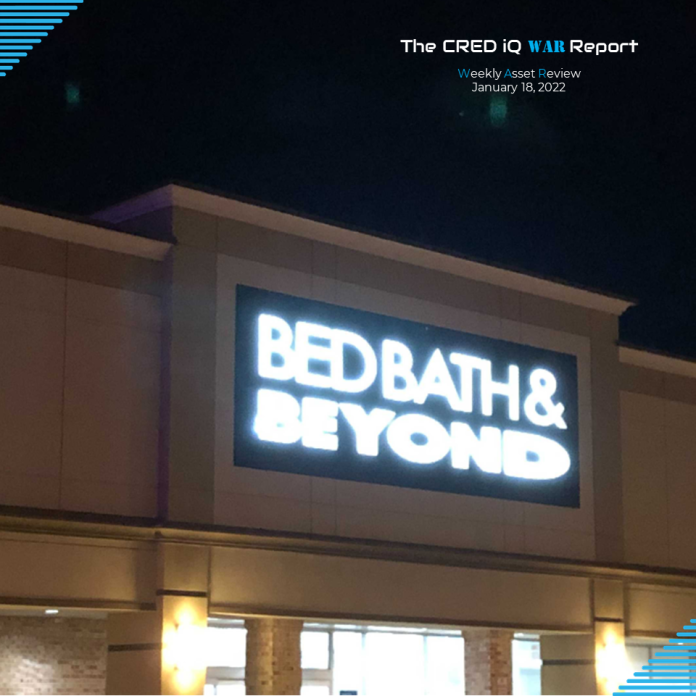

The iconic 20% off coupon will be available for use at fewer locations starting in February 2022 following the release of 37 locations by Bed Bath & Beyond that are slated for closure. The closures are the latest development in the retailer’s plan to close approximately 200 locations, which was originally announced in July 2020. The full list of closures can be found here.
CRED iQ examined the list and identified store locations that served as collateral for CMBS loans. At least 8 properties securing more than $300 million in outstanding debt were identified within CRED iQ’s CMBS universe that had exposure to impending Bed Bath & Beyond closures. Two of the loans are secured by properties that feature Bed Bath & Beyond as the largest tenant. Several of the closing stores had lease expirations scheduled for the end of January 2022, including the largest CMBS loan with exposure — the $133.5 million Waterfront at Port Chester. Many of Bed Bath & Beyond’s leases with near-term expirations likely have a low probability of renewal given the retailer’s closure initiatives and recent operational struggles.
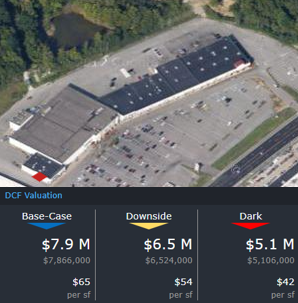
The largest Bed Bath & Beyond storefront slated for closures is the 50,000-sf location at Atlanta’s Perimeter Square, which secures a $35 million loan. Bed Bath & Beyond’s lease size at this location is nearly twice of size of the retail chain’s average footprint and accounts for 27% of the property’s NRA. The lease was scheduled to expire in January 2025 so Bed Bath and Beyond may have the ability to auction the lease or sublease the dark space for the remainder of its term. The loan was originated in October 2018, less than 4 years ago. The property’s second largest tenant, Havertys Furniture, has a 44,000-sf lease, accounting for 24% of the property’s NRA, that is scheduled to expire in July 2022. If Bed Bath & Beyond and Havertys Furniture both vacate or go dark, then third-largest tenant TJ Maxx will be able to terminate its lease or pay reduced rent.
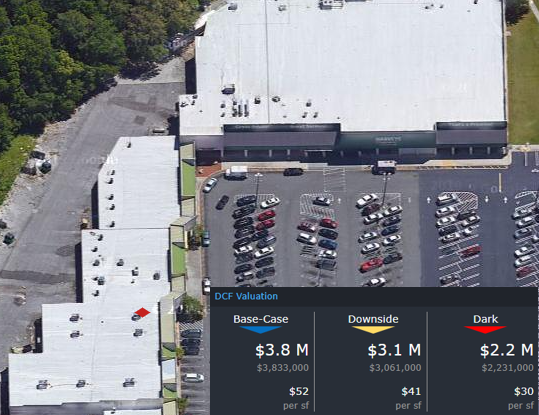
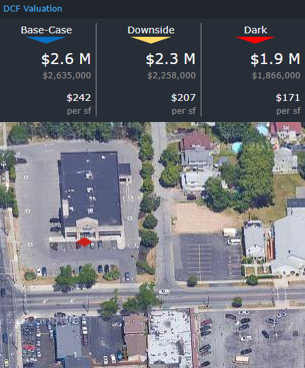
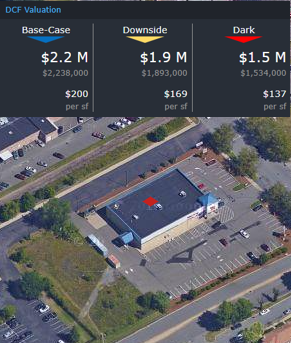
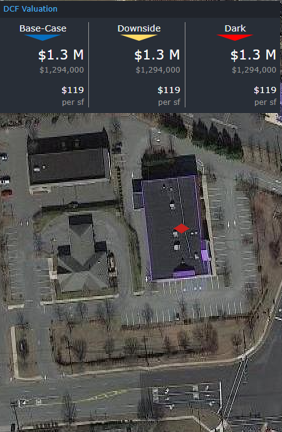
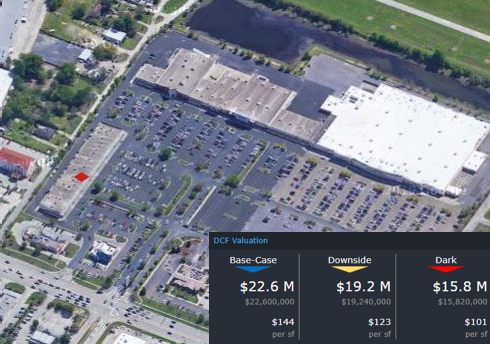
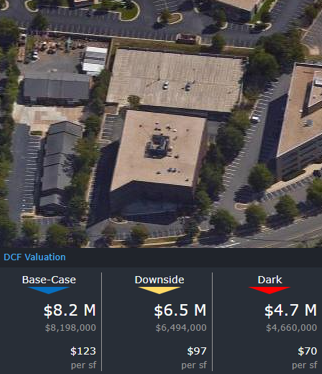
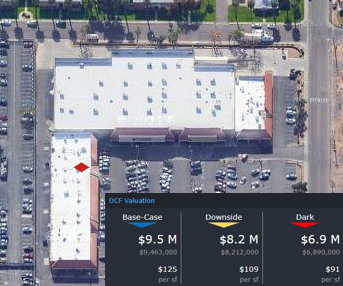
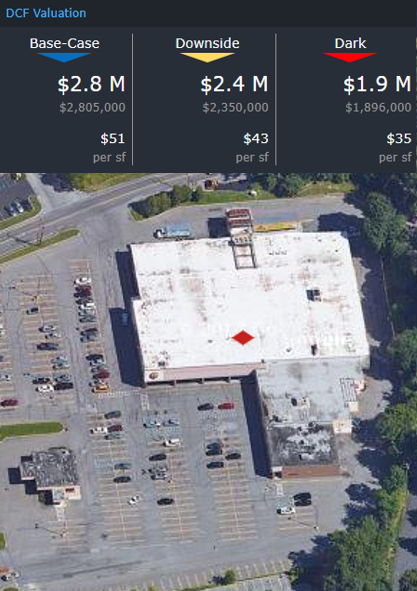
A list of all CMBS loans with exposure to Bed Bath and Beyond’s February closures appears below and includes links to free previews for each property on CRED iQ’s platform. CRED iQ subscribers also have access to updated valuations for each property, that account for the immediate loss of Bed Bath & Beyond as a tenant. CRED iQ valuations factor in a base-case (most likely), a downside (significant loss of tenants), and dark scenarios (100% vacant).
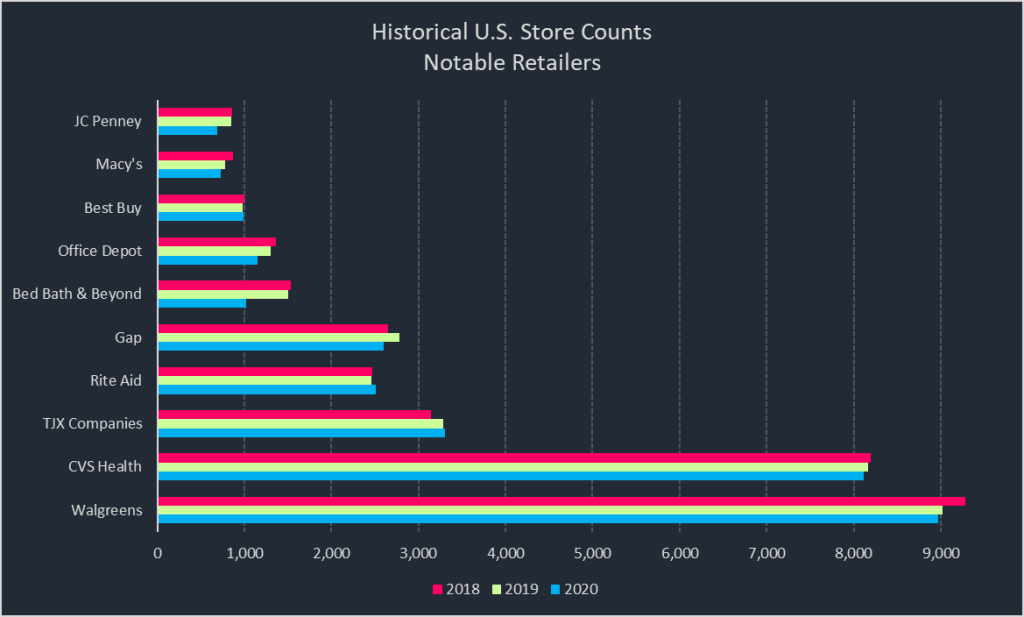
Bed Bath & Beyond is one of several retailers that announced store closures over the past couple of months. On a larger scale, Bed Bath & Beyond closed more than 500 locations between year-end 2018 and year-end 2020. Year end is an opportune time for retailers to assess the performance of store fleets to identify underperformers, while still capitalizing on an end-of-year surge of holiday sales. Pharmacy chains CVS Health and Rite Aid both announced store closure initiatives in late-2021. All three major pharmacy retailers — Walgreens, CVS, and Rite Aid — have reduced physical store counts since 2018. Additionally, department store chain Macy’s continued to follow through with its pre-pandemic store optimization plan to close approximately 125 locations by announcing the permanent closure of six of those locations in early-2022. For a silver lining, not all retailers have been closing stores and optimizing locations. Dollar General, Dollar Tree, and TJ Maxx have opened more store locations on a net basis since 2018.
About CRED iQ
CRED iQ is a commercial real estate data, analytics, and valuation platform providing actionable intelligence to CRE and capital markets investors. Subscribers to CRED iQ use the platform to identify valuable leads for leasing, lending, refinancing, distressed debt, and acquisition opportunities. Our data platform is powered by over $2.0 trillion of CMBS, CRE CLO, SBLL, Ginnie Mae, FHA/HUD, and Freddie Mac loan and property data.
This week, the CRED iQ team will be in attendance at CREFC’s Conference in Miami. Feel free to drop us a line if you want to talk the latest in commercial real estate analytics or simply browse some vacant retail storefronts along Lincoln Road.
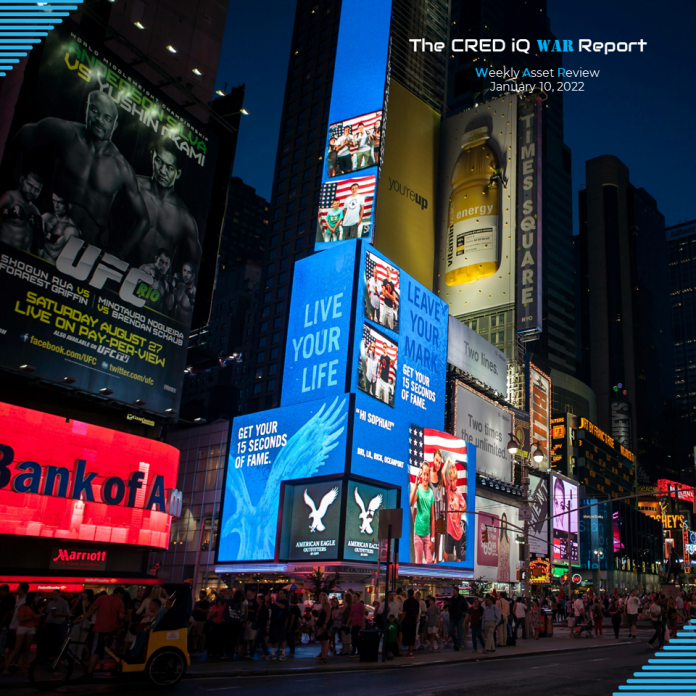
In this week’s WAR Report, CRED iQ calculated real-time valuations for 5 distressed properties that have transferred to special servicing within the past 2 months. Among these is a Times Square retail property and 2 office properties with evidence of tenants vacating in favor of higher quality alternatives. The 2 highlighted office properties contributed to recent increases in CRED iQ’s office sector delinquency rate, which saw its second consecutive increase to 2.74%. Click the link below for a list of all office properties.
CRED iQ valuations factor in a base-case (most likely), a downside (significant loss of tenants), and dark scenarios (100% vacant). For full access to the valuation reports as well as full CMBS loan reporting, including detailed financials, updated tenant information, and borrower contact information, sign up for a free trial here.
1551 Broadway
25,600 sf, Retail and LED Signage, Times Square, NY[View Details]
This $180 million loan transferred to special servicing on November 15, 2021 shortly after a 60-day forbearance expired. The loan was originally scheduled to mature in July 2021, but the borrowing entity, a co-ownership between Wharton Properties (90%) and SL Green (10%), was unable to secure fund to take out the debt. The 60-day forbearance was granted at loan maturity to allow additional time for refinancing. Potentially complicating matters is a $103.8 million mezzanine loan that was funded in 2017.
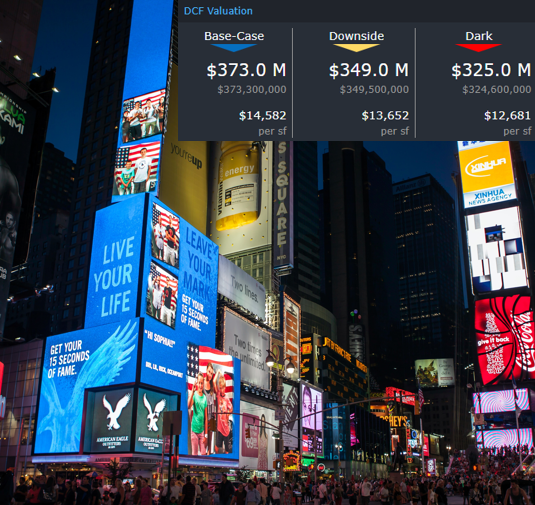
The loan is secured by a 3-story, 25,600-sf retail building located in Times Square. Included as collateral is 14,500 sf of LED signage that spans an additional 4 stories on top of the building. The property is entirely leased by American Eagle Outfitters pursuant to a lease that expires in February 2024. The retail store was temporarily closed during the pandemic and media reports have indicated the possibility of American Eagle vacating at lease expiration. Reports of the space being marketed to prospective tenants started emerging in early 2020. The property is one of the best positioned within Times Square. The average daily pedestrian count along Broadway, between W 46th Street and W 47th Street, was 175,153 during December 2021, which was slightly higher than 2019 pre-pandemic levels and more than 140% higher than 2020 levels.
American Eagle paid annualized total base rent of $21.3 million in 2021. Prior to loan origination, a little over 50% of total base rent was attributed to the LED signage. For the full valuation report and loan-level details, click here.
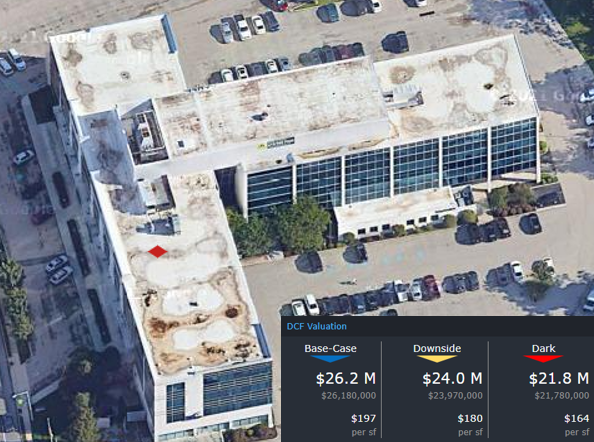
This $29.3 million loan transferred to special servicing on November 16, 2021 due to the lease expiration of the collateral property’s largest tenant, Hamilton Lane. The loan is secured by a 4-story, 113,115-sf office building in Bala Cynwyd, PA, approximately 5 miles northwest of Center City Philadelphia. Hamilton Lane occupied 52,045 sf and accounted for 39% of the building’s GLA. The former tenant vacated One Presidential in favor of Seven Towers Bridge, a new headquarters in Conshohocken, PA. Hamilton Lane leased space at two other office properties in Bala Cynwyd and cited a need to consolidate its employees into one location; although, a flight to quality appeared to also play a factor. Seven Tower Bridge is a newly constructed development with superior amenities than One Presidential. In addition to One Presidential losing its largest tenant, Novak Francella LLC, accounting for 11% of the GLA, vacated at lease expiration in July 2021.
LNR, as special servicer, will discuss potential workouts with the borrower, Keystone Property Group. Foreclosure or receivership are possibilities given low occupancy at the collateral and uncertain leasing opportunities for such a large space. Altogether, Hamilton Lane left 3 large vacancies in the Bala Cynwyd submarket. CRED iQ estimates occupancy at the property to be approximately 31%.
One potential complication for workout is a $3.6 million subordinate mortgage that was originated by The Bancorp Bank. The payment waterfall for the senior and subordinate components of the mortgage was structured as pro-rata, but the transfer to special servicing shifted the waterfall to a sequential pay structure. For the full valuation report and loan-level details, click here.
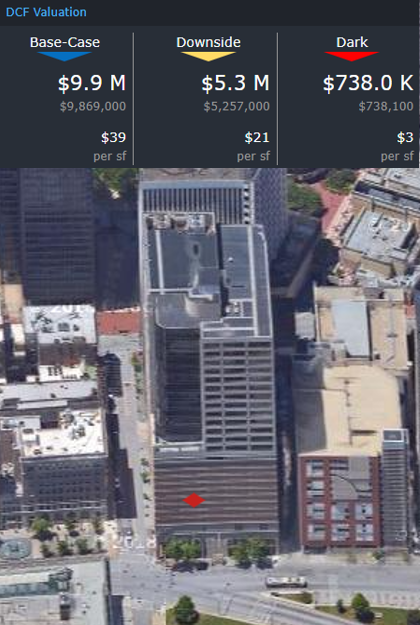
This $11.8 million loan transferred to special servicing on November 12, 2021 due to imminent monetary default. The loan is secured by leasehold interest in a 28-story office tower in the Baltimore, MD CBD. The property’s largest tenant, law firm Silverman Thompson, is vacating at lease expiration in February 2022 in favor of 400 East Pratt Street, which overlooks the Inner Harbor. Silverman Thompson’s lease accounted for 10% of the property’s GLA. The second-largest tenant at the property, Alperstein & Diener, accounts for 4% of the GLA and has a lease expiration in April 2022.
The property’s two ground leases will be considerations for workout negotiations. The property’s main ground lease expires in 2112. A second ground lease covers parking access to the building and expires in 2033. Annual ground rent was last reported to be approximately $375,000.
Occupancy at 201 North Charles has steadily declined for 3 consecutive years from 80% in 2019 to 70% in 2021 as the CBD has fallen out of favor with office tenants. Many high-profile tenants, including T. Rowe Price, have moved or are planning moves to nearby Harbor Point — again continuing with the theme of flight to quality mentioned with One Presidential. CRED iQ’s estimated occupancy for the property is 60%. For the full valuation report and loan-level details, click here.
This $4.5 million loan transferred to special servicing on December 3, 2021 following the loss of the collateral property’s anchor tenant, ShopRite. The loan is secured by a 54,876-sf neighborhood center in Newburgh, NY, approximately 70 miles north of Manhattan along the Hudson River. ShopRite terminated its lease at the property and vacated in September 2021. The tenant occupied 41,676 sf, accounting for 76% of the GLA, pursuant to a lease that was scheduled to expire in June 2025. However, ShopRite had a termination option at any time as long as six months’ notice was provided. Replacement with another grocery tenant may be plausible, but servicer commentary for the loan indicates significant levels of deferred maintenance. The property’s second-largest tenant is Family Dollar with a lease that expires in 2037 and accounts for 15% of the GLA. Assuming the absence of any co-tenancy clauses tied to ShopRite’s lease termination, CRED iQ’s estimated occupancy is equal to 24%. For the full valuation report and loan-level details, click here.
5,800 sf, Mixed Use (Retail/Multifamily), Manhattan, NY[View Details]
This $3.0 million loan transferred to special servicing on November 26, 2021. The loan is secured by a 4-story, 5,800-sf mixed-use property located in the Upper East Side of Manhattan, NY. The building contains 6 multifamily units and a ground-floor retail unit. The retail unit was previously occupied by TD Ameritrade pursuant to a lease that expired in March 2021, but the tenant went dark as early as July 2020. Additionally, the borrower has been unresponsive with providing the servicer updated financials for the property. The latest set of financials available were from 2018. For the full valuation report and loan-level details, click here.
CRED iQ is a commercial real estate data, analytics, and valuation platform providing actionable intelligence to CRE and capital markets investors. Subscribers to CRED iQ use the platform to identify valuable leads for leasing, lending, refinancing, distressed debt, and acquisition opportunities. Our data platform is powered by over $2.0 trillion of CMBS, CRE CLO, SBLL, Ginnie Mae, FHA/HUD, and Freddie Mac loan and property data.
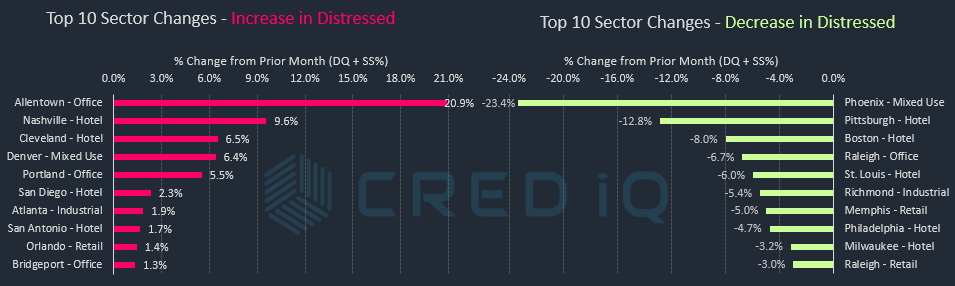
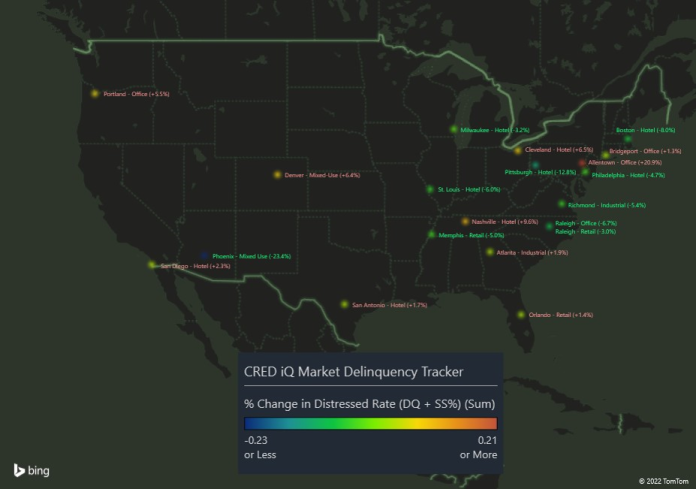
CRED iQmonitors distressed rates (DQ + SS%) and market performance for nearly 400 MSAs across the United States, covering over $900 billion in outstanding CRE debt. Distressed rates for the current month and month-over-month changes are presented below, by property type, for the 50 largest markets. This month, distress in the office sector became more apparent, accounting for four of the 10 largest percentage increases in distress by market-sector. Conversely, the hotel and lodging sectors continue to exhibit improvement — nine of the 10 biggest improvements by market-sector distress were for retail or lodging.
The Chicago market exhibited notable increases in distress this month, which was largely caused by the transfer of two loans to special servicing. The $100 million 135 South LaSalle loan transferred to special servicing due to insufficient cash flow following the departure of Bank of America from the collateral property at lease expiration in July 2021. The collateral is a 44-story, 1.3 million-sf office tower, but is classified by servicer data as mixed-use (other) due to a ground-floor retail component. Additionally, the $240 million 181 West Madison loan transferred to special servicing this month due to the bankruptcy of the sponsor, HNA Group. The collateral is a 50-story office tower located in the Central Loop of the Chicago CBD. This is the second consecutive month that Chicago office has appeared as a market-sector with one of the 10 largest month-over-month increases in distress.
The Raleigh office market exhibited the second largest month-over-month increase in distress following the delinquency of the $20.8 million Brier Creek Corporate Center I & II loan. Occupancy at the collateral property declined to 24% after its largest tenant, biopharmaceutical company UCB, vacated at lease expiration in March 2021.
The Top 5 distressed markets remained unchanged from the prior month. The Minneapolis MSA has the highest overall distressed rate at 23.1%. New Orleans (15.28%), Louisville (14.19%), Cleveland (11.76%), and Milwaukee (10.98%) round out the list of markets with the highest rates of distress. Following an increase in distress within the Allentown MSA, Sacramento (0.54%) now has firm position as the market with the lowest percentage of distress among the Top 50 MSAs.
New York-Northern New Jersey-Long Island, NY-NJ-PA MSA
$6,416.1
5.5%
-0.3%
Hotel
$1,619.4
43.1%
-1.7%
Industrial
$07.5
0.5%
0.0%
Multifamily
$511.6
1.5%
-0.2%
Office
$1,285.2
3.2%
0.3%
Other
$1,488.8
6.7%
-0.6%
Retail
$1,503.7
11.2%
-2.4%
Self Storage
$0.0
0.0%
0.0%
Orlando-Kissimmee, FL MSA
$250.4
2.3%
-1.5%
Hotel
$161.2
5.7%
-0.7%
Industrial
$0.0
0.0%
0.0%
Multifamily
$01.9
0.0%
0.0%
Office
$47.1
9.5%
-0.1%
Other
$0.0
0.0%
0.0%
Retail
$40.2
4.7%
-15.7%
Self Storage
$0.0
0.0%
0.0%
Philadelphia-Camden-Wilmington, PA-NJ-DE-MD MSA
$860.9
4.7%
-0.6%
Hotel
$346.0
38.7%
-1.7%
Industrial
$0.0
0.0%
0.0%
Multifamily
$110.2
1.2%
-0.1%
Office
$131.5
3.4%
0.8%
Other
$47.8
3.5%
-0.2%
Retail
$225.5
9.5%
-3.8%
Self Storage
$0.0
0.0%
0.0%
Phoenix-Mesa-Scottsdale, AZ MSA
$409.4
2.3%
0.0%
Hotel
$38.9
2.3%
-0.1%
Industrial
$10.2
2.1%
-0.1%
Multifamily
$0.0
0.0%
0.0%
Office
$23.7
1.1%
0.0%
Other
$180.5
25.5%
0.9%
Retail
$156.1
7.4%
0.1%
Self Storage
$0.0
0.0%
0.0%
Pittsburgh, PA MSA
$141.2
2.9%
-0.3%
Hotel
$110.0
39.9%
-1.8%
Industrial
$0.0
0.0%
0.0%
Multifamily
$0.0
0.0%
0.0%
Office
$15.3
1.6%
-0.1%
Other
$08.0
2.1%
0.0%
Retail
$07.8
1.2%
0.0%
Self Storage
$0.0
0.0%
0.0%
Portland-Vancouver-Beaverton, OR-WA MSA
$483.3
6.9%
-1.1%
Hotel
$471.5
44.1%
-13.9%
Industrial
$0.0
0.0%
0.0%
Multifamily
$10.2
0.2%
0.0%
Office
$01.6
0.6%
0.0%
Other
$0.0
0.0%
0.0%
Retail
$0.0
0.0%
0.0%
Self Storage
$0.0
0.0%
0.0%
Raleigh-Cary, NC MSA
$43.7
1.2%
-2.0%
Hotel
$11.9
3.8%
-18.0%
Industrial
$0.0
0.0%
0.0%
Multifamily
$0.0
0.0%
0.0%
Office
$20.8
6.7%
6.7%
Other
$0.0
0.0%
0.0%
Retail
$10.9
3.0%
-6.1%
Self Storage
$0.0
0.0%
0.0%
Richmond, VA MSA
$128.9
3.8%
-0.5%
Hotel
$39.4
15.1%
-2.7%
Industrial
$06.8
5.4%
0.3%
Multifamily
$0.0
0.0%
0.0%
Office
$0.0
0.0%
0.0%
Other
$0.0
0.0%
0.0%
Retail
$82.6
15.8%
-2.4%
Self Storage
$0.0
0.0%
0.0%
Riverside-San Bernardino-Ontario, CA MSA
$366.2
3.8%
-0.3%
Hotel
$82.4
20.7%
2.3%
Industrial
$0.0
0.0%
0.0%
Multifamily
$0.0
0.0%
-0.2%
Office
$0.0
0.0%
0.0%
Other
$0.0
0.0%
0.0%
Retail
$283.7
13.1%
0.3%
Self Storage
$0.0
0.0%
0.0%
Sacramento-Arden-Arcade-Roseville, CA MSA
$30.4
0.5%
-0.1%
Hotel
$05.8
1.6%
0.0%
Industrial
$0.0
0.0%
0.0%
Multifamily
$0.0
0.0%
0.0%
Office
$10.9
1.9%
0.2%
Other
$0.0
0.0%
0.0%
Retail
$13.7
1.7%
0.0%
Self Storage
$0.0
0.0%
-3.1%
Salt Lake City, UT MSA
$47.2
1.3%
-0.3%
Hotel
$47.2
16.3%
-2.8%
Industrial
$0.0
0.0%
0.0%
Multifamily
$0.0
0.0%
0.0%
Office
$0.0
0.0%
0.0%
Other
$0.0
0.0%
0.0%
Retail
$0.0
0.0%
0.0%
Self Storage
$0.0
0.0%
0.0%
San Antonio, TX MSA
$153.1
2.4%
-0.3%
Hotel
$02.9
0.8%
-3.9%
Industrial
$0.0
0.0%
0.0%
Multifamily
$04.9
0.1%
0.0%
Office
$0.0
0.0%
0.0%
Other
$0.0
0.0%
0.0%
Retail
$143.7
16.3%
-0.1%
Self Storage
$01.5
1.0%
0.0%
San Diego-Carlsbad-San Marcos, CA MSA
$216.4
1.9%
-0.1%
Hotel
$79.3
3.9%
0.0%
Industrial
$0.0
0.0%
0.0%
Multifamily
$0.0
0.0%
-0.2%
Office
$0.0
0.0%
0.0%
Other
$20.7
3.2%
-0.1%
Retail
$116.4
9.7%
-0.2%
Self Storage
$0.0
0.0%
0.0%
San Francisco-Oakland-Fremont, CA MSA
$307.6
1.3%
-0.1%
Hotel
$189.6
8.2%
-0.4%
Industrial
$0.0
0.0%
0.0%
Multifamily
$21.0
0.3%
0.0%
Office
$18.8
0.2%
0.0%
Other
$30.6
1.7%
-0.9%
Retail
$47.7
3.7%
0.1%
Self Storage
$0.0
0.0%
0.0%
San Jose-Sunnyvale-Santa Clara, CA MSA
$104.5
0.8%
-0.3%
Hotel
$89.8
4.5%
-1.6%
Industrial
$0.0
0.0%
0.0%
Multifamily
$0.0
0.0%
0.0%
Office
$14.7
0.2%
0.0%
Other
$0.0
0.0%
-0.6%
Retail
$0.0
0.0%
0.0%
Self Storage
$0.0
0.0%
0.0%
Seattle-Tacoma-Bellevue, WA MSA
$144.5
0.8%
-0.5%
Hotel
$137.8
9.0%
-6.7%
Industrial
$0.0
0.0%
0.0%
Multifamily
$0.0
0.0%
0.0%
Office
$0.0
0.0%
0.0%
Other
$0.0
0.0%
0.0%
Retail
$06.7
0.4%
0.0%
Self Storage
$0.0
0.0%
0.0%
St. Louis, MO-IL MSA
$414.7
9.9%
0.3%
Hotel
$58.3
20.5%
0.0%
Industrial
$0.0
0.0%
0.0%
Multifamily
$23.2
1.4%
0.1%
Office
$107.6
19.4%
0.2%
Other
$26.2
5.1%
-1.0%
Retail
$199.4
19.7%
-0.2%
Self Storage
$0.0
0.0%
0.0%
Tampa-St. Petersburg-Clearwater, FL
$292.8
3.2%
-0.3%
Hotel
$21.8
1.9%
-1.2%
Industrial
$0.0
0.0%
0.0%
Multifamily
$02.6
0.0%
0.0%
Office
$23.9
4.2%
0.7%
Other
$0.0
0.0%
0.0%
Retail
$244.5
26.0%
-1.2%
Self Storage
$0.0
0.0%
0.0%
Tucson, AZ MSA
$171.8
5.9%
0.2%
Hotel
$01.4
0.6%
0.1%
Industrial
$0.0
0.0%
0.0%
Multifamily
$0.0
0.0%
0.0%
Office
$0.0
0.0%
0.0%
Other
$0.0
0.0%
0.0%
Retail
$170.4
25.2%
0.7%
Self Storage
$0.0
0.0%
0.0%
Virginia Beach-Norfolk-Newport News, VA-NC MSA
$121.8
2.9%
-2.3%
Hotel
$09.4
2.0%
-3.2%
Industrial
$21.2
13.4%
0.3%
Multifamily
$0.0
0.0%
0.0%
Office
$0.0
0.0%
0.0%
Other
$0.0
0.0%
0.0%
Retail
$91.3
11.7%
-8.3%
Self Storage
$0.0
0.0%
0.0%
Washington-Arlington-Alexandria, DC-VA-MD-WV MSA
$828.4
3.0%
-0.1%
Hotel
$51.0
5.5%
0.6%
Industrial
$11.2
2.0%
0.0%
Multifamily
$01.3
0.0%
0.0%
Office
$366.3
5.7%
0.3%
Other
$249.7
12.8%
-0.3%
Retail
$149.0
5.7%
-0.4%
Self Storage
$0.0
0.0%
0.0%
Grand Total
$26,843.8
4.1%
-0.4%
About CRED iQ
CRED iQ is a commercial real estate data, analytics, and valuation platform providing actionable intelligence to CRE and capital markets investors. Subscribers to CRED iQ use the platform to identify valuable leads for leasing, lending, refinancing, distressed debt, and acquisition opportunities. Our data platform is powered by over $2.0 trillion of CMBS, CRE CLO, SBLL, Ginnie Mae, FHA/HUD, and Freddie Mac loan and property data.
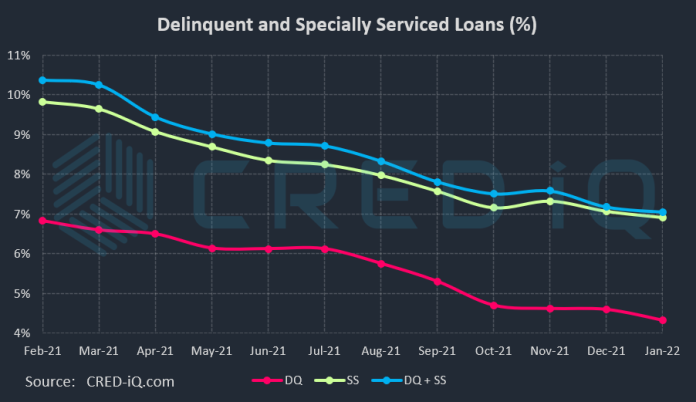
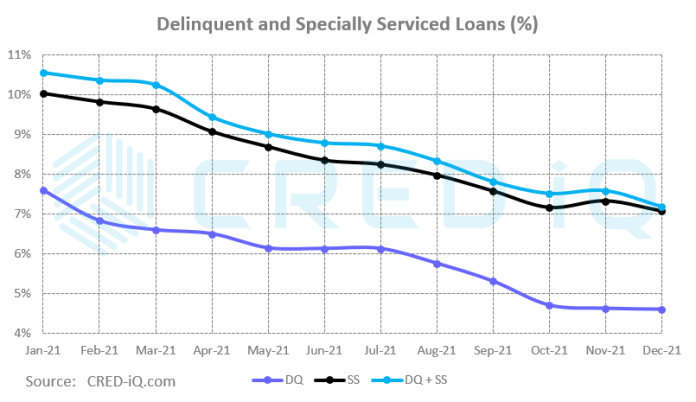
The CRED iQ overall delinquency rate had a modest decline this month, which marks its 18th consecutive improvement. The delinquency rate, equal to the percentage of all delinquent specially serviced loans and delinquent non-specially serviced loans, for CRED iQ’s sample universe of $500+ billion in CMBS conduit and single-asset single-borrower (SASB) loans was 4.59%, which compares to the prior month’s rate of 4.62%. Additionally, CRED iQ’s special servicing rate, equal to the percentage of CMBS loans that are with the special servicer (delinquent and non-delinquent), declined month-over-month to 7.06% from 7.32%, after a brief increase in the prior month. The special servicing rate has declined 11 out of the 12 previous months. Aggregating the two indicators of distress – delinquency rate and special servicing rate – into an overall distressed rate (DQ + SS%) equals 7.18% of CMBS loans that are specially serviced, delinquent, or a combination of both. The overall distressed rate declined compared to the prior month rate of 7.58% given both declines in the delinquency and special servicing rates.
DQ = All delinquent CMBS loans in the conduit and SASB universe, including specially serviced and non-specially serviced loans SS = All specially serviced CMBS loans in the conduit and SASB universe, including current, delinquent and REO DQ + SS = All distressed CMBS loans in the conduit and SASB universe that are delinquent, specially serviced, or a combination of both
By property type, the delinquency rate for office notably increased to 2.74%, compared to 2.18% in the prior month. The increase in office delinquency was carried by two loans secured by Chicago office buildings — 181 West Madison and 135 South LaSalle. The $100 million 135 South LaSalle loan, which was featured in CRED iQ’s July 20, 2021 WAR Report, became delinquent due to insufficient cash flow after the collateral property’s largest tenant, Bank of America, vacated at lease expiration. The $240 million 181 West Madison loan became delinquent following the bankruptcy filing of the loan sponsor, HNA Group. The $1.2 billion 245 ParkAvenue loan had a similar fate last month.
New delinquencies pushed the office delinquency rate to its highest level in 12 months. Both of the newly delinquent Chicago office loans transferred to special servicing this month, resulting in the second consecutive increase in the office special servicing rate.
Lodging continues to have the highest delinquency (9.71%) and special servicing (14.16%) rates among property types, followed by retail delinquency (7.52%) and special servicing (12.23%) rates. Both lodging and retail exhibited improvements compared to the prior month, which is a trend that has been consistent over the past year as those loans continue to be worked out and resolved.
DQ = All delinquent CMBS loans in the conduit and SASB universe, including specially serviced and non-specially serviced loans SS = All specially serviced CMBS loans in the conduit and SASB universe, including current, delinquent and REO DQ + SS = All distressed CMBS loans in the conduit and SASB universe that are delinquent, specially serviced, or a combination of both
CRED iQ also monitors an overall distressed rate (DQ + SS%) by property type to account for loans that qualify for either delinquent or special servicing subsets. The overall distressed rates typically track slightly higher than special servicing rates as most delinquent loans are also with the special servicer. This month, overall distressed rates for office and self-storage increased while lodging, retail, multifamily, and industrial declined. The 3 largest loans to transfer to special servicing this month were also delinquent. Two of those loans are secured by the aforementioned office properties located in the Chicago, IL MSA. The third loan, and 2nd largest transfer, was the $180 million 1551 Broadway loan, which is secured by Times Square retail. For additional information for these 3 loans, click View Details below:
CRED iQ is a commercial real estate data, analytics, and valuation platform providing actionable intelligence to CRE and capital markets investors. Subscribers to CRED iQ use the platform to identify valuable leads for leasing, lending, refinancing, distressed debt, and acquisition opportunities. Our data platform is powered by over $2.0 trillion of CMBS, CRE CLO, SBLL, Ginnie Mae, FHA/HUD, and Freddie Mac loan and property data.
In our first WAR Report for 2022, CRED iQ examines the impact of commercial real estate values following a December 21, 2021 announcement by Rite Aid disclosing the closure of 63 stores, some of which have already been shuttered. The announcement follows a similar initiative by CVS Health, which CRED iQ detailed in its December 14, 2021 WAR Report. Rite Aid has already identified store locations that will be closed and began its initiative in November 2021; although, the firm has not disclosed specific locations. The store closure initiative was driven by a need to improve profitability for the company and, as such, unproductive stores in less desirable locations are at risk of being shuttered.
Rite Aid closures are not a new development for commercial real estate investors. The retailer has exited several markets in past years and notably sold approximately 2,000 stores to Walgreens in 2017. Many of the acquired stores were redundant (located within 1 mile) with Walgreens’ incumbent operations and were subsequently closed. In many cases, Walgreens honored Rite Aid’s lease terms to maintain control of the space and limit competition; but examples of subleases came in the form of an agreement with Dollar Tree, O’Reilly Auto Parts, or local wine and spirits shops.
CRED iQ leveraged its platform to identify properties leased to Rite Aid, including single-tenant net lease properties and multi-tenant retail properties. CRED iQ identified 185 properties securing $1.7 billion in outstanding mortgage debt with Rite Aid as tenant. About half of the 185 properties are single tenant or net lease properties. Classifying properties by lease expiration date, CRED iQ was further able to isolate properties with Rite Aid lease expirations over the next 3 years as shown in the table below:
Lease Expiration Year
# of Properties
Aggregate Outstanding Balance ($000’s)
2021 or Earlier
3
$1,227
2022
2
$2,937
2023
5
$9,214
2024
7
$12,155
For a copy of the comprehensive list of all CMBS properties with Rite Aid as a tenant — including nearly 100 single tenant locations, please reach out to Shane Beeson (shane@cred-iq.com) or click the link below.
[2] a complete list of all Rite Aid locations in the US (more than 2,400) and
[3] a list of former Rite Aid locations. Following the 2017 Walgreens acquisition of nearly 2,000 Rite Aid stores, many rent rolls have not been updated to reflect new tenant names. As such, data reported for many properties still indicate Rite Aid is a tenant, whereas the location has since been converted to a Walgreens. A few of these examples were highlighted below and show timely examples of the aftermath of a net lease retail closure.
This week’s WAR Report focuses specifically on singlet tenant properties. Single tenant properties lease to Rite Aid generally trade at higher capitalization rates than their CVS or Walgreens counterparts. Location within a region of commerce is also a key factor and many Rite Aids had inferior locations compared to competing pharmacies. This was magnified in the 2017 acquisition by Walgreens that resulted in several Rite Aid closures. Featured properties below include single tenant retail locations with near-term lease expirations or former Rite Aid locations that secure loans in special servicing.
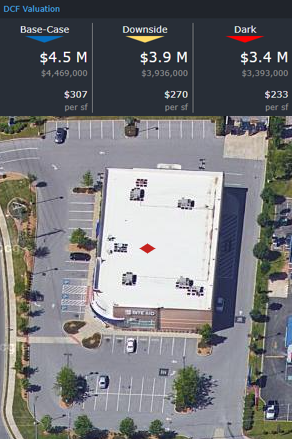
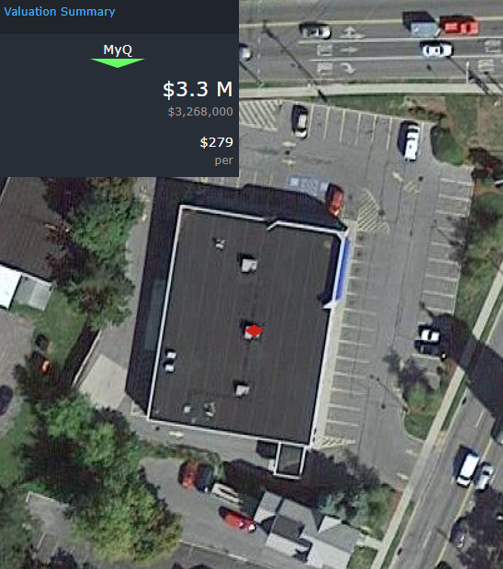
CRED iQ valuations factor in a base-case (expected lease renewal at in-place rent), a downside (lease renewal at 50% reduction in rent), and dark scenarios (100% vacant). Select valuations are provided for the properties below. For full access to the valuation reports including all 3 valuation scenarios as well as full CMBS loan reporting, with detailed financials, updated tenant information, and borrower contact information, sign up for a free trial here.
This specially serviced property in Murfreesboro, TN is physically vacant but is leased to Walgreens through September 2028. The property has an allocated loan amount of $3.1 million and is part of a 5-building net lease portfolio that secures a $10.1 million mortgage. Rite Aid was the initial tenant at loan origination, but the lease was assumed by Walgreens as part of its 2017 acquisition. Walgreens subsequently closed the store due to its proximity to a superior store location less than a half mile away. The superior Walgreens location is positioned at a nearby signalized intersection, which has more frequent cross traffic and is closer to an interchange with Interstate 24. The portfolio loan transferred to special servicing on June 21, 2021 due to non-compliance with a cash management trigger, likely related to the vacant building. Walgreens has made the vacant building available for sublease; however, use restrictions generally preclude other pharmacy operations. For the full valuation report and loan-level details, click here.
This REO property, which has outstanding debt of $2 million, was formerly occupied by Rite Aid pursuant to a lease that expired in September 2018. Rite Aid’s operations at the store were acquired by Walgreens in 2017, similar to the Murfreesboro location above. Walgreens favored another location less than a mile away and did not renew the 315 Arsenal Street lease at expiration. The 11,699-sf freestanding retail property then became economically and physically vacant. The building has been with the special servicer, LNR Partners, since 2016 and title to the property was acquired in May 2019. In May 2021, a lease was signed with O’Reilly Auto Parts, which is expected to open in early 2022. The property will likely be marketed for sale once the new tenant is operational. For the full valuation report and loan-level details, click here.
This freestanding retail building leased to Rite Aid through August 2022. The property has an allocated loan amount of $1.5 million and is part of a 2-building net lease portfolio that secures a $3.2 million mortgage. Scheduled loan maturity is a little more than a year after Rite Aid’s lease expiration at the 1714 Norton Street location. The property is located in the town of Irondequoit, which is approximately 3 miles north of the Rochester, NY CBD. This particular Rite Aid location is about a mile away from Rochester General Hospital and faces intense pharmacy competition in the surrounding region. There are 3 Walgreens and 1 CVS within 2 miles of the property. The nearest Rite Aid is about 1.5 miles away, located more proximate to the Rochester CBD. For the full valuation report and loan-level details, click here.
This freestanding Rite Aid in Wilkes-Barre secures a $1.4 million loan and is located approximately 20 miles southwest of Scranton, PA. Rite Aid’s lease expires in March 2022, which is a significant concern. A second Rite Aid Pharmacy is located less than a half mile away and the competitive Rite Aid is located more central to the urban center, within the Public Square retail corridor of Wilkes-Barre. However, the 155 East Northampton Street location has drive-through amenities that are not available at the Public Square location. Loan maturity is scheduled for June 1, 2025. For the full valuation report and loan-level details, click here.
This physically vacant building in Flemington, NJ secures a $1.4 million loan and was formerly occupied by Rite Aid until the store was acquired by Walgreens in 2017. Walgreens assumed the lease, which is scheduled to expire in October 2023. Walgreens operates a pharmacy located directly across the street and shuttered operations at the 78 Church Street location in July 2018. The property is now dark and the lease likely will not be renewed. The loan transferred to special servicing in November 2018, shortly after the Walgreens operations closed; however, updated commentary indicates the loan may return to the master servicer in the near term. Loan maturity is scheduled for October 2023. For the full valuation report and loan-level details, click here.
CRED iQ is a commercial real estate data, analytics, and valuation platform providing actionable intelligence to CRE and capital markets investors. Subscribers to CRED iQ use the platform to identify valuable leads for leasing, lending, refinancing, distressed debt, and acquisition opportunities. Our data platform is powered by over $2.0 trillion of CMBS, CRE CLO, SBLL, Ginnie Mae, FHA/HUD, and Freddie Mac loan and property data.
The CRED iQ team made the most out of 2021 by providing market constituents with commercial real estate analytics, loan and property data, as well as fresh takes on commercial real estate trends and new cycles. CRED iQ’s WAR Report (Weekly Asset Review) is among its most popular reads, providing in-depth analysis on a variety of topics including distressed asset valuations and credit risk analysis. CRED iQ’s commentary on commercial mortgage origination trends has gained popularity this year as well, examining lender terms and loan structures for new originations. Lastly, our CRED DQ report — featuring CMBS delinquency and special servicing rates as well as market delinquency tracking — has been featured in several widely recognized media outlets.
The team here at CRED iQ looks forward to providing more great content in 2022!
One of our most popular WAR Report posts that featured a regional mall located in Lancaster, PA and 2 mixed-used properties located in Lower Manhattan.
CRED iQ is a commercial real estate data, analytics, and valuation platform providing actionable intelligence to CRE and capital markets investors. Subscribers to CRED iQ use the platform to identify valuable leads for leasing, lending, refinancing, distressed debt, and acquisition opportunities. Our data platform is powered by over $2.0 trillion of CMBS, CRE CLO, SBLL, Ginnie Mae, FHA/HUD, and Agency loan and property data.
This week, CRED iQ looks to the year ahead in commercial real estate and examines commercial mortgages with maturity dates scheduled in 2022. CRED iQ’s database has approximately $97 billion in commercial mortgages that are scheduled to mature in 2022, including loans securitized in CMBS conduit trusts, single-asset single-borrower deals (SASB), and CRE CLOs, as well as multifamily mortgages securitized through government-sponsored entities. The SASB subset of nearly $50 billion comprises the majority of scheduled maturities in 2022; however, approximately 83% of that balance is tied to floating-rate loans that have extension options available, providing no assurances of refinancing or new origination opportunities.
For this charting session, we focus on 2022 maturing loans that have been securitized in CMBS conduit transactions, which totals approximately $19 billion. This group of loans provides for a more diverse observation of loans across property type, class, and geographic location. Breaking down 2022 maturities by property type, retail has the highest concentration with 38% of outstanding debt and is followed by office with 24%. Lodging has the third-highest concentration with 14% of the outstanding balance of scheduled maturities in 2022. Property type concentrations for 2022 maturities shadow the makeup of 2012 vintage conduits, which were only a few years removed from the great financial crisis and consist primarily of 10-year mortgages that are coming due this year. Within 2012 vintage conduit deals, concentrations in multifamily loans were smaller due to the post-crisis re-emergence of Freddie Mac securitizations, which provided for greater volume in retail, office, and lodging loans.
From a monthly perspective, the second half of 2022 has the highest concentration of scheduled maturities. Many CRE professionals recently experienced the time compression of closing new deals by year-end 2021 and the trope holds true with December 2022 having the highest total of scheduled maturities, $2.8 billion, out of any month. October 2022 is second-highest with $2.5 billion in scheduled maturities and is following by July 2022 with $2.3 billion. Loans generally have 3 to 4-month open periods so lenders often have opportunity to provide refinancing earlier than stated maturity dates.
Approximately 14% of the 2022 scheduled maturity debt is already delinquent or in special servicing, which portends maturity defaults, delayed payoffs, or extended workouts. Furthermore, an additional 4% of the total debt has received some type of forbearance in 2020 or 2021 to provide COVID-19 relief. Cure statuses vary among loans with forbearance agreements, and many loans have not been able to recover to pre-pandemic performance levels with the relief that had been provided. Such examples include a $55.6 million loan secured by Southpark Mall in Colonial Heights, VA, which was granted forbearance in July 2020. The loan is scheduled to mature in June 2022, but a timely payoff appears unlikely given its most recent transfer to special servicing in February 2021.
Factors for a timely payoff at maturity can differ by property type. Lodging and non-essential retail had the most pronounced adverse impacts from the pandemic, whereas cracks in the office sector are appearing for lower-tier assets.
Retail
Retail is the property type that contributes most to potential 2022 maturity risk — of the $7.3 billion in conduit retail loans scheduled to mature in 2022, loans totaling $2 billion have already transferred to special servicing. Much of the distress is attributed to outsized loans backed by regional malls, which were a popular securitization choice for 2012 vintage conduits. From another angle, the average size of a retail loan that is scheduled to mature in 2022 was about $16.8 million but the average size of a distressed retail loan maturing in 2022 is approximately $44.1 million.
Stabilization is a key issue for lodging loans with near-term maturities. For a successful maturity resolution, stable collateral performance is a primary consideration for refinancing. Recovery and stabilization within this sector may be facing headwinds as the Omicron COVID variant continues to sweep across the country. Hotel loans accounting for 23% of the aggregate balance of scheduled lodging maturities have had forbearance agreements in 2022, highest of any property type by a wide margin. The repayment of forbearance and the replenishment of reserves accounts will be a consideration for monitoring lodging loans scheduled to mature in 2022.
Although office loans have relatively low delinquency and special servicing rates compared to lodging and retail, many office properties are being evaluated with a high level of scrutiny. With nearly $4.5 billion in office CMBS debt coming due in 2022, lenders are focused on several credit factors including lease rollover. CMBS office loans with 2022 maturity dates are secured by more than 538 million square of office space, of which 76 million square feet, or 14% of total GLA, is attached to leases that expire within the next 12 months. Office properties with high concentrations of near-term lease rollover present issues with long-term refinancing due to uncertainty of cash flows should tenants vacate or renew at lower rates.
Aside from a focus on 2022 maturities, the year ahead brings plenty of opportunities within the CRE industry. Looking back — there is $18.9 billion in outstanding debt with a scheduled maturity date in 2021 that still needs to be worked out as well as several billion in REO assets that are on track to be liquidated. Looking ahead to 2023 — CRED iQ’s early estimates indicated nearly $154 billion in scheduled maturities; however, the aggregate total is fluid when considering loan extensions and potential prepayments throughout 2022.
About CRED iQ
CRED iQ is a commercial real estate data, analytics, and valuation platform providing actionable intelligence to CRE and capital markets investors. Subscribers to CRED iQ use the platform to identify valuable leads for leasing, lending, refinancing, distressed debt, and acquisition opportunities. Our data platform is powered by over $2.0 trillion of CMBS, CRE CLO, SBLL, Ginnie Mae, FHA/HUD, and Agency loan and property data.
This week’s landscape takes us to a view of Raleigh, NC, which is the location of one of this week’s highlighted properties — Arbor Creek Apartment Homes.
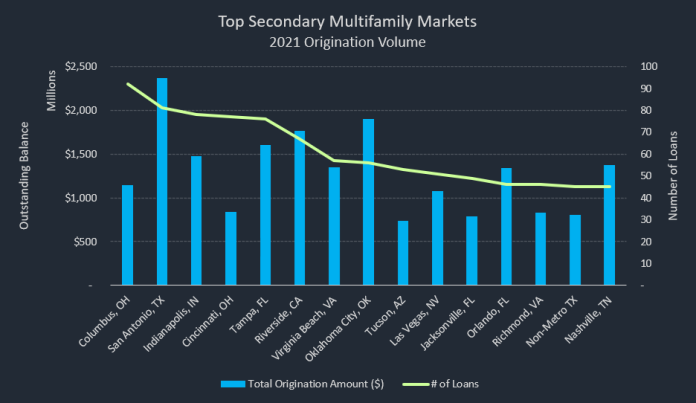
This week, CRED iQ reviewed the commercial real estate lending landscape and highlighted multifamily properties that have secured financing in the past 2 months. The highlighted loan originations featured 4 properties within the New York-Northern NJ MSA as well as a property located in the highly sought-after Sun Belt market of Raleigh, NC. In certain cases, mortgage loans from properties’ prior financing packages were catalogued in CRED iQ’s database, which enables users to evaluate prior loans terms and pre-origination financial history.
Using CRED iQ’s proprietary Commercial Real Estate Comp scoring functionality, we compared CMBS lender terms and loan structures for newly originated loans to ascertain trends in the commercial real estate lending environment. Additionally, we provide valuations for each asset to evaluate leverage levels in relation to originators’ LTVs. The CRED iQ valuations factor in a base-case (Most Likely), a downside (significant loss of tenants), and dark scenarios (100% vacant). Base-case valuations for select properties are provided below. For full access to the valuation reports as well as full CMBS loan reporting, including detailed financials, updated tenant information, and borrower contact information, sign up for a free trial here.
The Eddy
310 units, Mid-Rise Multifamily, Harrison, NJ
Ironstate Development secured $90 million in mortgage debt from Deutsche Bank on November 23, 2021 in the form of a $43 million first mortgage and a $47 million subordinate loan to refinance existing debt on The Eddy multifamily complex. The loan was structured with a 10-year term and an initial 5-year interest-only period. The weighted average interest rate for the financing package was 2.89% — consisting of 2.45% for the senior debt and 3.29% for the junior debt. The loan will be locked out from prepayment for 3 years, and then require a yield maintenance charge for prepayment until its open period 3 months prior to maturity in December 2031. Many of CRED iQ’s loan comparisons are secured by properties located across the Passaic River in Newark, NJ; however, one of the more relevant comps is the $97 million mortgage, originated in June 2018, that is secured by the Harrison Urby Apartments. The loan had an interest rate of 2.04% with a 5-year interest-only period.
The Eddy’s mortgage debt is secured by fee interest in a 310-unit mid-rise multifamily property in Harrison, NJ. The property was developed in 2021 and comprises studios, 1-bedroom, and 2-bedroom unit types. The property leased up quickly after coming online in February 2021 and was 98% occupied as of November 2021. The development of the property included a Payment in Lieu of Taxes (PILOT) agreement that is effectively a temporary tax abatement.
The property was appraised at a value of $140.1 million, equal to $451,935/unit, as of October 13, 2021, which implied a whole-loan LTV of 64% and a capitalization rate of 4.38% based on the originator’s underwritten NCF. For the full valuation report and loan-level details, click here.
Subject Property
Name
The Eddy
Address
555 South 1st Street Harrison, NJ 07029
Property Type
Multifamily
Property Subtype
Mid Rise
Building Size
310 units
Year Built
2021
Submarket
Newark
County
Hudson
MSA
New York-Northern New Jersey-Long Island, NY-NJ-PA MSA
Origination Date
11/21/2021
Loan Amount
$90,000,000
Interest Rate
2.89%
Valuation
Appraised Value
$140,100,000 ($451,935/unit)
Appraisal Date
10/13/2021
Appraisal LTV
64.24%
CRED iQ Base-Case Value
$138,400,000 ($446,444/unit)
Arbor Creek Apartment Homes
347 units, Garden-Style Multifamily, Raleigh, NC
Bellwether Enterprise originated a $35.6 million mortgage on October 26, 2021 to refinance existing debt on a multifamily property in Raleigh, NC. The floating-rate loan had a 10-year term, a 5-year interest-only period, and was indexed to 30-day SOFR plus 2.40%. The loan will be locked out from prepayment for 1 year and will require a prepayment penalty of 1% until its open period beings 4 months prior to maturity. For those looking for origination opportunities in the Sun Belt, one of CRED iQ’s most relevant comps in a $24.4 million loan secured by The Retreat at Raleigh — a 554-unit multifamily property located less than a mile away from Arbor Creek Apartment Homes. The comparable loan has a maturity date on January 1, 2023 but will be open for prepayment on September 1, 2022.
The Arbor Creek Apartment Homes loan is secured by a 347-unit affordable housing property located west of the Raleigh, NC CBD. All but 10 of the units offer rents at less than or equal to 80% of Area Median Income (AMI). There are 132 units, equal to 38% of total units, that are rented at less than or equal to 50% AMI. The apartments were 95% occupied as of August 2021. The property was appraised for $54.3 million, equal to $156,484/unit, as of August 5, 2021, which results in an LTV of 65.6% and an implied cap rate of 4.11% based on the originator’s underwritten NCF. For the full valuation report and loan-level details, click here.
Subject Property
Name
Arbor Creek Apartment Homes
Address
5400 Portree Place Raleigh, NC 27606
Property Type
Multifamily
Property Subtype
Garden
Building Size
347
Year Built
1969
Submarket
West Raleigh
County
Wake
MSA
Raleigh-Cary, NC MSA
Origination Date
10/26/2021
Loan Amount
$35,639,000
Interest Rate
30-Day Avg SOFR In Advance + 2.40%
Valuation
Appraised Value
$54,300,000 ($156,484/unit)
Appraisal Date
8/5/2021
Appraisal LTV
56.48%
CRED iQ Base-Case Value
$51,440,000 ($148,251/unit)
New Floral Gardens (II and IB)
260 units, Multifamily, North Bergen, NJ
NorthMarq originated two loans totaling $34 million on November 1, 2020 to refinance $15.8 million in existing debt on 260 affordable housing units in North Bergen, NJ. The two loans each have an interest rate of 2.88% and are structured with 10-year terms and 30-year amortization schedules. The loans will be locked out from prepayment for 2 years, and defeasance will be permitted after lockout through the remainder of the loan term. Both loans will be open for prepayment four months prior to maturity. CRED iQ’s highest scoring loan comp is the $47.55 million Hudson Mews loan, which was originated on December 9, 2020 and has an interest rate of 2.39%. Hudson Mews is a 198-unit multifamily property located approximately a half mile away from the New Floral Gardens properties.
New Floral Gardens consists of two properties — building IB contains 145 units and building II contains 115 units. The properties are located within the Hudson Waterfront of northern New Jersey with immediate access to the Lincoln Tunnel. Occupancy at both properties has been stable since 2012 and was most recently greater than 95% as of September 2021. Over 80% of the units offer rents less than or equal to 50% of Area Median Income (AMI).
The New Floral Gardens IB property had the higher appraised value of the two, equal to $37.3 million, or $257,310/unit. The New Floral Gardens II property was appraised for a value of $19.8 million, or $172,087/unit. For the full valuation reports and loan-level details, click here.
Subject Properties
Name
New Floral Gardens IB
New Floral Gardens II
Address
1200-1220 26th Street North Bergen, NJ 07047
2625 Kennedy Boulevard North Bergen, NJ 07047
Property Type
Multifamily
Multifamily
Property Subtype
High Rise
High Rise
Building Size
145
115
Year Built
1959
1952
Submarket
Hudson Waterfront
Hudson Waterfront
County
Hudson
Hudson
MSA
New York-Northern New Jersey-Long Island, NY-NJ-PA MSA
Origination Date
11/1/2021
11/1/2021
Loan Amount
$22,000,000
$12,000,000
Interest Rate
2.88%
2.88%
Valuation
Appraised Value
$37,310,000 ($257,310/unit)
$19,790,000 ($172,087/unit)
Appraisal Date
8/24/2021
8/24/2021
Appraisal LTV
58.90%
60.50%
CRED iQ Base-Case Value
$35,420,000 ($244,276/unit)
$19,360,000 ($168,373/unit)
Forest Hills South Co-Op
605 units, Cooperative Housing, Forest Hills, NY
A $16.9 million mortgage was originated by National Cooperative Bank on November 18, 2021 to refinance existing debt on a cooperative housing property in central Queens, NY. The 10-year loan was structured with a 30-year amortization period and an interest rate of 2.85%. The loan would require a yield maintenance charge for prepayment for most of its term until prepayment provisions ease up to a 1% penalty, starting 7 months prior to maturity. One of CRED iQ’s highest scoring loan comps is a $17 million loan secured by the Hampton Court CoOp in the Kew Gardens neighborhood of Queens. The comparable loan was originated in December 2019 and had an interest rate of 2.92%. Hampton Court contained 323 units across 4 buildings.
The Forest Hills cooperative housing property spans 7 buildings along 113th Street in the Forest Hills neighborhood of Queens. Three of the buildings have frontage along Queens Boulevard. Of the 605 units, 584 units are owned by tenant-shareholders and 21 units owned by the loan sponsor or cooperative. Additionally, there are 18 commercial units that function primarily as ground-floor retail.
The property was appraised at a value of $253 million ($418,182/unit) as of September 23, 2021, which aligns with CRED iQ’s analysis of over 40 sales transactions of units at the property in 2021. CRED iQ’s average sales price was equal to $421,451/unit or $255 million. However, CRED iQ’s Base-Case valuation of $173.7 million, equal to $287,056/unit), is based on the scenario of the property operating as traditional multifamily. For the full valuation report and loan-level details, click here.
Subject Property
Name
Forest Hills South Owners, Inc.
Address
77-15 113th Street Queens, NY 11375
Property Type
Multifamily
Property Subtype
Cooperative Housing
Building Size
605 units
Year Built
1939
Submarket
Forest Hills
County
Queens
MSA
New York-Northern New Jersey-Long Island, NY-NJ-PA MSA
Origination Date
11/18/2021
Loan Amount
$16,900,000
Interest Rate
2.85%
Valuation
Appraised Value
$253,000,000 ($418,182/unit)
Appraisal Date
9/23/2021
Appraisal LTV
6.68%
CRED iQ Base-Case Value
$173,700,000 ($287,056/unit)
Coolidge Hill Road Apartments
28 units, Low-Rise Multifamily, Watertown, MA
A $4 million loan was originated by Bank of America on November 19, 2021 to refinance existing debt on a 28-unit multifamily property in Watertown, MA. The interest-only loan has a 10-year term and an interest rate of 3.77%. The loan will be locked out from prepayment for 2 years, and defeasance will be permitted after lockout through the remainder of the loan term. One of CRED iQ’s highest rated comps for this new origination is a $9.4 million loan that is secured by Homer Apartments — a 58-unit multifamily property located in Cambridge, MA. This comparable loan was originated on December 31, 2020 and had an interest rate of 2.92%.
Coolidge Hill Road Apartments consists of two buildings — a 24-unit, 3-story building known as Coolidge Hill Manor and an adjacent quadplex. The property was 100% occupied as of October 26, 2021 and was appraised for a value of $7.1 million ($253,571/unit). The appraisal value resulted in an LTV of 56.5% and an implied cap rate of 4.54%. For the full valuation report and loan-level details, click here.
Subject Property
Name
Coolidge Hill Apartments
Address
39 Coolidge Hill Road Watertown, MA 02472
Property Type
Multifamily
Property Subtype
Low Rise
Building Size
28 units
Year Built
1925
Submarket
Waltham/Watertown
County
Middlesex
MSA
Boston-Cambridge-Quincy, MA-NH MSA
Origination Date
11/19/2021
Loan Amount
$4,010,000
Interest Rate
3.77%
Valuation
Appraised Value
$7,100,000 ($253,571/unit)
Appraisal Date
10/26/2021
Appraisal LTV
56.48%
CRED iQ Base-Case Value
$6,067,000 ($216,691/unit)
For full access to our loan database and valuation platform, sign up for a free trial below:
CRED iQ is a commercial real estate data, analytics, and valuation platform providing actionable intelligence to CRE and capital markets investors. Subscribers to CRED iQ use the platform to identify valuable leads for leasing, lending, refinancing, distressed debt, and acquisition opportunities. Our data platform is powered by over $2.0 trillion of CMBS, CRE CLO, SBLL, Ginnie Mae, FHA/HUD, and Agency loan and property data.
CRE professionals are in the midst of the holiday season and while some may reminisce about the glory days of the Sears and JCPenney holiday catalogs — others are closing deals for now-vacant Sears and JCPenney boxes. CRED iQ welcomes the CRE community in finding their next gift (opportunity) with an examination of commercial real estate properties that are REO within CMBS. As of October 2021, there were approximately 350 properties in CMBS transactions that are REO. Unpaid balances for these properties total approximately $5.2 billion. However, distressed assets typically have additional amounts due in terms of property protection and debt service advances by servicers, which in this case totals about $584 million, for a total exposure of approximately $5.8 billion. These REO assets have a finite holding period and will be sold to market at some point in the future. Special servicers, on behalf of CMBS trusts, are generally required to sell REO assets by the end of the 3rd year following a title transfer but may be granted extensions under certain conditions. Circumstance provides opportunity for distressed investors, especially with a notable increase in volume of distressed CRE opportunity funds that have seeded in 2021.
The vast majority of CMBS REO inventory is retail, accounting for 47% of the aggregate outstanding debt for all REO properties. Office, 21% of the total, and Lodging, 15% of the total, round out the top 3 property types. Akin to a Teddy Ruxpin or limited-edition Squishmallow, Manufactured Housing and Industrial REO assets are positioned as the hard-to-get property types with limited inventory. There were only 3 manufactured housing properties and 11 industrial properties that were REO.
From a historical perspective, the total number of REO assets has declined by 5% over the prior 12 months. The decline in the number of REO assets was led by Retail which saw a net reduction of about 60 assets over the course of a year. However, as the number of retail assets has been trending downwards, the total number of REO hotels has more than doubled in the past year — increasing by a factor of 2.4x. The number of office properties has declined year-over-year as well, exhibiting a 40% decrease. Despite reductions in the number of REO assets, the total outstanding debt on REO has increased by approximately 13%. The most logical explanation is that REO assets with smaller unpaid debt amounts are also generally smaller basis properties that can attract a wider range of acquisition prospects and more efficient closings. High basis assets, especially those in severe distress or in need of CapEx and repositioning, with large outstanding debt amounts, may have more limited buyer pools. This is most evident with Retail REO inventory, which had its outstanding balance increase by $201.6 million, despite approximately 60 fewer assets. Smaller community centers and strip centers were liquidated while larger basis regional malls remained unsold with limited buyer pools.
Of the largest REO assets by total exposure, six out of 10 are regional malls. The remaining 4 are office properties. The highlighted regional malls have been REO for an average of just under 3 years — the title to Ingram Park Mall in San Antonio, TX was most recently conveyed to the special servicer in April 2021. Portals I, an office property in Washington, DC, has been REO for 5 and a half years, which is the longest among the Top 10. Value depreciation of these assets may be the most noticeable at first glance. Seven of the 10 properties have been re-appraised and the average decline in value compared to loan origination was 70%, a glaring example of the severity of distress present with REO assets. Looking ahead, there are over 350 properties totaling close to $5.7 billion that are delinquent with a workout strategy of foreclosure cited by servicers. These properties serve as the potential pipeline for additional REO assets; however, workouts of CRE properties are very fluid and often do not result in the acquisition of title by special servicers and lenders. Regardless, distressed investors should not limit their opportunities and explore these properties as additional options. Happy holiday hunting!
Largest REO Properties in CMBS by Total Exposure
Name
Address
Property Type
Unpaid Balance
Total Exposure
Years REO
Appraisal Value at Loan Origination
Most Recent Appraisal Value
Decline in Appraisal Value
Town Center at Cobb
400 Ernest West Barrett Parkway Kennsesaw, GA 30144
Regional Mall
$172,217,882
$179,156,107
1.5
$322,000,000
NAV
NAV
Portals I
1250 Maryland Avenue Southwest Washington, DC 20024
Office
$155,000,000
$158,272,544
5.5
$235,000,000
$136,700,000
-41.8%
One AT&T Center
909 Pine Street St. Louis, MO 63101
Office
$107,147,765
$125,775,049
4.7
$207,260,000
$9,200,000
-95.6%
Ingram Park Mall
6301 Northwest Loop 410 San Antonio, TX 78238
Regional Mall
$119,627,225
$119,627,225
0.6
$215,400,000
NAV
NAV
Koger Center
2540 W Executive Circle Tallahassee, FL 32301
Office
$103,271,007
$112,722,443
0.7
$145,000,000
$39,800,000
-72.6%
University Mall
155 Dorset Street South Burlington, VT 05403
Regional Mall
$92,000,000
$97,440,784
6.4
$116,300,000
$45,200,000
-61.1%
Florence Mall
2028 Florence Mall Florence, KY 41042
Regional Mall
$89,404,415
$91,665,476
1.4
$158,600,000
NAV
NAV
Three Westlake Park
550 Westlake Park Boulevard Houston, TX 77079
Office
$76,651,330
$91,375,698
3.1
$121,150,000
$25,175,000
-79.2%
Rushmore Mall
2200 N Maple Ave Rapid City, SD 57701
Regional Mall
$89,000,000
$89,109,564
3.1
$117,500,000
$23,500,000
-80.0%
Killeen Mall
2100 South W S Young Drive Killeen, TX 76543
Regional Mall
$82,000,000
$82,267,263
4.5
$102,500,000
$39,100,000
-61.9%
About CRED iQ
CRED iQ is a commercial real estate data, analytics, and valuation platform providing actionable intelligence to CRE and capital markets investors. Subscribers to CRED iQ use the platform to identify valuable leads for leasing, lending, refinancing, distressed debt, and acquisition opportunities. Our data platform is powered by over $2.0 trillion of CMBS, CRE CLO, SBLL, Ginnie Mae, FHA/HUD, and Agency loan and property data.
CRED iQ was happy to contribute data and analysis to last week’s insightful article in Commercial Observer by @AndrewCoen discussing the impacts of remote working on CMBS debt, and, in particular, loans secured by office properties. CRED iQ provided delinquency rates and special servicing rates for loans secured by office properties for primary markets across the U.S. Additionally, we offered guidance on identifying potential credit risks within the office sector as well as insights into the remote working dynamic. For those our followers that missed the story, below is a link to the article.
The COVID-19 pandemic has thus far not caused any material distress to CMBS office debt. Only 2.89 percent is in either delinquency or special servicing compared to 1.9 percent in 2019, according to data from commercial real estate data firm CRED iQ. Markets with the highest delinquency/special servicing rates including Hartford, Conn. (22.3 percent), St. Louis (19.2 percent), Houston (13.9 percent) and Indianapolis (13.62 percent).”
Marc McDevitt, senior managing director at CRED iQ, noted that delinquency and special servicing rates historically don’t provide guidance for future levels of distress. Lease rollover risk and market vacancy trends are instead better indicators of credit risks. McDevitt said many of the increased vacancies are tied to flight to quality with firms seeking office space with “higher wellness attributes” along with downsizing as companies reevaluate spacing needs amid the evolution of remote working habits.
“The office environment is a concern for CMBS investors in the long term as they monitor the rise in market vacancy rates, especially in [central business district] submarkets,” McDevitt said. “However, corresponding increases in delinquency will likely be delayed due to longer lease terms relative to retail. In the near-to-medium term, investors are likely concerned about pockets of lease rollover for certain assets in specific markets.
For full access to our loan database and valuation platform, sign up for a free trial below:
CRED iQ is a commercial real estate data, analytics, and valuation platform providing actionable intelligence to CRE and capital markets investors. Subscribers to CRED iQ use the platform to identify valuable leads for leasing, lending, refinancing, distressed debt, and acquisition opportunities. Our data platform is powered by over $2.0 trillion of CMBS, CRE CLO, SBLL, Ginnie Mae, FHA/HUD, and Agency loan and property data.