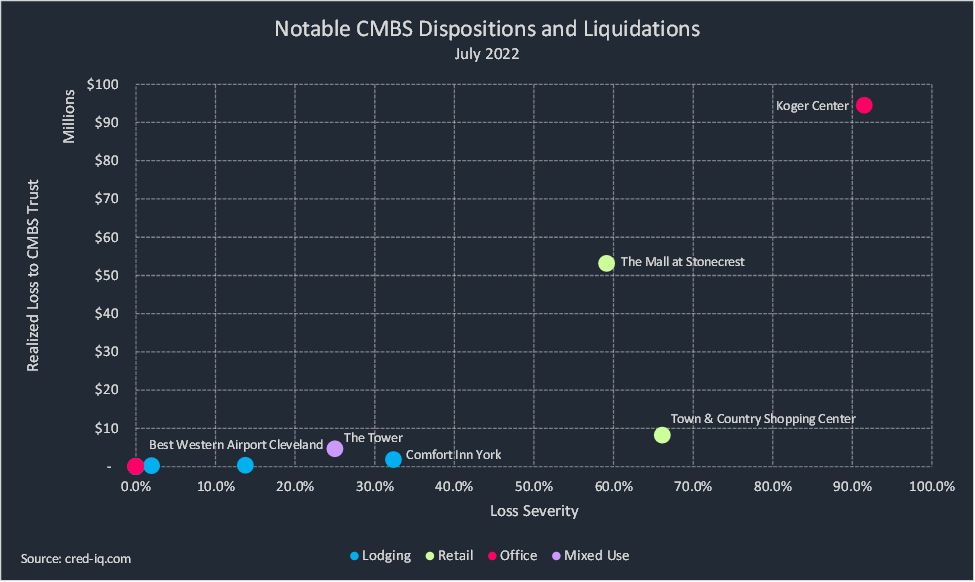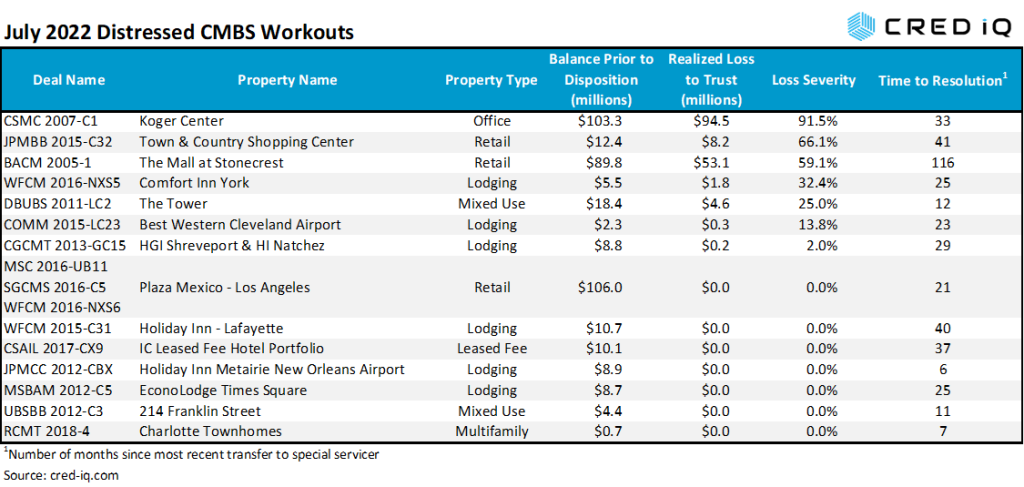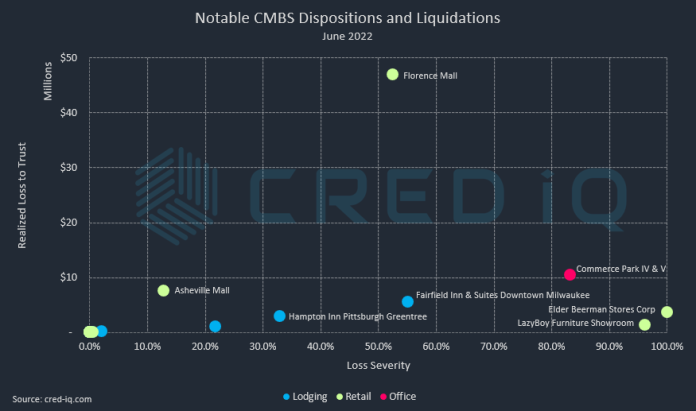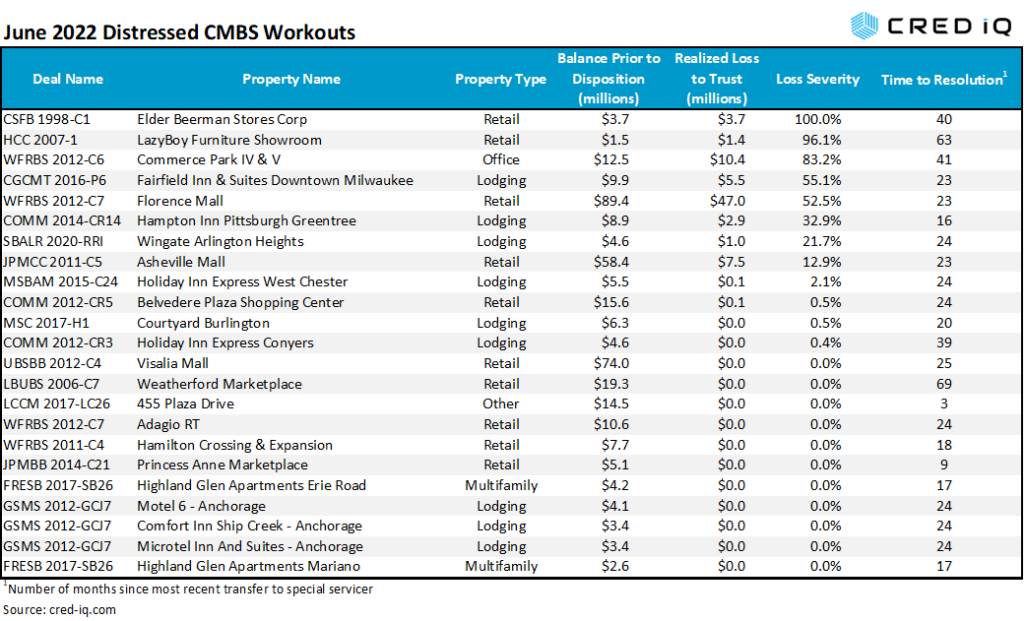

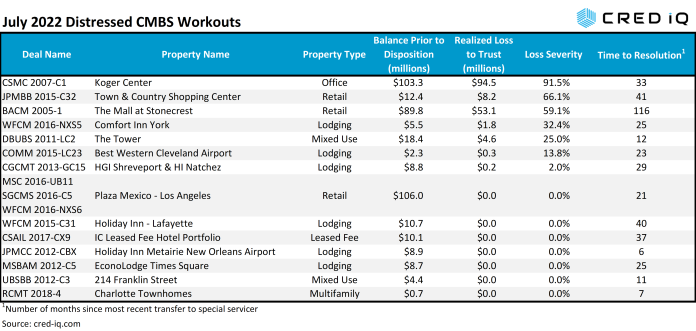
CMBS conduit transactions incurred approximately $60 million in realized losses during April 2022 through the workout of distressed assets. Additionally, a $15.5 mortgage securitized in a Freddie K-Deal securitization, Courtyard Towers, was liquidated with a loss severity of 100%. CRED iQ identified 19 workouts classified as dispositions, liquidation, or discounted payoffs in April 2022. Of those 19 workouts, there were eight distressed assets that were resolved without a loss. One resolution – Portofino Inn & Suites – Anaheim CA — resulted in excess proceeds available to the trust after the REO asset was sold. The sales price for the asset, which was reportedly north of $62 million, was significantly greater than its total exposure, equal to the unpaid balance, servicer advances, and liquidation expenses. Loss severities for the month of April ranged from 4% to 100%, based on outstanding balances at disposition. Total realized losses in April represented a decline compared to March’s realized loss totals of approximately $84.4 million.
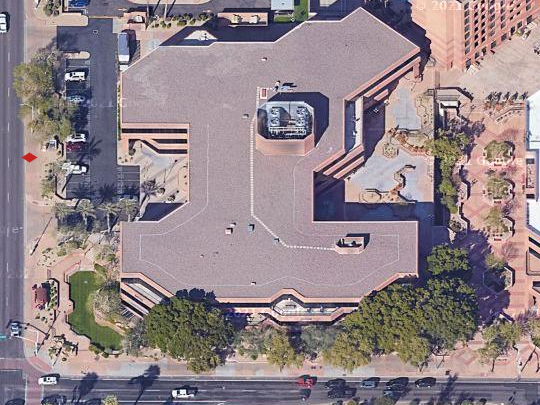
Courtyard Towers represents the largest loss, by total amount and severity, among all distressed workouts this month. For historical context, the loan, which was securitized in the FREMF 2018-KX03 transaction, incurred the largest individual loss for any Freddie K-Deal securitization to date. Prior to the workout of Courtyard Towers, there had been 13 resolutions of loans that resulted in realized losses to Freddie K-Deal securitizations. Courtyard Towers is a 175-unit assisted living facility located in Mesa, AZ. The property had been with the special servicer since October 2018. Several prior sale agreements fell out of contract and the property was ultimately sold for $4.85 million, which was significantly below the loan’s $15.5 million outstanding balance at disposition. After liquidation expenses and amounts due to the servicer, the result was a full loss for the loan.
The largest distressed loan, by balance at disposition, to be resolved was the $48.9 million Plaza At Harmon Meadow loan. The loan had transferred to special servicing in April 2020 due to maturity default. After nearly two years in special servicing, the loan was resolved without incurring a loss.
Excluding defeased loans, there was approximately $6.1 billion in securitized debt that was paid off or worked out in April, which was significantly higher than $3.3 billion in March 2022. In April, 10% of the loan resolutions were categorized as dispositions, liquidations, or discounted payoffs, which was in line with the prior month. An additional 13% of the loans paid off with prepayment penalties.
By property type, mixed-use had the highest total of outstanding debt paid off in April. The high volume of mixed-use payoffs was driven by the retirement of a $1.4 billion mortgage secured by Ala Moana — a mixed-use complex in Honolulu, HI comprising a super-regional mall and two office towers.
About CRED iQ
CRED iQ is a commercial real estate data, analytics, and valuation platform designed to unlock investment, financing, and leasing opportunities. CRED iQ provides real-time property, loan, tenant, ownership, and valuation data for over $2.0 trillion of commercial real estate.
In this week’s WAR Report, CRED iQ calculated real-time valuations for five distressed properties that have transferred to special servicing in March and April 2022. Featured properties include a student housing complex serving the University of Akron as well as multiple office properties in the Hartford, Philadelphia and Chicago MSAs. CRED iQ’s special servicing rate for office loans increased to 3.73% in April 2022, moving inversely compared to the overall special servicing rate for all property types. Three of the five office properties highlighted this week were suburban office campuses — all with notable occupancy issues.
CRED iQ valuations factor in a base-case (most likely), a downside (significant loss of tenants), and dark scenarios (100% vacant). For full access to the valuation reports as well as full CMBS loan reporting, including detailed financials, updated tenant information, and borrower contact information, sign up for a free trial here.
This $34.9 million loan transferred to special servicing on March 11, 2022 due to imminent monetary default. The collateral property, University Edge, was impacted by the pandemic, resulting in a below breakeven DSCR for the loan during 2020 and through the nine-month period ended September 2021. The loan was current in payment as of April 2022, but workout negotiations have been initiated between the borrower and Midland Loan Services, acting as special servicer.
Historically, the August 2020 distressed workout of 22 Exchange is a notable comparison to University Edge for a potential range of outcomes. 22 Exchange was a 471-bed student housing property located about a half mile away from University Edge. The property became REO in December 2018 and was sold in August 2020 for approximately $12.5 million, equal to $26,539 per bed or $88,028 per unit. The new owner converted the property to traditional multifamily use after acquisition.
University Edge is a 148-unit student housing facility located adjacent to the University of Akron. The property contains 578 beds and 18,380 sf of ground-floor retail, which is primarily leased to food service tenants. Occupancy has slumped since the onset of the pandemic with remote learning opportunities allowing enrolled students more flexibility in housing location farther away from campus. The student housing portion of the property was approximately 84% occupied as of September 2021. Servicer commentary indicated the property was 54% pre-leased for the Fall 2022 semester. For the full valuation report and loan-level details, click here.
This $25.6 million loan transferred to special servicing on March 7, 2022 due to non-compliance with cash management provisions. The mortgage has multiple cash management triggers tied to tenant events, including a trigger connected to the collateral property’s 5th largest tenant — the US Department of Housing and Urban Development (HUD). HUD occupies 6% of the collateral property’s NRA pursuant to a lease that expires in October 2022. A cash trap was structured to take effect nine months prior to lease expiration if a renewal has not been signed. Concurrent with the loan’s transfer to special servicer, debt service payments were 30 days delinquent.
The loan is secured by the Stilts Building, a 23-story office tower in the CBD of Hartford, CT. The property was 79% occupied as of year-end 2021, which was a decline compared to 87% in 2020 but not too far off from the occupancy level of 82% in 2012 prior to loan origination. The property has concentrated near-term lease rollover risk with 35% of the property’s NRA expiring in the next 24 months. The elevated lease rollover risk and cash management issues may present complications for the loan’s impending maturity date in April 2023. For the full valuation report and loan-level details, click here.
201,167 sf, Suburban Office, Wilmington, DE [View Details]
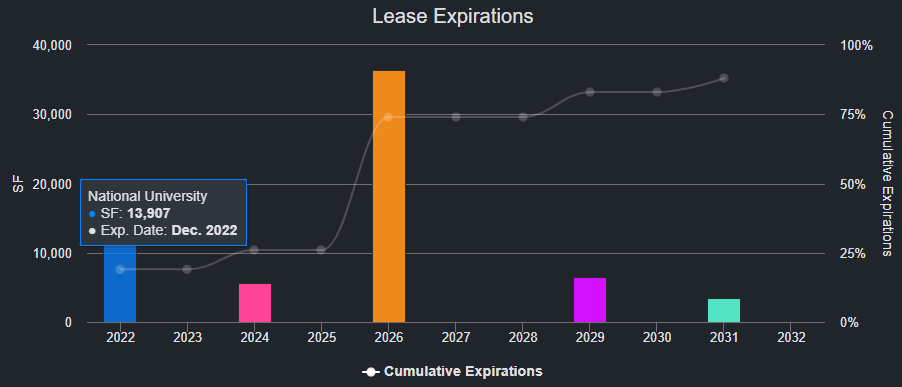
This $24.6 million loan transferred to special servicing on March 15, 2022. The reason for the transfer was not specified at the time of writing. However, the collateral property’s largest tenant, DuPont Capital Management, failed to renew its lease within 12 months of expiration, which triggered a cash trap. DuPont Capital Management occupies 53,227 sf at 1 Righter Parkway, equal to 27% of the office complex’s aggregate NRA, pursuant to a lease that expires in December 2022. The tenant has two, five-year extension options available.
The loan is secured by a leasehold interest in two, three-story office buildings located in the suburbs of Wilmington, DE. Each building — 1 Righter Parkway and 2 Righter Parkway —is subject to individual ground leases that expire in 2046 and 2048, respectively. The ground leases reset every five years with CPI increases. The two office buildings were 96% occupied as of year-end 2021. Occupancy has the potential to decline to approximately 69% should DuPont Capital Management vacate at lease expiration. For the full valuation report and loan-level details, click here.
311,772 sf, Suburban Office, Oak Brook, IL [View Details]
This $19.9 million loan transferred to special servicing on April 1, 2022 due to delinquency. The loan became 60 days delinquent in April 2022. The collateral property’s largest tenant, Sanford LP, had a lease expiration in December 2021. Servicer commentary indicated the tenant, which occupied 39% of the collateral property’s NRA, was looking to downsize its space. The tenant’s search for a smaller office footprint included other properties in the local market.
Oak Brook Office Center is a four-building suburban office park located approximately 20 miles west of Chicago, IL. Sanford LP’s lease was for the entirety of the building located at 2707 Butterfield Road. Occupancy across all four buildings in the office park was 75% as of year-end 2021. Any reduction in space or departure by Sanford LP will likely lead to a below breakeven DSCR for the loan if the vacant space is not backfilled in a timely matter. For the full valuation report and loan-level details, click here.
198,946 sf, Suburban Office, Albany, NY [View Details]
This $11.1 million loan transferred to special servicing on April 7, 2022 due to imminent monetary default. Servicer commentary for the loan stated the borrower had requested COVID-related relief but credit issues appear to be more sustained than implied by a temporary relief request. The loan is secured by West Mall Office Park, a three-building office park located in Albany, NY. Occupancy across all three buildings was 71% as of June 2021 and one of the buildings appears to be vacant. The property’s former largest tenant, for-profit college operator Midred Elley, reduced its footprint at the office park in 2019 from 28% of the aggregate NRA to 19%. Despite the transfer to special servicing, the loan was current in payment as of April 2022. For the full valuation report and loan-level details, click here.
CRED iQ is a commercial real estate data, analytics, and valuation platform providing actionable intelligence to CRE and capital markets investors. Subscribers to CRED iQ use the platform to identify valuable leads for leasing, lending, refinancing, distressed debt, and acquisition opportunities. Our data platform is powered by over $2.0 trillion of CMBS, CRE CLO, SBLL, Ginnie Mae, FHA/HUD, and Freddie Mac loan and property data.
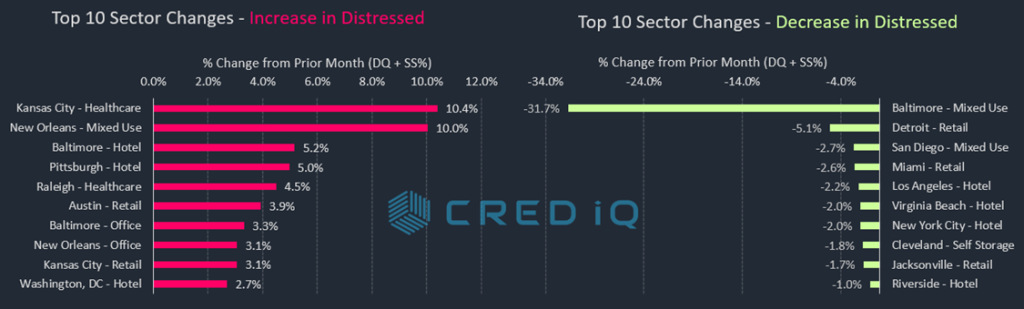
CRED iQ monitors distressed rates and market performance for nearly 400 MSAs across the United States, covering over $900 billion in outstanding commercial real estate (CRE) debt. Distressed rates (DQ + SS%) include loans that are specially serviced, delinquent, or a combination of both. Distressed rates and month-over-month changes are presented below for the 50 largest MSAs, including distressed rates that are stratified by property type/sector, resulting in a granular view of distress by market-sector.
Distressed figures include all properties listed as 30 day delinquent or worse, as well as specially serviced loans within the securitized universe including Conduit, Agency, SBLL, and CRE CLO.
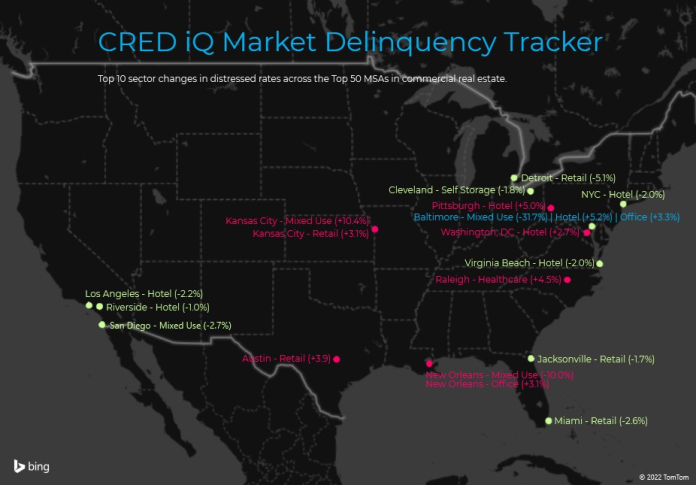
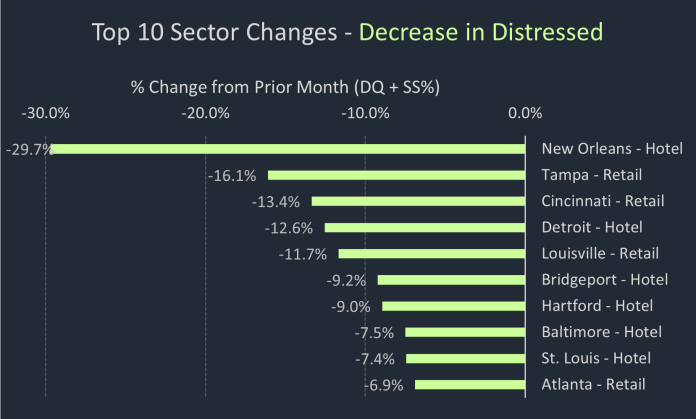
The majority of Top 50 MSAs exhibited an improvement in the overall rate of distressed commercial mortgages in April 2022. There were approximately 36 markets, or 72% of the Top 50, with month-over-month declines in the percentage of distressed CRE loans. Among the MSAs with the sharpest declines this month were Memphis and Birmingham, AL. By property type, much of the improvement was attributed to the lodging sector. Loans secured by lodging properties accounted for nine of the 10 largest declines in distress by market-sector, including Birmingham, AL, Philadelphia, and Detroit.
Conversely, the Baltimore market had the highest increase in distressed CRE loans compared to the prior month. The increase was primarily driven by a 30-day delinquency from a loan secured by Chatham Gardens Apartments, a 414-unit multifamily property located in Ellicott City, MD.
Office was the most prevalent property type among increases in distress by market-sector, accounting for four of the Top 10 increases in distress. The Hartford office market experienced the highest month-over-month increase in distress. A $25.6 million mortgage secured by the Stilts Building at 20 Church Street transferred to special servicing in March 2022. The Atlanta office market was also among the Top 10 market-sectors to show a higher month-over-month rate of distress. A major contributor to Atlanta’s office distress is a $115.3 million mortgage secured by the Peachtree Center, which transferred to special servicing ahead of its April 2022 maturity date. Peachtree Center is a seven-building office complex located in the CBD of Atlanta. Reported occupancy across the seven buildings was 61% as of September 2021. The loan’s initial maturity date was in April 2022, but the borrower has a 12-month extension option.
Distressed rates for the industrial sector exhibited notable increases in multiple markets this month due to delinquencies and transfers to special servicing. In one example, the $26.1 million FMC Technologies loan transferred to special servicing. The FMC Technologies loan was last featured in CRED iQ’s November 30, 2021 Weekly Asset Review, which detailed the implications of single tenant TechnipFMC’s lease expiration on March 31, 2022. The loan’s transfer to special servicing adversely impacted the distressed rate for Houston industrial properties. The distressed rate for industrial properties in the New York City MSA was also adversely impacted this month — the $51.2 million Supor Industrial Portfolio loan, secured by a portfolio of properties in Harrison, NJ, became 30 days delinquent in April 2022.
The Minneapolis MSA has the highest overall distressed rate at 22.3%, which was a slight decline compared to the prior month. Louisville (17.4%), New Orleans (13.3%), Milwaukee (11.0%), and Cleveland (9.5%) comprise the remaining markets with the highest rates of distress. After a one-month hiatus, the Cleveland MSA re-entered the Top 5 markets with CRE distress. The Sacramento market (0.43%) had the lowest percentage of distress among the Top 50 MSAs, supplanting the Raleigh MSA, which held the distinction previously.
Riverside – Riverside-San Bernardino-Ontario, CA MSA
$274.0
3.1%
-0.2%
Riverside – Hotel
$64.8
23.1%
-2.7%
Riverside – Industrial
$0.0
0.0%
0.0%
Riverside – Multifamily
$08.1
0.2%
0.0%
Riverside – Office
$0.0
0.0%
0.0%
Riverside – Other
$0.0
0.0%
0.0%
Riverside – Retail
$201.0
9.7%
-0.7%
Riverside – Self Storage
$0.0
0.0%
0.0%
Sacramento – Sacramento-Arden-Arcade-Roseville, CA MSA
$25.4
0.4%
-0.6%
Sacramento – Hotel
$05.7
1.6%
-9.3%
Sacramento – Industrial
$0.0
0.0%
0.0%
Sacramento – Multifamily
$0.0
0.0%
0.0%
Sacramento – Office
$06.1
0.8%
0.0%
Sacramento – Other
$0.0
0.0%
0.0%
Sacramento – Retail
$13.6
1.7%
0.0%
Sacramento – Self Storage
$0.0
0.0%
0.0%
Salt Lake City – Salt Lake City, UT MSA
$46.8
1.3%
0.0%
Salt Lake City – Hotel
$46.8
16.6%
-0.3%
Salt Lake City – Industrial
$0.0
0.0%
0.0%
Salt Lake City – Multifamily
$0.0
0.0%
0.0%
Salt Lake City – Office
$0.0
0.0%
0.0%
Salt Lake City – Other
$0.0
0.0%
0.0%
Salt Lake City – Retail
$0.0
0.0%
0.0%
Salt Lake City – Self Storage
$0.0
0.0%
0.0%
San Antonio – San Antonio, TX MSA
$142.9
2.2%
0.1%
San Antonio – Hotel
$08.4
3.1%
0.8%
San Antonio – Industrial
$01.4
0.8%
0.8%
San Antonio – Multifamily
$08.0
0.2%
0.2%
San Antonio – Office
$0.0
0.0%
0.0%
San Antonio – Other
$0.0
0.0%
0.0%
San Antonio – Retail
$125.1
14.0%
-0.1%
San Antonio – Self Storage
$0.0
0.0%
0.0%
San Diego – San Diego-Carlsbad-San Marcos, CA MSA
$87.9
0.7%
-0.3%
San Diego – Hotel
$61.7
3.1%
-0.8%
San Diego – Industrial
$0.0
0.0%
0.0%
San Diego – Multifamily
$01.4
0.0%
-0.2%
San Diego – Office
$0.0
0.0%
0.0%
San Diego – Other
$20.5
2.9%
-0.1%
San Diego – Retail
$04.3
0.4%
0.0%
San Diego – Self Storage
$0.0
0.0%
0.0%
San Francisco – San Francisco-Oakland-Fremont, CA MSA
$169.8
0.7%
-0.9%
San Francisco – Hotel
$62.8
2.8%
-4.5%
San Francisco – Industrial
$0.0
0.0%
0.0%
San Francisco – Multifamily
$20.8
0.3%
0.0%
San Francisco – Office
$0.0
0.0%
-1.1%
San Francisco – Other
$38.6
2.2%
0.0%
San Francisco – Retail
$47.6
4.1%
0.1%
San Francisco – Self Storage
$0.0
0.0%
0.0%
San Jose – San Jose-Sunnyvale-Santa Clara, CA MSA
$135.7
1.0%
0.0%
San Jose – Hotel
$121.0
5.8%
0.0%
San Jose – Industrial
$0.0
0.0%
0.0%
San Jose – Multifamily
$0.0
0.0%
0.0%
San Jose – Office
$14.7
0.2%
0.0%
San Jose – Other
$0.0
0.0%
0.0%
San Jose – Retail
$0.0
0.0%
0.0%
San Jose – Self Storage
$0.0
0.0%
0.0%
Seattle – Seattle-Tacoma-Bellevue, WA MSA
$76.2
0.4%
-0.2%
Seattle – Hotel
$71.8
5.9%
-2.4%
Seattle – Industrial
$0.0
0.0%
0.0%
Seattle – Multifamily
$04.3
0.1%
0.0%
Seattle – Office
$0.0
0.0%
0.0%
Seattle – Other
$0.0
0.0%
0.0%
Seattle – Retail
$0.0
0.0%
0.0%
Seattle – Self Storage
$0.0
0.0%
0.0%
St. Louis – St. Louis, MO-IL MSA
$376.4
9.0%
-0.7%
St. Louis – Hotel
$42.2
15.7%
-5.0%
St. Louis – Industrial
$0.0
0.0%
0.0%
St. Louis – Multifamily
$07.7
0.5%
-1.0%
St. Louis – Office
$108.9
20.1%
0.9%
St. Louis – Other
$23.0
4.2%
0.0%
St. Louis – Retail
$194.5
19.8%
0.0%
St. Louis – Self Storage
$0.0
0.0%
0.0%
Tampa – Tampa-St. Petersburg-Clearwater, FL
$300.0
3.4%
-0.1%
Tampa – Hotel
$29.9
4.4%
0.1%
Tampa – Industrial
$0.0
0.0%
0.0%
Tampa – Multifamily
$02.5
0.0%
0.0%
Tampa – Office
$23.7
3.9%
-0.2%
Tampa – Other
$0.0
0.0%
0.0%
Tampa – Retail
$243.9
27.2%
0.5%
Tampa – Self Storage
$0.0
0.0%
0.0%
Tucson – Tucson, AZ MSA
$165.9
5.3%
-0.6%
Tucson – Hotel
$04.7
1.6%
-6.5%
Tucson – Industrial
$0.0
0.0%
0.0%
Tucson – Multifamily
$0.0
0.0%
0.0%
Tucson – Office
$0.0
0.0%
0.0%
Tucson – Other
$0.0
0.0%
0.0%
Tucson – Retail
$161.3
20.1%
0.0%
Tucson – Self Storage
$0.0
0.0%
0.0%
Virginia Beach – Virginia Beach-Norfolk-Newport News, VA-NC MSA
$226.2
5.0%
-0.2%
Virginia Beach – Hotel
$0.0
0.0%
-2.1%
Virginia Beach – Industrial
$21.2
6.9%
0.0%
Virginia Beach – Multifamily
$0.0
0.0%
0.0%
Virginia Beach – Office
$02.8
0.7%
0.7%
Virginia Beach – Other
$0.0
0.0%
0.0%
Virginia Beach – Retail
$202.2
23.2%
0.2%
Virginia Beach – Self Storage
$0.0
0.0%
0.0%
Washington, DC – Washington-Arlington-Alexandria, DC-VA-MD-WV MSA
$537.8
1.9%
-0.3%
Washington, DC – Hotel
$14.8
1.6%
-1.8%
Washington, DC – Industrial
$11.2
2.0%
0.0%
Washington, DC – Multifamily
$01.2
0.0%
0.0%
Washington, DC – Office
$323.6
4.8%
-0.6%
Washington, DC – Other
$44.7
2.7%
0.0%
Washington, DC – Retail
$142.2
4.9%
-0.3%
Washington, DC – Self Storage
$0.0
0.0%
0.0%
Grand Total
$23,696.8
3.5%
-0.2%
About CRED iQ
CRED iQ is a commercial real estate data, analytics, and valuation platform providing actionable intelligence to CRE and capital markets investors. Subscribers to CRED iQ use the platform to identify valuable leads for leasing, lending, refinancing, distressed debt, and acquisition opportunities. Our data platform is powered by over $2.0 trillion of CMBS, CRE CLO, SBLL, Ginnie Mae, FHA/HUD, and Freddie Mac loan and property data.
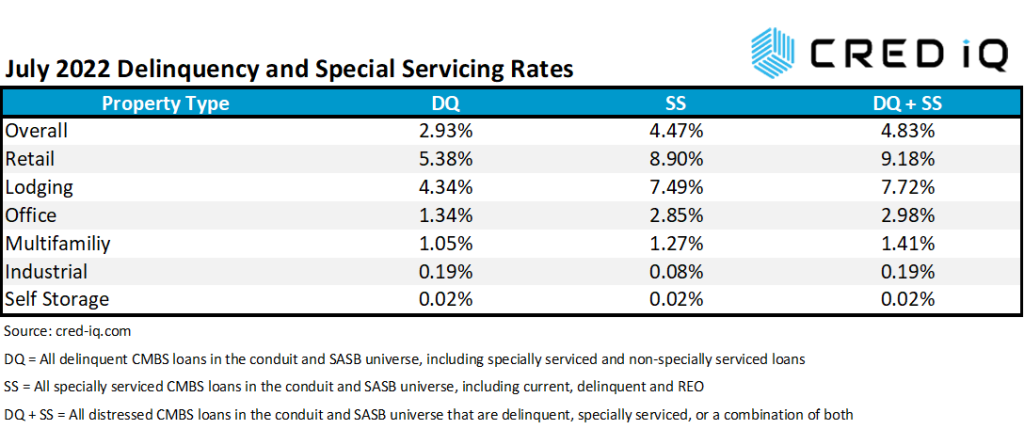
DQ = All delinquent CMBS loans in the conduit and SASB universe, including specially serviced and non-specially serviced loans SS = All specially serviced CMBS loans in the conduit and SASB universe, including current, delinquent and REO DQ + SS = All distressed CMBS loans in the conduit and SASB universe that are delinquent, specially serviced, or a combination of both
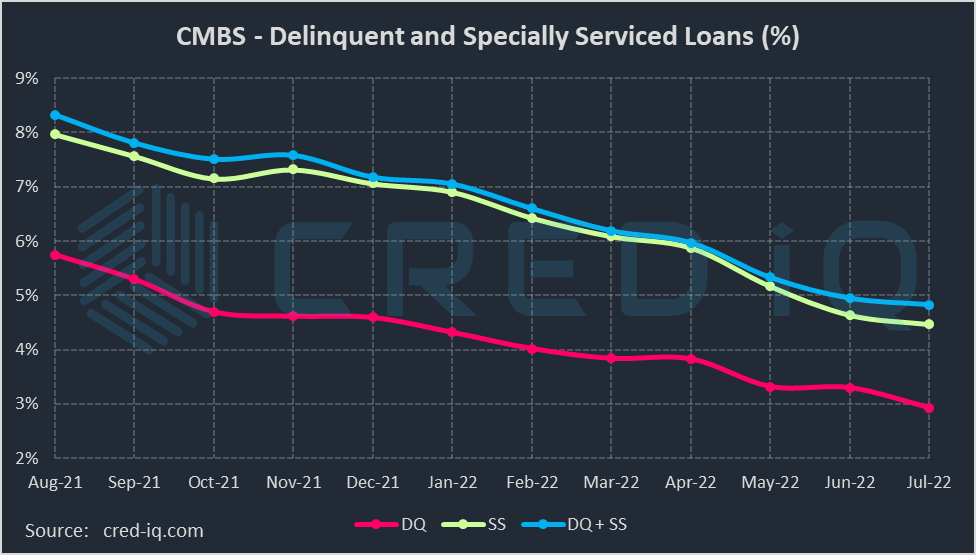
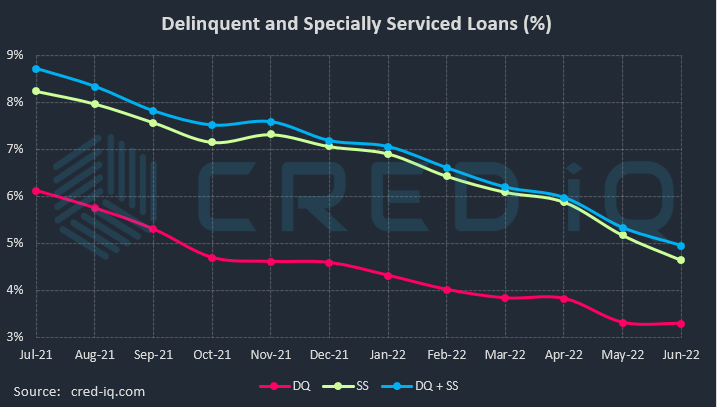
The CRED iQ overall delinquency rate for CMBS showed nominal movement during the April 2022 remittance period but still tallied a decline for the 23rd consecutive month. The delinquency rate, equal to the percentage of all delinquent specially serviced loans and delinquent non-specially serviced loans, for CRED iQ’s sample universe of $500+ billion in CMBS conduit and single asset single-borrower (SASB) loans was 3.83%, which compares to the prior month’s rate of 3.84%. CRED iQ’s special servicing rate, equal to the percentage of CMBS loans that are with the special servicer (delinquent and non-delinquent), declined month-over month to 5.88% from 6.09%. The special servicing rate is now approximately 45% lower than its pandemic-era peak of 10.79% in October 2020. Aggregating the two indicators of distress – delinquency rate and special servicing rate – into an overall distressed rate (DQ + SS%) equals 5.97% of CMBS loans that are specially serviced, delinquent, or a combination of both. The overall distressed rate declined compared to the prior month rate of 6.19%. The overall distressed rates typically track slightly higher than special servicing rates as most delinquent loans are also with the special servicer.
DQ = All delinquent CMBS loans in the conduit and SASB universe, including specially serviced and non-specially serviced loans SS = All specially serviced CMBS loans in the conduit and SASB universe, including current, delinquent and REO DQ + SS = All distressed CMBS loans in the conduit and SASB universe that are delinquent, specially serviced, or a combination of both
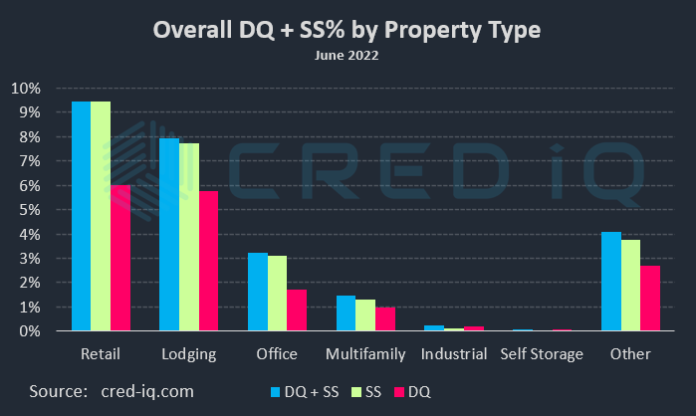
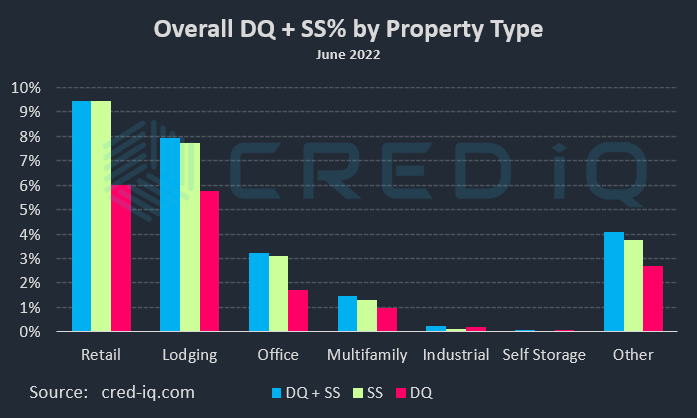
The individual delinquency rate for the retail sector spiked higher this month to 7.34%, compared to 7.06% as of March 2022. The sharp increase can be attributed partially to a reversion to delinquent payments from the $125 million Westfield Palm Desert loan, which is secured by a regional mall in California. The loan was marked as current in payment during previous months but became 30 days delinquent as of April 2022. Westfield Palm Desert transferred to special servicing in August 2020 and was delinquent for nearly all of 2021. Notably, the loan sponsor, Unibail-Rodamco-Westfield, was featured in the news in early-April 2022 for providing an update on its planned divestiture of U.S.-based regional malls.
The delinquency rate for lodging properties continued to show meaningful and consistent improvement. For a second consecutive month, the outstanding balance of delinquent lodging loans declined by more than $450 million. The lodging delinquency rate was 7.55% this month, which compared to 7.99% last month. One of the largest delinquency cures this month was the $135.1 million Marriott LAX loan, which is secured by a 1,004-room hotel adjacent to the Los Angeles International Airport. The loan was modified in February 2022 and terms of the agreement brought the loan current in payment. The loan transferred to special servicing in December 2020 and had been delinquent in payment until the closing of the modification agreement.
Changes in special servicing rates by individual property type were a mixed bag this month. The special servicing rate for lodging declined by approximately 15% this month. A large component of the shift was caused by the $982 million loan secured by the Ashford Hospitality Trust Portfolio. The loan transferred to special servicing in June 2020. The loan returned to the master servicer this month after furniture, fixture, and equipment (FF&E) reserves were replenished from being used to pay debt service during a forbearance period.
Special servicing rates for retail (11.21%) and office (3.73%) both increased compared to the prior month. The increase in the office special servicing rate was anticipated given last month’s revelation of Blackstone’s intentions to hand 1740 Broadway back to the lender. The increase in the special servicing rate for retail was driven by Destiny USA – a 2.1 million-sf regional mall in Syracuse, NY that is owned by Pyramid Management Group. The distressed shopping center secures a $430 million loan that is securitized in the JPMCC 2014-DSTY CMBS transaction. The loan transferred to special servicing due to imminent default ahead of the loan’s June 2022 maturity date. The loan had previously transferred to special servicing in April 2020 and returned to the master servicer in March 2021 after a loan modification. Another one of Pyramid’s properties, Walden Galleria, was a major driver behind increases in retail distress last month.
DQ + SS = All distressed CMBS loans in the conduit and SASB universe that are delinquent, specially serviced, or a combination of both
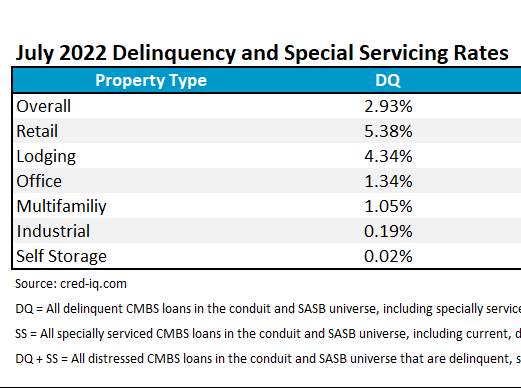
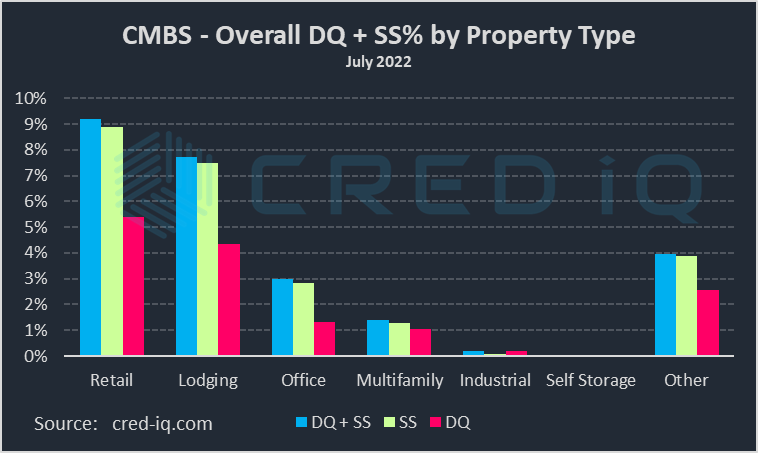
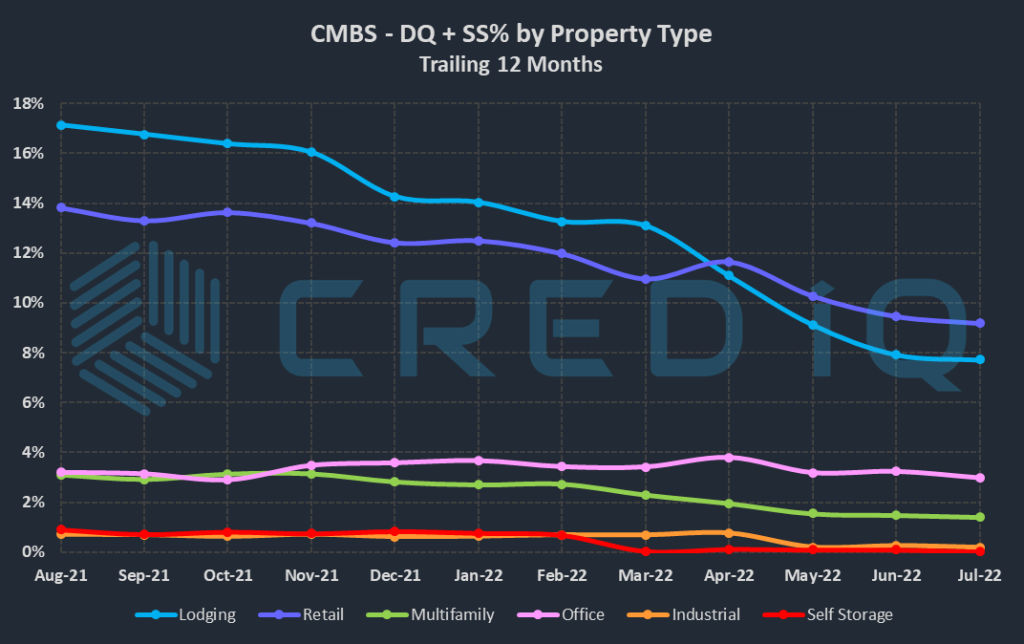
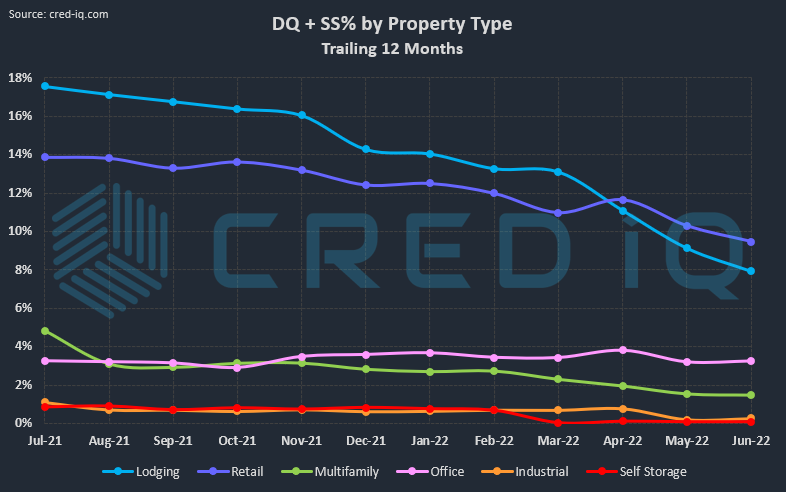
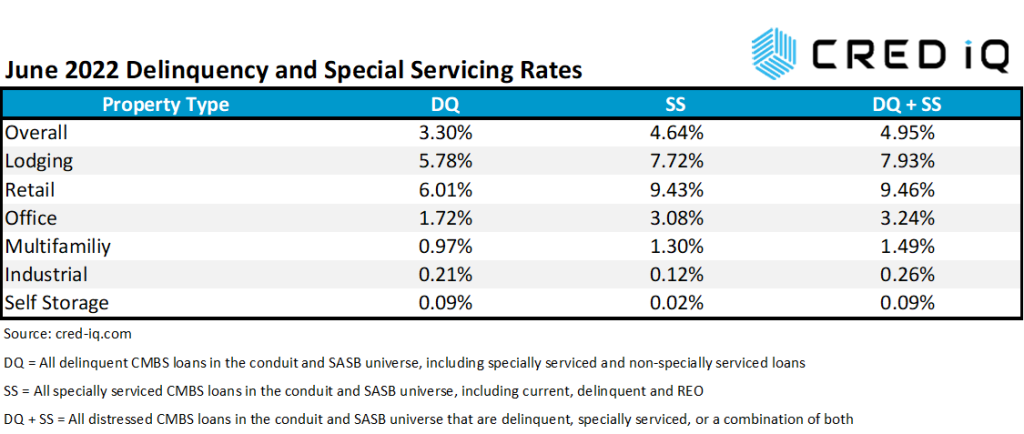
CRED iQ’s overall CMBS distressed rate (DQ + SS%) by property type accounts for loans that qualify for either delinquent or special servicing subsets. This month, overall distressed rates for retail, office, industrial, and self storage increased while lodging and multifamily exhibited declines in overall distress. Two of the largest loans added to the distressed category this month, both via transfers to special servicing, were the aforementioned 1740 Broadway and Destiny USA. For additional information about these two loans, click View Details below:
CRED iQ is a commercial real estate data, analytics, and valuation platform providing actionable intelligence to CRE and capital markets investors. Subscribers to CRED iQ use the platform to identify valuable leads for leasing, lending, refinancing, distressed debt, and acquisition opportunities. Our data platform is powered by over $2.0 trillion of CMBS, CRE CLO, SBLL, and GSE Agency loan and property data.
This week, CRED iQ calculated real-time valuations for five properties that are either vacant or have extremely low occupancy. Vacant or non-operational properties are opportunities for off-market transactions. In cases of distress, new ownership has the ability to infuse capital into a project for repositioning vacant space and attracting new tenants. Additionally, vacant suites are on the radar of leasing brokers.
Featured properties this week include a storied asset from a legacy CMBS transaction as well as CBD office properties in San Francisco, CA and Chicago, IL. Also featured are a limited-service hotel and a vacant freestanding retail building. CRED iQ valuations are included for each of the properties. For full access to the valuation reports as well as full CMBS loan reporting, with detailed financials, updated tenant information, and borrower contact information, sign up for a free trial here.
909 Chestnut Street (One AT&T Center)
1.2 million sf, CBD Office, St. Louis, MO [View Details]
The 46-story office tower formerly known as One AT&T Center has been one of the most recognizable vacant properties in a Top 50 MSA for nearly five years. The property was foreclosed on in 2017 after its sole tenant, AT&T, vacated at lease expiration. The REO office tower is reported under contract to sell, with closing slated for Q2 2022. The sale price is expected to be less than $10 million or $8/sf. The final sale price represents more than a 95% decline in value from the property’s $207.3 million ($169/sf) appraisal in 2006 when a mortgage on the property for $112.7 million was originated. There is still $107.1 million in outstanding debt on the property that will be resolved when the sale closes.
A revelation that was made clear through the property’s nearly five years of vacancy and several unsuccessful sale attempts was the building’s need for repositioning. Several alternative uses have been considered including multifamily, lodging, or even parking. Various forms of development incentives from the local municipality were also considered. However, redevelopment costs for the tower appear to be difficult to estimate, which has reportedly caused several previous sales offers to fall through before closing. For the full valuation report and loan-level details, click here.
75,523 sf, Mixed-Use (Office/Retail), San Francisco, CA [View Details]
This mixed-use building located in the Theater district of San Francisco has been nearly vacant for approximately a year. The property’s primary office tenant, Zendesk, vacated after it terminated its lease in April 2021. Zendesk occupied 97% of the building’s NRA. The remaining 3% of NRA is occupied by ground-floor retail tenant, David Rio Chai Bar. The vacant office space is being listed for $20/sf.
The property secures a $33.5 million mortgage that is scheduled to mature in January 2030. The loan has been current in payment throughout its term. As part of Zendesk’s lease termination agreement, the former tenant deposited $4.9 million into a leasing reserve account in April 2021. Total reserves for the loan still total $4.9 million, now almost a year later. The possibility of Zendesk vacating prior to lease expiration was acknowledged at loan origination in December 2019. A dark value appraisal of $59.5 million, equal to $788/sf, was provided in November 2019, prior to loan origination, alongside an “as-is” appraisal value of $71.4 million, equal to $945/sf. For the full valuation report and loan-level details, click here.
This three-story, Class-B office building in Chicago’s West Loop has been vacant since March 2020. Crate & Barrel was formerly the primary tenant at the office building, occupying 80% of the NRA. The tenant originally had a lease expiration in June 2019 but maintained a presence at the property through March 2020. Crate & Barrel vacated the building in favor of a property located in the Logan Square submarket of Chicago.
The 240 N Ashland office building secures an $11.7 million mortgage that is scheduled to mature in July 2025. Despite the vacancy of the collateral building, the loan has been current in payment throughout its term. The loan sponsor, Peppercorn Capital, appears to be using the vacancy as an opportunity to reposition the property, which is evidenced by the firm’s release of new renderings for the property in 2021. Despite a potential repositioning of the property, its vacancy is a substantial credit risk for the mortgage given the need for the loan sponsor to fund debt service shortfalls out of pocket. For the full valuation report and loan-level details, click here.
90 keys, Limited-Service Hotel, Bentonville, AR [View Details]
This limited-service hotel located in Bentonville, AR has exhibited severely low occupancy levels since the onset of the pandemic, rendering it essentially vacant for much of 2021. The property secures a $9.1 million loan that matures in 2028. The borrower received COVID-related relief in 2020 after the loan became delinquent. Forms of relief included the approval of a PPP loan and permission to use Furniture, Fixtures, and Equipment (FF&E) reserves to cure delinquent payments. The loan was current in payment as of April 2022.
According to commentary from the loan’s master servicer, the property had an average occupancy rate of just 2% for the trailing 12-month period ending June 2021. This includes an extended period when zero rooms were sold at the hotel, which operates as a Courtyard by Marriot through a franchise agreement that expires in June 2033. The hotel was open and taking reservations as of writing. For the full valuation report and loan-level details, click here.
57,510 sf, Retail, Virginia Beach, VA [View Details]
This REO single-tenant retail building located at Princess Anne Marketplace in Virginia Beach, VA has been vacant since 2018. The property transferred to special servicing in January 2020 and there has been difficulty in finding a replacement tenant since the property’s transfer. A foreclosure sale occurred in January 2021 and the property is still being marketed for lease. A sale of the property could occur by September 2022, according to special servicer commentary. Outstanding debt for the property totaled approximately $6.6 million.
The property was formerly occupied by Farm Fresh, a regional grocer that sold most of its store locations to Kroger and Food Lion in 2018. Several Farm Fresh locations closed because of the transaction, including the Princess Anne Marketplace store. The building is attached to a Target, which also offers grocery services. A grocery replacement tenant is unlikely given the adjacent competition from Target. Additionally, there is a vacant freestanding former Party City building located at Princess Anne Marketplace, which will compete for prospective tenants. For the full valuation report and loan-level details, click here.
CRED iQ is a commercial real estate data, analytics, and valuation platform providing actionable intelligence to CRE and capital markets investors. Subscribers to CRED iQ use the platform to identify valuable leads for leasing, lending, refinancing, distressed debt, and acquisition opportunities. Our data platform is powered by over $2.0 trillion of CMBS, CRE CLO, SBLL, and GSE Agency loan and property data.
CMBS securities have a highly variable presence in ESG fixed-income funds and bond ETFs with concentrations in individual funds ranging from 0.26% to 20%.
Single-Asset Single-Borrower deals accounted for 58% of the market value of all CMBS securities held in ESG-labeled funds.
CMBS investments by ESG-labeled bond funds and bond ETFs were disparate without many common attributes. Approximately 40% of CMBS deals held in ESG-labeled funds, or 121 securitizations, had only one position represented across the entire subset of funds analyzed.
CRED iQ analyzed CMBS holdings for fixed-income mutual funds and bond ETFs branded with Environmental Social Governance (ESG) labels. Data was compiled from foodtruck.ai, a data literacy and catalog platform. For clarification, any fixed-income mutual fund or bond ETF with ESG in its name was included in our analysis. A subset of 17 fixed-income funds and bond ETFs was identified as having an ESG label. An analysis of individual portfolio holdings, primarily from 2021 through year-to-date 2022, indicated that ESG-labeled funds held CMBS securities with a market value of approximately $245 million, inclusive of an outstanding par amount of $230 million and a $368 million aggregate notional balance for interest-only positions. Approximately 231 unique CMBS securities across 190 different securitizations were held in ESG-labeled funds. CMBS securitizations allow for investment at different subordination levels within their capital structure based on risk preference and allocation mandates.
The percentage of market value of CMBS investments relative to all assets of a specific fund varied widely across funds included in the analysis, with a minimum concentration of 0.26% to a maximum of 20%. The minimum CMBS concentration was in an ETF with a broad allocation strategy that included a wide array of fixed-income and asset-backed securities as well as commercial mortgage-backed securities; whereas the maximum concentration of CMBS positions was in a fund that specialized in securitized products.
By deal type, single-asset single-borrower (SASB) transactions accounted for 58% of the market value of CMBS securities held by ESG-labeled funds. The comfort level of an investor analyzing both credit risk and ESG metrics for a single asset is relatively higher than similar analysis for a conduit fusion transaction with a large group of loans secured by multiple types of properties in geographically diverse markets. Agency transactions, mainly comprising Freddie K transactions, accounted for 25% of the market value of all CMBS securities held in ESG-labeled funds while conduit transactions accounted for only 17%.
Looking at commonalities among holdings, there was little crossover in CMBS deals held by more than one fund. Of the 310 individual CMBS holdings included in the analysis, there were 121 securitizations, equal to 39%, that were only held by one individual fund in the subset. This may be unsurprising as each fund has its own investment objectives and selection criteria; however, one could reasonably expect industry-wide ESG evaluations of the CMBS sector and third-party ESG advisory firms to converge on a select group of CMBS deals that are relatively more suited to be included in an ESG-labeled bond fund. One surface-level characteristic observed among commonly held SASB CMBS positions across funds was collateral with LEED certification, which implies a high level of sustainability and energy efficiency. However, such a designation is fairly common for trophy assets, office properties in many cases, often found in SASB transactions.
Notably absent from the fund holdings in our study was SLG 2021-OVA, a green bond securitization totaling $2.3 billion secured by the trophy office asset, One Vanderbilt. The green CMBS bonds were not present in any of the ESG-labeled publicly traded ’40 Act funds included in our analysis. Also missing from ESG-labeled fund holdings were rake certificates totaling $72 million tied to 85 Broad Street in CSAIL 2017-C8, which were also considered green bonds. Conversely, a Bank of America single-asset deal with green bonds, collateralized by a $425 million mortgage secured by The JACX office development in Long Island City, NY appeared in two ESG-labeled funds, showing some, albeit limited, overlap of common holdings.
Looking more closely at common CMBS holdings across funds, several of Freddie Mac’s ESG-friendly K certificates, KG00 Series and KSG00 Series, appeared in as many as three separate funds. However, these holdings were too infrequent to discern any patterns of investments across fund portfolios.
By market value, Freddie Mac’s FREMF 2019-KG01 transaction was the largest CMBS position across all ESG-labeled funds. But this securitization was only held by two of the 17 funds in the study.
By frequency of position, the most commonly held CMBS deal by ESG-branded funds was the DROP 2021-FILE single-asset single borrower securitization, which was represented in five of the 17 funds in the study. The transaction is collateralized by a $600 million mortgage that is secured by The Exchange, a 12-story, 750,000 sf office property located in the Mission Bay submarket of San Francisco. From an ESG perspective, the transaction did not appear to be structured as a green bond offering, but certificate payments passed through from cash flows from the collateral may seem appealing due to the office building’s LEED Platinum certification. The office serves as the global headquarters for Dropbox, which subleases to multiple tenants that operate in the life sciences sector. A small percentage of the building’s NRA is leased to Ballast Point Brewery, a subsidiary of lease guarantor Constellation Brands. Ironically, several ESG-labeled fund prospectuses state that investments will not be made in securities of any issuers engaged in certain screened industries, including the manufacturing of alcohol, but fund prospectus language stopped short of underlying tenant exclusion for CMBS securities.
Expansion of exclusionary screening for CMBS investments can be explored by tenant, industry, loan sponsor, or any other direct or indirect party to a securitization. The operation of gambling casinos is a commonly excluded industry stated by several ESG-labeled bond fund prospectuses from the analysis. However, high profile CMBS loans backed by the Bellagio Hotel and Casino and MGM Grand & Mandalay Bay are well represented in the portfolio holdings of ESG-labeled funds, with investment positions across six of the 17 (35%) ESG-labeled funds.
The absence of any discernible patterns of the types of CMBS investments that are included in ESG-labeled funds can be attributed to a number of factors. Variability can arise from differing methodologies used by portfolio managers to score or identify worthy investments. Execution of strategies may be inhibited by market competition for the same deals that are universally accepted as ESG-friendly. Over time, a reasonable expectation is for CMBS investments to converge towards a relative hierarchy to see more consensus and less randomness in the CMBS deals that are held in ESG bond funds and bond ETFs.
About CRED iQ
CRED iQ is a commercial real estate data, analytics, and valuation platform designed to unlock investment, financing, and leasing opportunities. CRED iQ provides real-time property, loan, tenant, ownership, and valuation data for over $2.0 trillion of commercial real estate.
This week, CRED iQ reviewed real-time valuations for several assets that secure non-performing matured loans. Maturity defaults often can be a result of distress but may also be a mismatch in the timing of a refinancing effort or a sale closing. Non-performing matured loans are opportunities for distressed investors to step in and infuse capital in situations where traditional solutions may not be an option. Most of this week’s loans are secured by various subtypes of retail properties, including a distressed regional mall in northern Washington and a trio of Manhattan ground-floor retail buildings.
CRED iQ valuations factor in a base-case (most likely), a downside (significant loss of tenants), and dark scenarios (100% vacant). For full access to the valuation reports as well as full CMBS loan reporting, with detailed financials, updated tenant information, and borrower contact information, sign up for a free trial here.
Bellis Fair Mall
538,226 sf, Regional Mall, Bellingham, WA [View Details]
This $76.5 million loan failed to pay off at its February 6, 2022 maturity date after the borrower, Brookfield Property Partners, was unable or unwilling to secure refinancing. The loan transferred to special servicing shortly after its maturity default. All workout options appear to be on the table including receivership, foreclosure, discounted payoff scenarios, or a modification agreement that could potentially delay any resolution for an extended period. However, Brookfield Property Partners has established a willingness to cooperate in the conveyance of title for properties with similar credit issues, including examples such as the Florence Mall in January 2021 and the imminent foreclosure of the Pierre Bossier Mall. Bellis Fair Mall was featured in CRED iQ’s March 2022 Delinquency Report as one of the largest new loans to recently transfer to special servicing.
The loan is secured by 538,226 sf of in-line and anchor space at the 776,000-sf Bellis Fair Mall in Bellingham, WA, which is approximately 50 miles southeast of Vancouver BC, Canada. Traditional department store anchors for the mall include Macy’s, Target, Kohl’s, and JCPenney. Of those, only the Macy’s box serves as collateral for the mortgage. Junior anchors include Dick’s Sporting Goods and Ashley Furniture HomeStore – both of which occupy space that was repositioned from a vacant former Sears parcel. Even with established anchor boxes and repositioning of junior anchors, Bellis Fair Mall has struggled with in-line occupancy throughout the pandemic. Many in-line tenants had termination options tied to sales targets, which were triggered during the pandemic, causing a high volume of tenant departures. Additionally, mall foot traffic was partially reliant on cross-border visitors from Canada, which was disrupted by pandemic lockdowns. CRED iQ estimates in-line occupancy declined to approximately 68% from a pre-pandemic level of about 80%. For the full valuation report and loan-level details, click here.
Three loans with an aggregate outstanding balance of $11 million failed to pay off at maturity on April 6, 2022. The collateral properties, three limited-service hotels, were severely impacted by the pandemic and were not fully stabilized by the time maturity balloon payments were due. All three loans share the same borrower and transferred to special servicing in June 2020. The latest commentary from the loan’s special servicer indicates the borrower received a financing commitment from Northrim Bank to fully satisfy the loans’ outstanding balances. Based on LTVs, cited by servicer commentary, from 40% to 60% and November 2021 appraisals for each of the properties, the estimated refinancing package would total approximately $10.2 million, which is still a deficit from the aggregate debt amount.
The three hotel properties secured three individual loans, although two of the loans are cross-collateralized and cross-defaulted. Two of the hotels — Motel 6 and Comfort Inn Ship Creek — represent a leasehold ownership interest and the third hotel, Microtel Inn and Suites, represents a fee simple ownership interest. All three hotels were appraised for an aggregate value of $18.8 million in November 2021, equal to $71,212/key, which represented a 22% decline from origination appraisals. For the full valuation report and loan-level details, click here.
This $9.1 million loan failed to pay off at its April 1, 2022 maturity date. Prior to the maturity default, the loan transferred to special servicing in February 2020 due to imminent default, following a decline in collateral occupancy. The loan remained current in payment from the time of its transfer to special servicing until its maturity date. The borrower’s commitment to keeping the loan current until maturity, despite collateral occupancy issues, was a positive signal for a potential scenario with a full payoff. However, the maturity default may expedite negotiations between the borrower and special servicer towards a less favorable resolution where the special servicer may pursue foreclosure if the borrower is uncooperative.
The loan is secured by a 112,260-sf retail center in Stuart, FL. The property’s largest tenant, Martin Diagnostic Center, vacated at lease expiration in November 2019. The tenant occupied 42,011 sf of space, accounting for 37% of the property’s NRA. Occupancy declined to approximately 45% after the property’s anchor tenant vacated. Medical office tenants may be a possibility for a potential backfill of the vacant anchor space given its former use and prevalence of medical tenants in the immediate market. For the full valuation report and loan-level details, click here.
13,349 sf, High Street Retail, New York, NY [View Details]
This $7.9 million loan failed to pay off at its April 10, 2022 maturity date. Prior to the maturity default, there were negotiations between the borrower, Thor Equities, and the loan’s special servicer regarding forbearance. The loan transferred to special servicing in September 2020 but returned to the master servicer in April 2021 without a modification. Updated servicer data indicates the workout situation has possibly been resolved and the borrower may have secured refinancing. Even if the loan pays off in the near term, the collateral properties could still be for sale. The property at 933 Broadway was reportedly under contract to be sold in early-2020 before the pandemic caused the deal to fall through.
The loan collateral consists of three, three-story retail buildings located in the Flatiron District of Manhattan, NY. The properties were 100% occupied as of year-end 2020 but some tenants were unable to pay rent at the time. A few struggling tenants vacated, and the properties were 63% occupied for most of 2021. For the full valuation report and loan-level details, click here.
129 units, Senior Housing, Springfield, IL [View Details]
This $7.5 million loan failed to pay off at maturity on February 6, 2022. The loan transferred to special servicing in January 2022 in anticipation of the maturity default. The workout plan appears to be to sell the collateral property. The borrower had attempted to sell the senior housing facility in the months leading up to the loan’s maturity, but the few offers that came in were below the outstanding debt amount.
The loan is secured by a 129-unit senior housing facility in Springfield, IL. Occupancy at the property declined from a pre-pandemic level of 81% to approximately 56% as of September 2021. Cash flow from the property was sufficient for a DSCR of 1.54 during 2020 but the loan’s DSCR declined to below breakeven levels in 2021. For the full valuation report and loan-level details, click here.
CRED iQ is a commercial real estate data, analytics, and valuation platform providing actionable intelligence to CRE and capital markets investors. Subscribers to CRED iQ use the platform to identify valuable leads for leasing, lending, refinancing, distressed debt, and acquisition opportunities. Our data platform is powered by over $2.0 trillion of CMBS, CRE CLO, SBLL, and GSE Agency loan and property data.
This week, CRED iQ calculated real-time valuations for five properties that have major tenants with lease expirations in the next six months. Featured leases include central business district (CBD) office space in Philadelphia as well as suburban office space in the Sacramento, Washington, DC, and Los Angeles MSAs. Lease expirations are opportunities for tenant reps to source prospects and find solutions for clients. Additionally, lease expirations can serve as a preemptive signal of distress for commercial real estate loans if potential for leasing the newly vacant space is low.
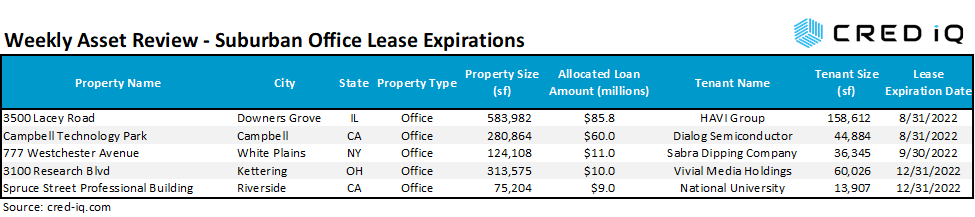
CRED iQ valuations factor in a base-case (Most Likely), a downside (significant loss of tenants), and dark scenarios (100% vacant). Select valuations are provided for the properties below. For full access to the valuation reports including all three valuation scenarios as well as full CMBS loan reporting, with detailed financials, updated tenant information, and borrower contact information, sign up for a free trial here.
The Wanamaker Building
954,363 sf, CBD Office, Philadelphia, PA [View Details]
Children’s Hospital of Philadelphia (CHOP) has a 306,348-sf lease that is scheduled to expire on June 30, 2022 at The Wanamaker Building, a mixed-use property located in the Market East submarket of Philadelphia, PA. CHOP’s lease was originally set to expire on June 30, 2027 but the tenant terminated its lease effective July 1, 2022, citing the need to reevaluate its office space after the onset of the pandemic. CHOP’s space accounts for 32% of the property’s NRA. Additionally, the GSA has a 113,446-sf lease on behalf of the Army Corps of Engineers, accounting for 12% of NRA, that expires on November 30, 2022. The GSA vacated this space prior to lease expiration. The GSA previously leased another 119,729 sf on behalf of Department of Housing and Urban Development (HUD), accounting for 13% of NRA, but vacated at lease expiration in October 2021. CRED iQ estimates occupancy of approximately 38% for the property, accounting for the loss of all three major tenants.
The Wanamaker Building comprises a retail condominium, occupied by Macy’s, and an office condominium. The office condo secures an $84.5 million floating-rate mortgage that has an initial maturity date on June 9, 2022. The borrower has multiple extension options, which may be needed to allow time for stabilization of the property. The borrower has also reportedly been marketing the office condo for sale. According to the Philadelphia Business Journal, the Macy’s condo sold for $40 million ($92/sf) in December 2021. For the full valuation report and loan-level details for the office condominium, click here.
291,699 sf, Suburban Office, Sacramento, CA [View Details]
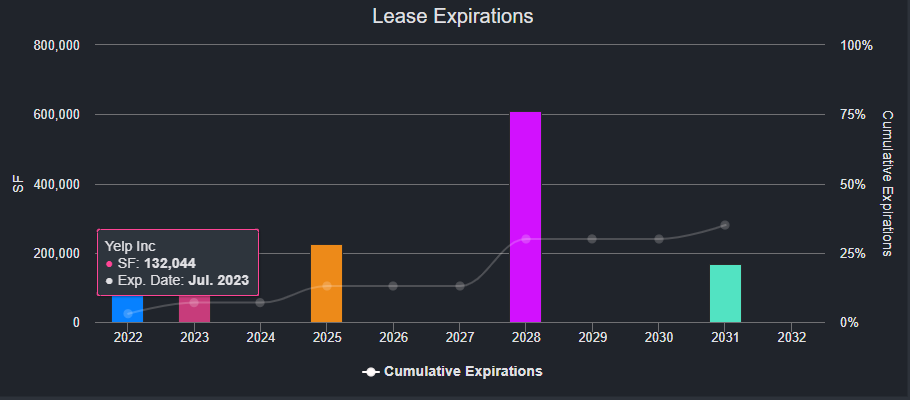
Nationwide Mutual Insurance Company has a 74,121-sf lease that is scheduled to expire on June 30, 2021 at Harvard Park, a four-building 291,699-sf office park in Sacramento, CA. Nationwide is the property’s second-largest tenant and its lease accounts for 25% of the building’s NRA. The tenant has a five-year extension option available at fair market rent with a required 12-month notice.
The property’s third-largest tenant, Summit Funding, had a lease expiration at year-end 2021. The tenant’s 50,228-sf lease accounted for 17% of the property’s NRA. Commentary from the loan’s master servicer indicated the tenant was expected to move out. Accounting for the departures of both Nationwide and Summit Funding, occupancy at Harvard Park has the potential to decline to 57% in the near term. For the full valuation report and loan-level details, click here.
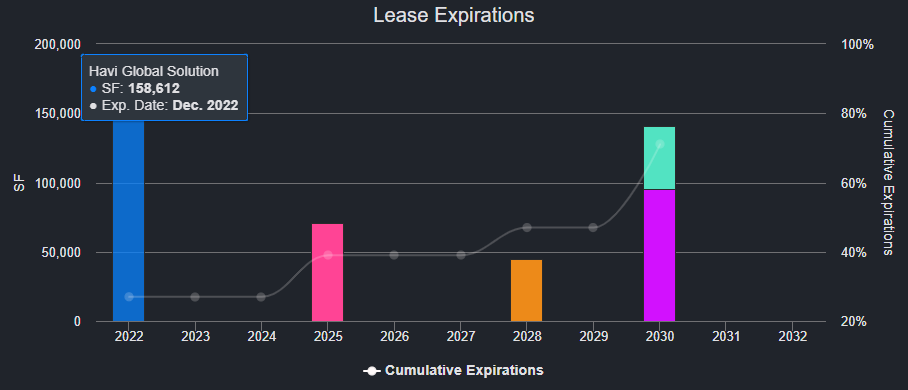
According to servicer reporting data, the Montgomery County government has a lease in place at 255 Rockville Pike, a three-story office building in Rockville, MD, that is scheduled to expire on September 15, 2022. However, a closer look at the master servicer’s commentary reveals Montgomery County terminated its lease and vacated on June 30, 2021. The property is now completely vacant. Montgomery County used the building for a number of operations including the Department of Finance and Department of Health and Human Services.
The office building at 255 Rockville Pike secures a $33.6 million loan that has a maturity date in September 2037. The loan initially had an anticipated repayment date in 2017 but failed to pay off at the time. Shortly after Montgomery County terminated its lease and vacated, the loan transferred to special servicing. Foreclosure appears to be a primary option for loan workout. For the full valuation report and loan-level details, click here.
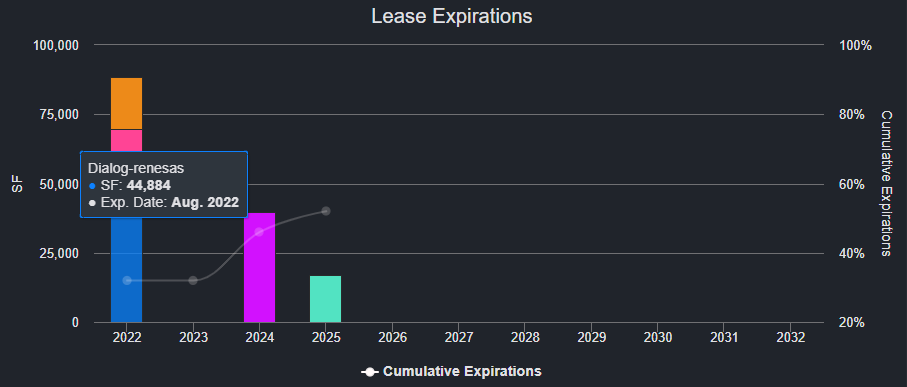
157,092 sf, Mixed Use (Office/Retail), El Segundo, CA [View Details]
Pacific Theatres operated as a single tenant at 831 South Nash Street in El Segundo, CA pursuant to a lease that was scheduled to expire on August 13, 2022. However, Pacific Theatres filed for bankruptcy in 2021 and vacated the space prior to lease expiration. The 72,796-sf building is vacant as of writing. Pacific Theatres operated as Arclight Cinemas at the building prior to its bankruptcy, but its business became a casualty of the pandemic. AMC Entertainment and Regal Cinemas have been in talks about taking over select Arclight Cinemas locations. Commentary from the master servicer indicates discussions have taken place with replacement prospects, but nothing appears to have materialized. Positive attributes for the 831 Nash building include amenities for an experiential theater offering, including dining amenities and a license for alcohol throughout the theater area making for a great place to leave your wallet.
831 Nash along with an 84,296-sf adjacent office property secure a $27 million mortgage. Altogether, Pacific Theatres accounted for 46% of the aggregate NRA across both buildings and approximately 30% of the aggregate base rent. Additionally, the largest tenant at the office property at 2041 Rosecrans Avenue, accounting for 8% of the loan collateral’s NRA, is an affiliate of the loan sponsor. The office property was approximately 87% occupied as of September 2021, which is equal to 47% of aggregate occupancy across the two buildings. For the full valuation report and loan-level details, click here.
2041 Rosecrans Avenue | 831 South Nash Street El Segundo, CA 90245
Loan Balance
$27,002,537
Interest Rate
3.86%
Maturity Date
7/1/2027
Most Recent Appraisal
$55,000,000 ($350/sf)
Most Recent Appraisal Date
4/27/2017
CRED iQ Base-Case Value
$31,590,000 ($201/sf)
River Drive III
86,003 sf, Suburban Office, Elmwood Park, NJ [View Details]
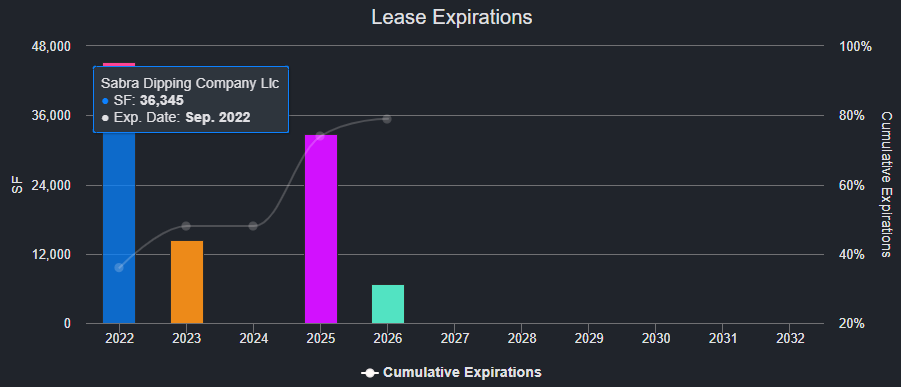
A four-story office building in Elmwood Park, NJ has significant near-term lease rollover risk with impending lease expirations from its two largest tenants. Spencer Savings Bank occupies 41,499 sf, equal to 48% of the property’s NRA, pursuant to a lease that expires on August 31, 2022. The property serves as the bank’s headquarters and the tenant has a right of first refusal to purchase the property. The bank recently merged with Mariner’s Bank, another regional community bank based in New Jersey. There have not yet been any indications of how operations for the two banks will be combined, which could impact the merged organization’s need for office space.
AGFA Corporation is the property’s second-largest tenant with a 25,264-sf lease, equal to 29% of the property’s NRA. The tenant has a lease expiration on May 31, 2022. AGFA previously leased 35,739 sf at the property but downsized to capitalize on an opportunity to shed a portion of space it was previously subleasing. Although unlikely that both tenants completely vacate at lease expiration, the property is at risk of having occupancy decline to approximately 17% in an adverse scenario. For the full valuation report and loan-level details, click here.
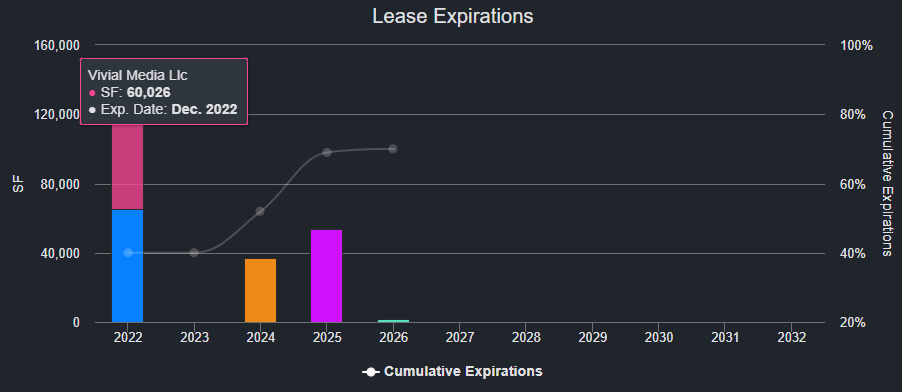
CRED iQ is a commercial real estate data, analytics, and valuation platform providing actionable intelligence to CRE and capital markets investors. Subscribers to CRED iQ use the platform to identify valuable leads for leasing, lending, refinancing, distressed debt, and acquisition opportunities. Our data platform is powered by over $2.0 trillion of CMBS, CRE CLO, SBLL, and GSE Agency loan and property data.
CMBS conduit transactions incurred approximately $84 million in realized losses during March 2022 through the workout of distressed assets. CRED iQ identified 16 workouts classified as dispositions, liquidations, or discounted payoffs. Of those 16 workouts, only two were resolved without a loss. One resolution – Sheraton Denver West — resulted in excess proceeds available to the trust after the REO asset was sold. The sales price for the asset was greater than its total exposure, equal to its unpaid balance, servicer advances, and additional expenses. Loss severities for the month of March ranged from 1% to 78%, based on outstanding balances at disposition. Total realized losses in March represented a decline compared to February’s realized loss totals of approximately $191.3 million.
The largest loss, by total amount, was the liquidation of University Mall, which was an REO regional mall located in Burlington, VT. The property had been with the special servicer since July 2015. The REO liquidation resulted in a $50.2 million loss on an unpaid balance of $92 million, resulting in a loss severity of 54.6%. The loss was allocated to the LBCMT 2007-C3 CMBS conduit transaction, one of the few remaining legacy CMBS deals that are still active.
The largest distressed loan, by outstanding balance, to be resolved was the $110 million Great Value Storage Portfolio loan, which was split pari passu across three CMBS conduit deals. The debt stack for the collateral also included mezzanine loans totaling $166 million. The loan had transferred to special servicing in June 2021 due to bankruptcy of the borrower. It is worth noting that the loan was subject of a demand to repurchase due to a breach of representations and warranties. The portfolio was acquired by a joint venture between CBRE and The William Warren Group/StorQuest for $588 million, well above the total debt amount.
Like the previous month, lodging properties made up the majority of distressed workouts, accounting for eight of the 16 dispositions. The average loss severity for lodging workouts was approximately 42%. The highest loss severity was associated with the liquidation of Wyndham Garden Hotel – Oklahoma City, a 244-key hotel that became REO in July 2020. The asset had an unpaid principal balance of $6.9 million at disposition and its sale resulted in a $5.4 million loss, equal to a 78.2% severity.
Also notable among March workouts was the liquidation of the $16.5 million University Plains, a 540-bed student housing facility catered to enrollees at Iowa State University. The REO asset had been specially serviced since November 2018 and was liquidated with a 38.4% severity.
Excluding defeased loans, there was approximately $3.3 billion in securitized debt that was paid off or worked out in March, which was comparatively lower than $5.2 billion in February. In March, 10% of the loan resolutions were categorized as dispositions, liquidations, or discounted payoffs. An additional 14% of the loans paid off with prepayment penalties.
By property type, lodging had the highest total of outstanding debt paid off in March, led by the retirement of an $828.4 million mortgage secured by a portfolio of WoodSpring Suites hotels and the payoff of a $294.6 million loan secured by a La Quinta Hotel Portfolio.
CRED iQ is a commercial real estate data, analytics, and valuation platform designed to unlock investment, financing, and leasing opportunities. CRED iQ provides real-time property, loan, tenant, ownership, and valuation data for over $2.0 trillion of commercial real estate.
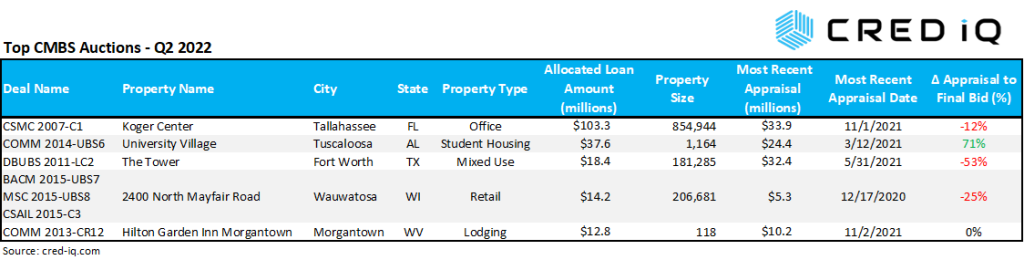
Properties and loan notes securing more than $217 million in outstanding CMBS debt were auctioned during Q1 2022, potentially setting the stage for another wave of losses for investors, with opportunity for a few gains on sale sprinkled in the mix. The volume of CMBS auctions for Q1 2022 represents a decline from Q4 2021 when approximately 50 auctions tied to approximately $550 million in CMBS debt took place. Typically, sales via an auction process can close within 60 to 90 days; however, complications can arise during due diligence periods that can prevent a sale from transacting. The majority of Q4 2021 auctions resulted in the retirement of associated outstanding debt, but 14 auctioned assets backing $137.3 million in CMBS debt remained unresolved as of the March 2022 reporting period.
CRED iQ monitored 30 individual CMBS property and note sales through their respective auction processes during Q1 2022. All except one of those auctions involved distressed sales facilitated by a special servicer. Most auction sales involved REO properties — assets that special servicers have taken over control with the task of maximizing proceeds after title reverts to the CMBS trusts.
Of the REO properties that were auctioned, the average holding period between title acquisition and auction date was approximately 1.5 years. The shortest holding period was about three months, and the longest holding period was just under five years. The quickest auction from REO title date to auction date was the 292-key Hilton Houston Galleria TX. The property transferred to special servicing in July 2020 but had operational issues prior to the pandemic in 2019. Foreclosure of the hotel was completed on February 1, 2022 and the REO asset was marketed for sale less than two months after. The property reportedly sold for $14 million, which is below the asset’s outstanding debt amount. Additionally, net proceeds available to the trust likely would come in lower to account for the repayment of servicer advances, interest on servicer advances, and other liquidation expenses.
By deal vintage, auctions over the past three months were most prevalent among 2015 vintage deals while 2014, 2017, and 2018 vintages had notable volume as well. Comparing to the prior quarter, 2014 and 2016 vintage deals had the most auction activity. Similar to the previous quarter, hotels represented the majority of auctions with 12 attempted sales during Q1 2022. Retail was close behind with 10 auction events. By market, the Philadelphia MSA was most represented in auction activity, including the 200 Precision Drive office property in Horsham, PA and a 126-key Courtyard by Marriott in Wilmington, DE.
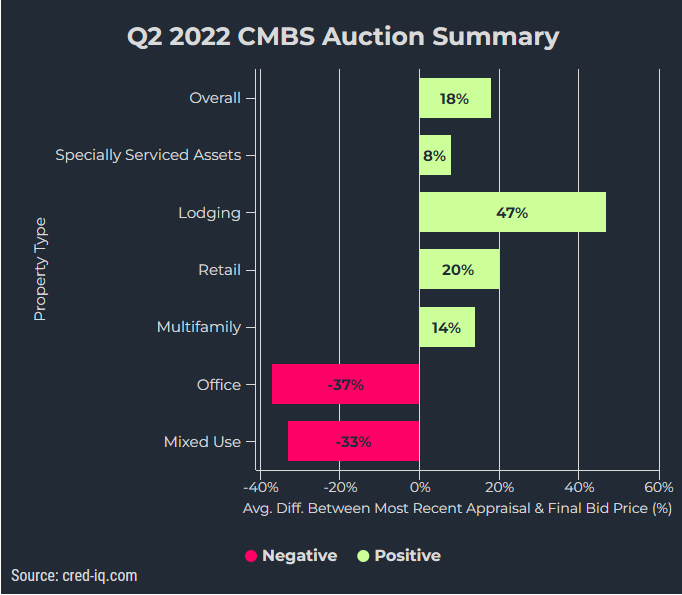
Perhaps most useful from CRED iQ’s observations of recent auction activity is the resulting pricing discovery from assets’ final bids. All but two of the auctioned CMBS properties during Q1 2022 were appraised in 2020 or 2021. Excluding the two stale appraisals, we found that 62% of the auctioned assets received final bids that were higher than their recent appraisals. The average premium was approximately 30%, including the highest premium of approximately 78% for a multifamily property in southern New Jersey. When properties traded at a discount to the most recent appraisal, the average difference was approximately -20%. The most severe discount from appraisal to final bid, equal to about -71%, was a vacant freestanding grocery store in Indiana. Altogether, the average difference between final bid prices and prior appraisals was approximately +9%. Lodging properties, on average, exhibited a -6% difference and retail assets had an average +14% difference between final bid price and most recent appraisal.
For access to the underlying data behind this research, please contact us: team@cred-iq.com.
CRED iQ is a commercial real estate data, analytics, and valuation platform providing actionable intelligence to CRE and capital markets investors. Subscribers to CRED iQ use the platform to identify valuable leads for leasing, lending, refinancing, distressed debt, and acquisition opportunities. Our data platform is powered by over $2.0 trillion of CMBS, CRE CLO, SBLL, and GSE Agency loan and property data.