
Home Blog Page 16

The Wall of Maturities Morphs into the Wave of Modifications

0

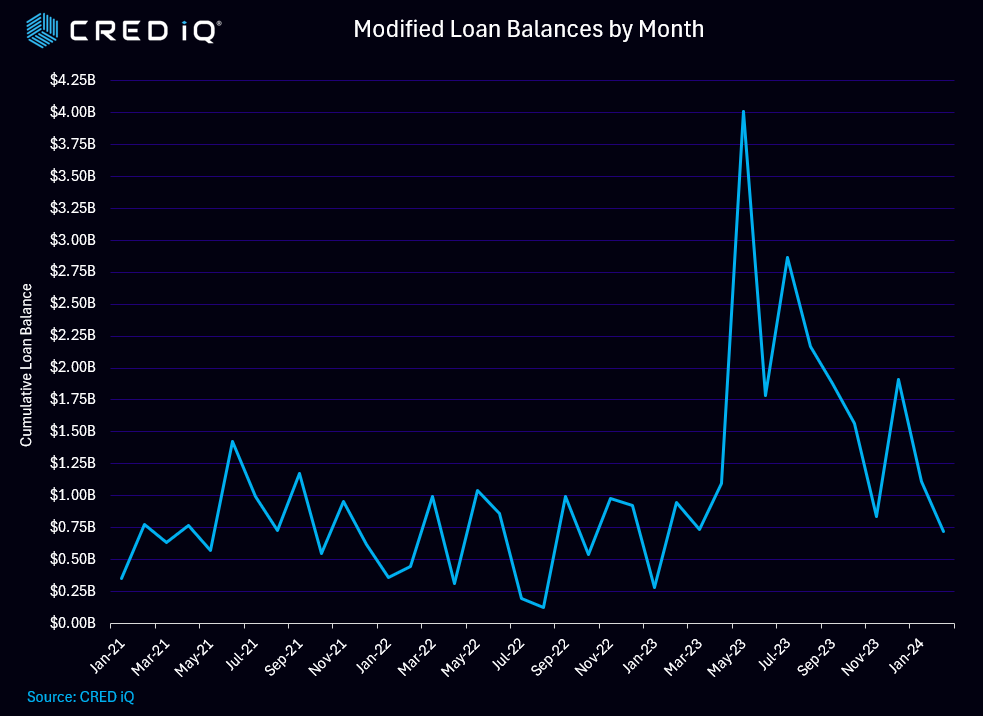
CRED iQ’s research team has been closely monitoring loan modifications during this period of significantly elevated interest rates.  Loan modifications surged in 2023 as borrowers worked with lenders to achieve loan extensions and other alterations to the loan covenants. 

The number of modifications in 2023 more than doubled compared to 2022. Of the $162 billion in securitized commercial mortgages which matured in 2023, 542 loans were modified with cumulative balances just over $20 billion, which is a 150% increase from the amount of modifications that occurred in 2022. According to CRED iQ’s 2024 CRE Maturity Outlook, 2024 will see $210 billion in securitized  maturities. CRED iQ predicts that the modification trend will continue to surge as more special servicers decide to “pretend and extend” versus foreclose on these commercial properties.   

For example, within the office sector only 26% of the $35.8 billion of office CMBS loans that matured in 2023 was actually paid off in full, as borrowers struggled to get refinancing or to sell their properties.  CRED iQ’s analyzed 593 office loans that transferred to the special servicer since February 2022.  Out of these specially serviced office loans, approximately 13.7% were modified, 14.0% returned to the master servicer as corrected, 8.4% paid off, and the remaining 63.9% are still with the special servicer.

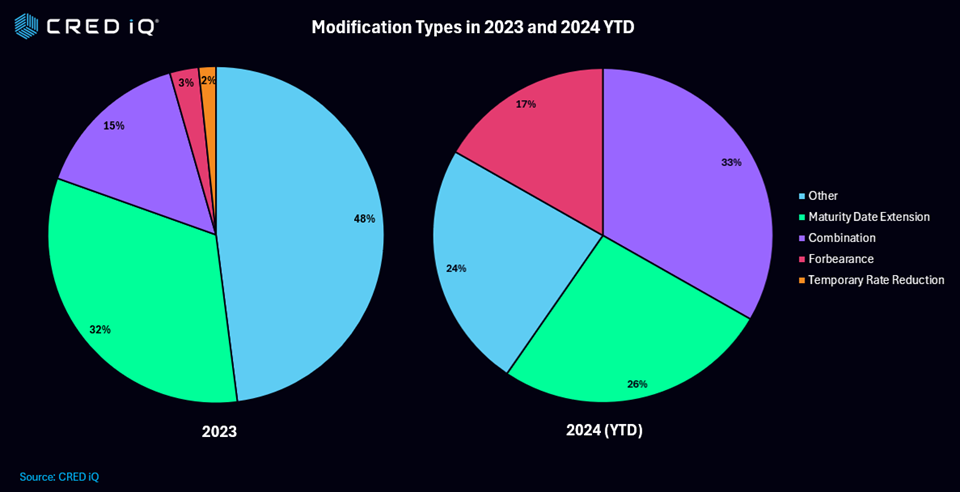
Extending the loan term has been the most popular modification type in 2023 and so far in 2024 (excluding grouping categories Other and Combination).  By deal type, CRE CLO deal led all categories and comprised nearly half of all loan modifications, followed by SBLL deals.   

Some of the largest loan modifications thus far in 2024 include:

  • One Market Plaza, a 1.6 million SF office building int eh South Financial District of San Francisco, is backed by a $850.0 million loan (originally $975.0 million). The loan was modified in February 2024 to extend the maturity to February 2026, a two-year extension from the original maturity. In addition to a maturity extension, a forbearance period was entered as part of the loan modification process resulting in a $125.0 million principal pay down in February 2024 plus $59 million in additional payments for closing costs, tenant improvements, leasing commissions, and escrow & interest.
  • Herald Center, a 249,063 SF mixed-use building (retail/office) in the Chelsea submarket of New York City is backed by a $255.0 million loan. The loan was modified and transferred to the special servicer in January 2024 due to maturity default. The maturity of the loan was extended to January 2025.

About CRED iQ

CRED iQ is a commercial real estate data, analytics, and valuation platform providing actionable intelligence to CRE and capital markets investors. Subscribers use the platform to identify valuable leads for leasing, lending, refinancing, distressed debt, and acquisition opportunities.

The platform also offers a highly efficient valuation engine which can be leveraged across all property types and geographies. Our data platform is powered by over $2.0 trillion in transactions and data covering CRE, CMBS, CRE CLO, Single Asset Single Borrower (SASB), and all of GSE/Agency.

The Emergence of CRE CLO Distress

0

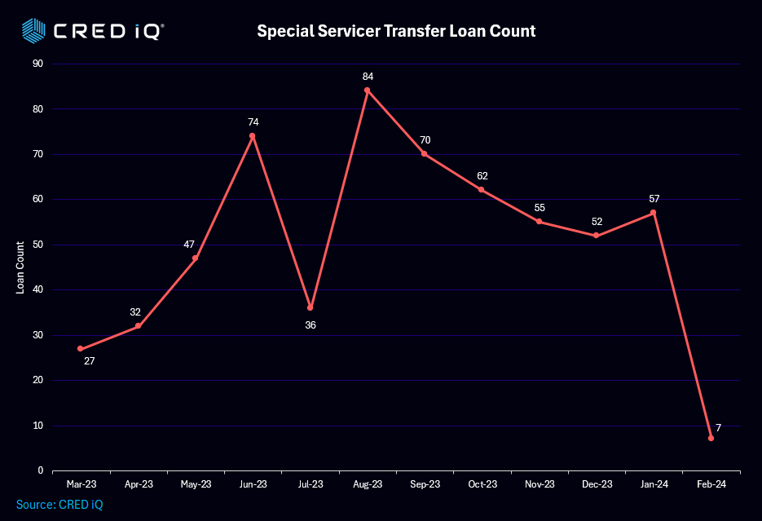
CRED iQ’s research team set out to explore CRE distress from a fresh perspective.   We were interested in examining special servicer loan transfers over the past year.  Our team wanted to understand trends by deal type and reason over time.

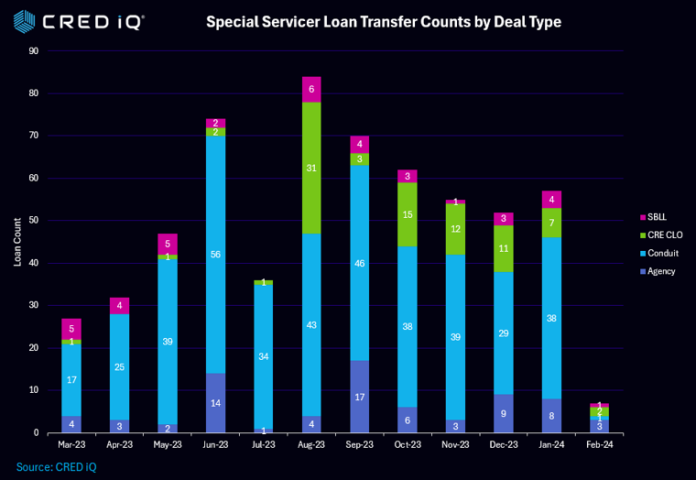
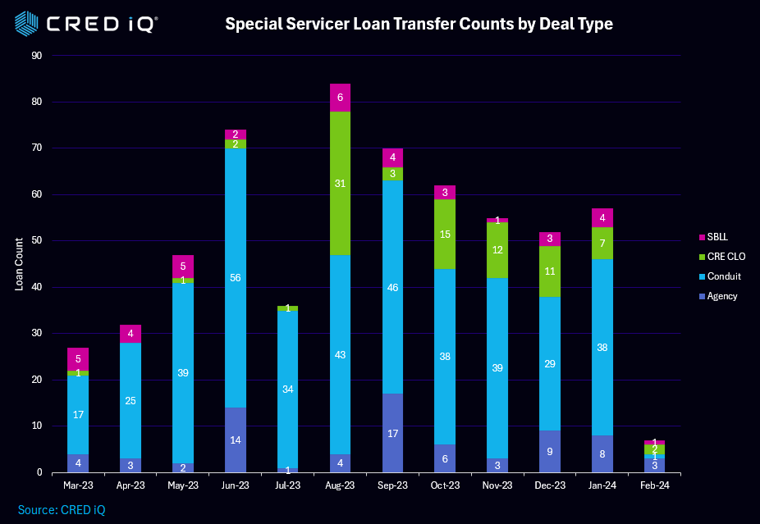
As a starting point we broke down each month’s transfers by deal type and plotted these along a timeline which seems to reveal some noteworthy trends.

February saw a spike in agency deal filings –with 36 loans transferring. Apart from February, Conduit loans dominated all other classes in loan filings –consistent with the proportional size of the conduit universe.  

In August of 2023, the highest number of loans transferred to the special servicer.  August marked the beginning of a trend of substantial distress in the CRE CLO arena.   Following months of 1 or two loan transfers, August saw 31 CRE CLO loans sent to special service.  41 more CRE CLO loans would transfer for the balance of 2023 and that trend continues to be a major focus in 2024. 

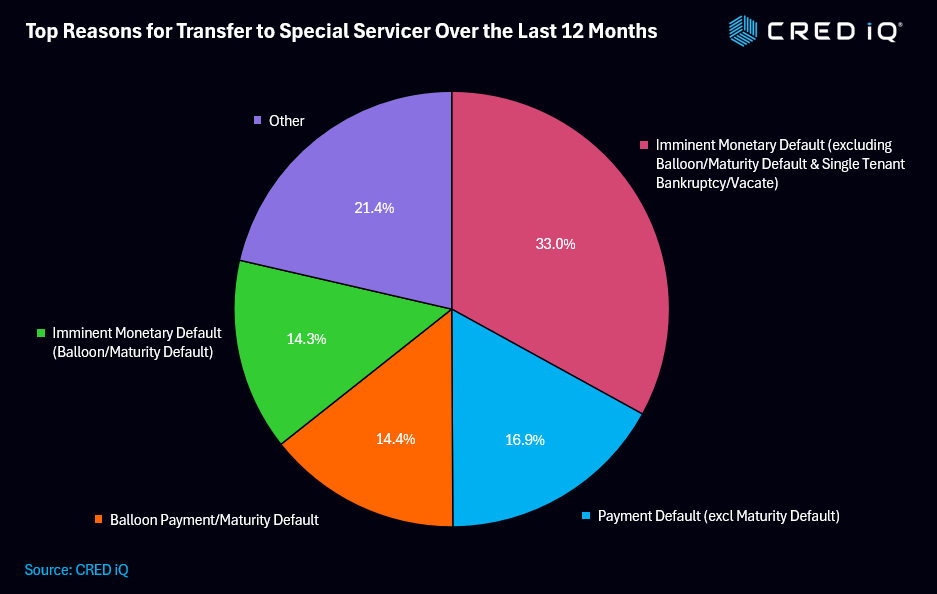
Over this past 12-month period, Imminent Monetary Default was the leading transfer reason. The data breaks down this category into two separate groupings.  When combined, roughly half of the leans in our study were transferred for Imminent Monetary Default. 

About CRED iQ

CRED iQ is a commercial real estate data, analytics, and valuation platform providing actionable intelligence to CRE and capital markets investors. Subscribers use the platform to identify valuable leads for leasing, lending, refinancing, distressed debt, and acquisition opportunities.

The platform also offers a highly efficient valuation engine which can be leveraged across all property types and geographies. Our data platform is powered by over $2.0 trillion in transactions and data covering CRE, CMBS, CRE CLO, Single Asset Single Borrower (SASB), and all of GSE/Agency.

CRED iQ’s Top 50 Markets Distress Ranking

0

CRED iQ monitors distressed rates and market performance for nearly 400 MSAs across the United States, covering over $900 billion in outstanding commercial real estate (CRE) debt. Distressed rates include loans that are specially serviced, delinquent (30 days past due or worse), or a combination of both.

CRED iQ’s research team set out to examine the distress in today’s securitized CRE ecosystem.  We wanted to explore geographic trends as well as the causes or triggers that earned the distressed designation.  We focused upon the top 50 MSAs for this analysis. 

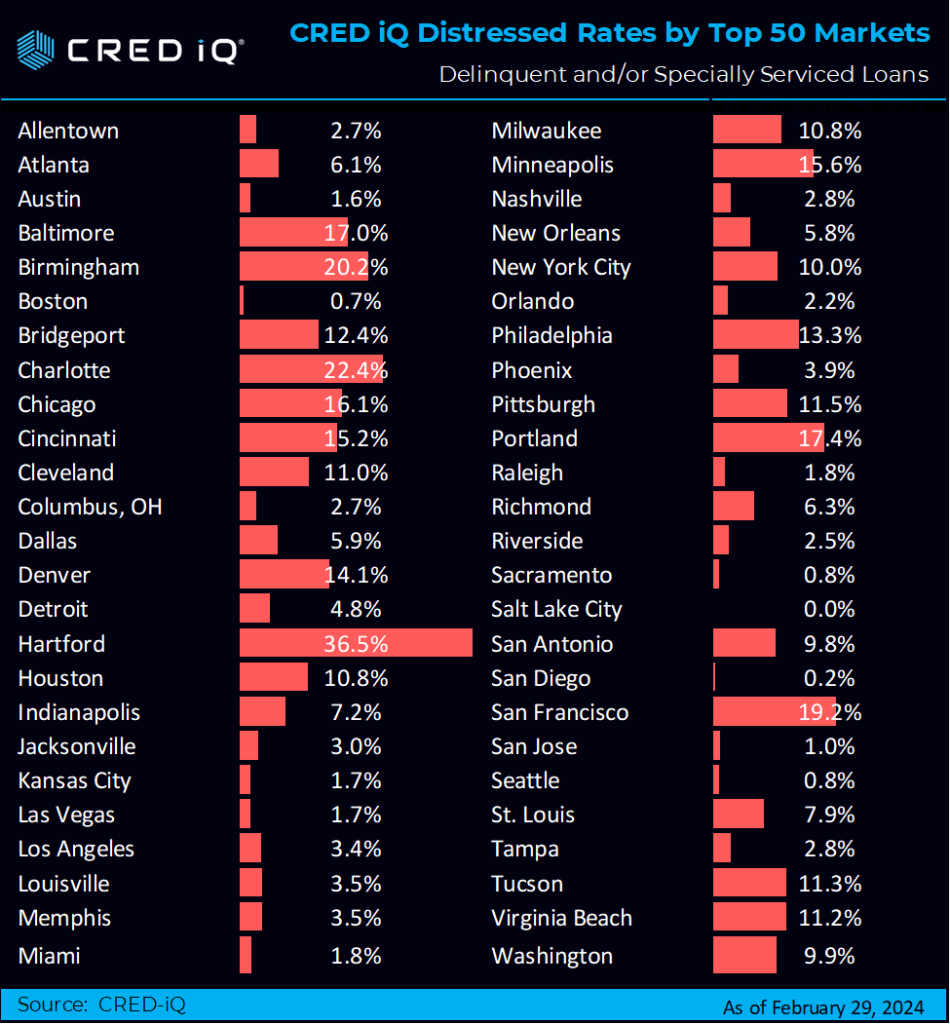
Across the top 50 MSAs, our team calculated CRED iQ Distress Rate for each market (which combines Delinquent and/or Specially Serviced loans).  Hartford logged the highest level of distress at 36.5%, followed by Charlotte (22.4%), Birmingham (20.2%), San Francisco (19.2%) and Portland (17.4%) –rounding out the top 5 MSAs with the highest levels of distress.  To provide perspective, the overall distress rate for all loans across every market was 7.35% as of February 2024. 

Some of the strongest performing MSAs include Salt Lake City operating at 0% distress today, while San Diego, Sacramento, Seattle, and Boston have less than 1% of their loans in distress.  

Among the scope of distressed  loans in our analysis, one of the largest is the $384.0 million Nema San Francisco.  The loan is backed by a 754-unit multifamily property in San Francisco. Cash flow at the high-rise property was unable to cover expenses, leading to imminent default. Consequently, the loan transferred to the special servicer in August 2023. The asset value decreased from $534.6 million ($720,955/unit) at underwriting to $328.8 million ($436,074/unit) in October 2023. Despite 91.9% occupancy, DSCR was reported below breakeven at 0.81.

Breaking Down the Distress Categories

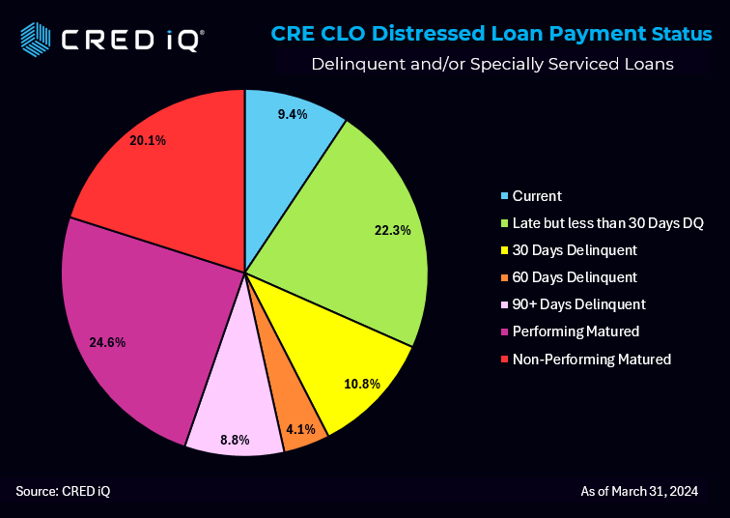
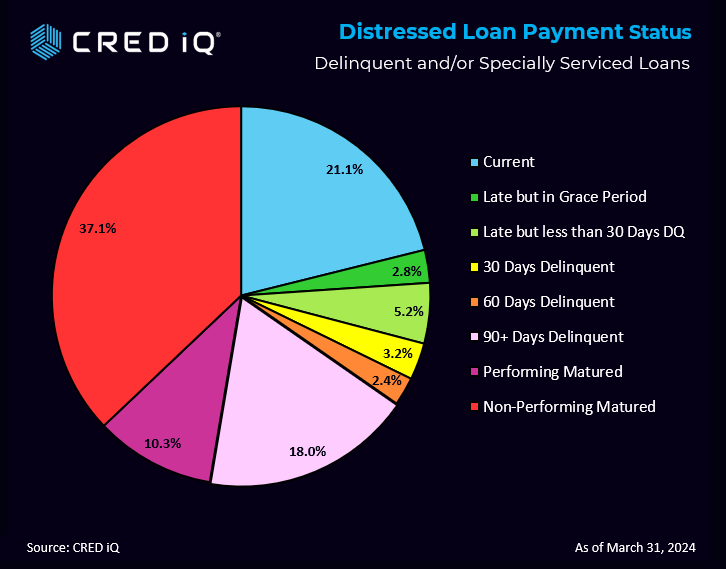
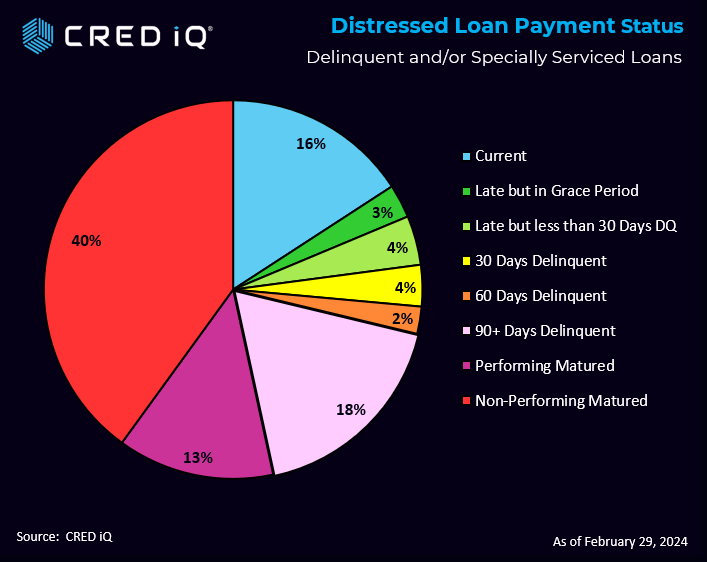
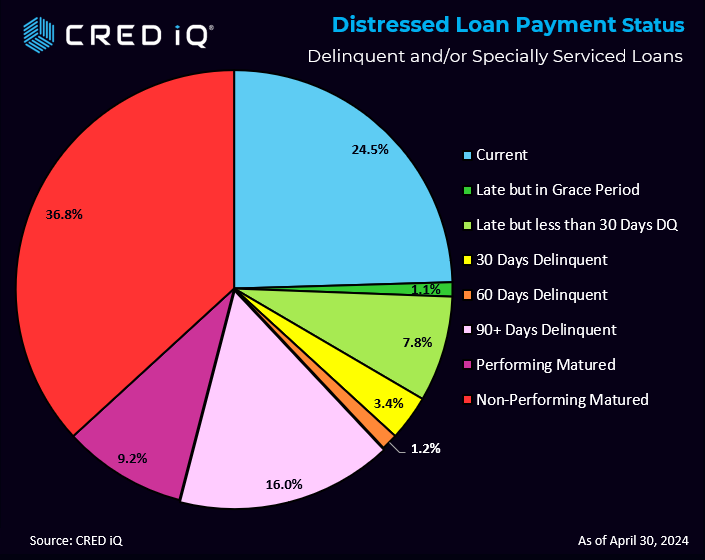
With the geographic concentrations in mind, our team took a step back and evaluated the triggers/causes that landed each loan in distress.  16% of all the loans are current with another 7% within the grace period or 30 days late. Meanwhile a whopping 40% are past their maturity dates and have stopped making monthly payments. On the other side, 13.4% are past their maturity dates, but still make their monthly mortgage payments on time.  Measuring delinquency during loan terms prior to maturity dates, CRED iQ calculated 23.7% of the distressed loans are reporting between 30 days to 120+ days delinquent. 

Early Warning Signals

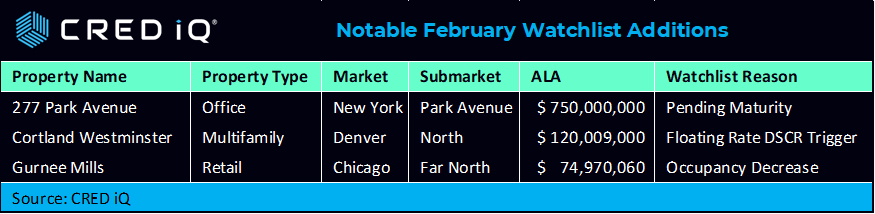
CRED iQ’s early signals of upcoming distress include loans that have been added to the servicer’s watchlist for credit-related issues.  Issues include weak financial performance, low occupancy, high tenant rollover, upcoming maturity risk among other reasons to be flagged as possible troubles.  Some notable loans that were added to the watchlist in February include:

About CRED iQ

CRED iQ is a commercial real estate data, analytics, and valuation platform providing actionable intelligence to CRE and capital markets investors. Subscribers use the platform to identify valuable leads for leasing, lending, refinancing, distressed debt, and acquisition opportunities.

The platform also offers a highly efficient valuation engine which can be leveraged across all property types and geographies. Our data platform is powered by over $2.0 trillion in transactions and data covering CRE, CMBS, CRE CLO, Single Asset Single Borrower (SASB), and all of GSE / Agency.

Multifamily logged its Largest Monthly Increase in Distress in over 18 Months.

0

Each month the CRED iQ research team aggregates the entirety of payment statuses reported for each loan, along with special servicing status to arrive at the Distress Rate. 

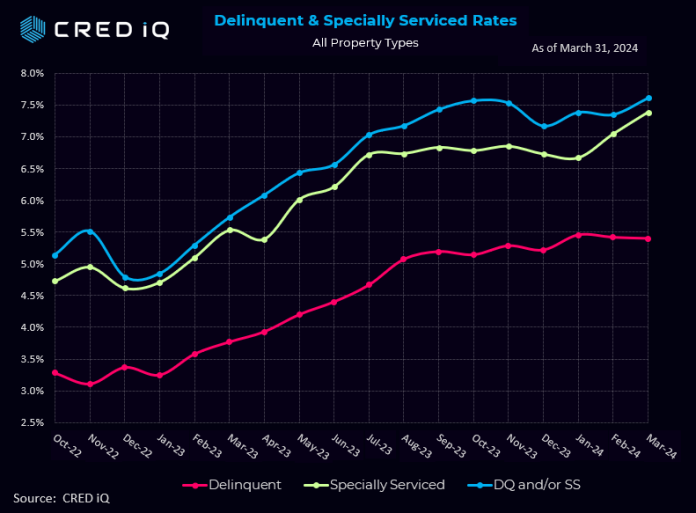
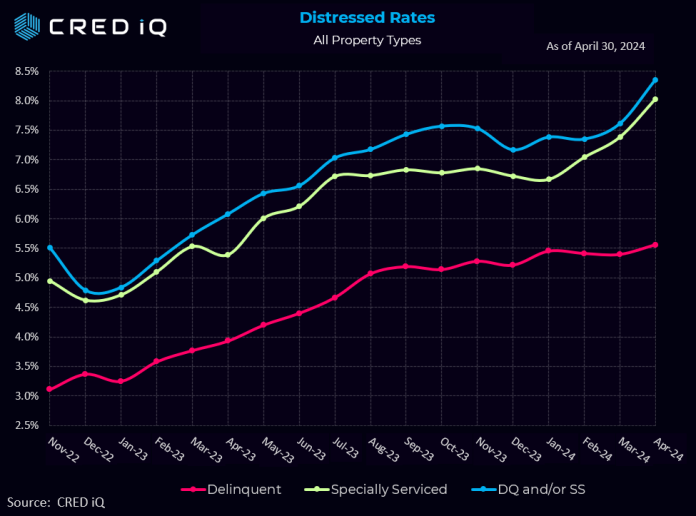
CRED iQ’s Distress Rate for all property types trimmed 4 basis points in February to 7.35% from 7.39%.  Our distress rate has logged modest decreases in 3 of the last 4 months (net reduction of 18 basis points during that period).  The overall distress rate declined primarily due to a large self storage portfolio ($2.1B) loan’s payment status became current this month after being delinquent last month.  Despite the overall distress rate being slightly down, it is notable that 5 of the largest property types each increased this month.  

Multifamily’s distress rate earned the largest monthly increase with 80 basis points—the largest monthly increase in that sector in well over 18 months. Our team is wondering if the see-saw trending will continue—albeit with wider swings. Something to watch for in March results.

Underlying CRED iQ’s Distress Rate, the CRED iQ Specially Serviced rate rose 37 basis points to 7.04% while the Delinquent print matched the distress rate with a 4-basis point reduction in February.

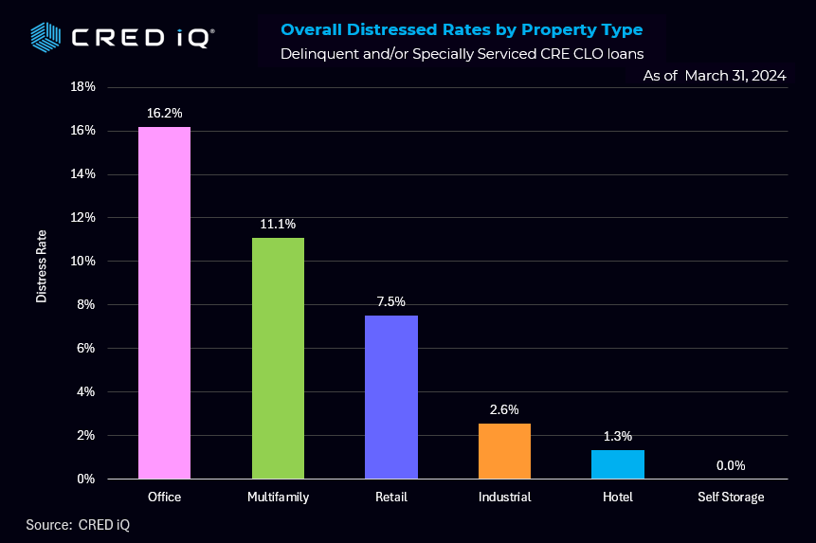
Once again, the office sector claimed the largest Overall Distress Rate of 11.0%, an increase of 47 basis points from the previous month. 

An example of issues we are tracking within the multifamily scene is one loan, The Reserve at Brandon, a 982-unit multifamily property in East Tampa, that is backed by a $94.1 million loan that fell 30 days delinquent in February.  The loan’s rate cap expiration date was in April 2024, along with its initial maturity date.  There were three, 12-month extension options at securitization. The loan was added to the watchlist in May 2023 due to low occupancy and DSCR – mostly recently reported in September at 82.3% and 0.41, respectively. At underwriting, the as-is appraisal for the multifamily community was $232.5M ($263,762/unit) with an as-stabilized value of $312.6 million, with stabilization anticipated for March 2025.  Servicer commentary indicates there are discussions of extending the April 2024 maturity date.

The hotel segment’s distress rate saw a modest increase of 20 basis points and industrial and self-storage continued to enjoy near zero distress levels. 

CRED iQ’s Distress Rate aggregates the two indicators of distress – Delinquency Rate and Specially Serviced Rate – yielding the Distress Rate.  This includes any loan with a payment status of 30+ days or worse, any loan actively with the special servicer, and includes non-performing and performing loans that have failed to pay off at maturity.  
About CRED iQ

CRED iQ is a commercial real estate data, analytics, and valuation platform providing actionable intelligence to CRE and capital markets investors. Subscribers use the platform to identify valuable leads for leasing, lending, refinancing, distressed debt, and acquisition opportunities.

The platform also offers a highly efficient valuation engine which can be leveraged across all property types and geographies. Our data platform is powered by over $2.0 trillion in transactions and data covering CRE, CMBS, CRE CLO, Single Asset Single Borrower (SASB), and all of GSE / Agency.

CRED iQ’s CRE CLO Top Issuer Rankings

0

CRED iQ continued and expanded its CRE CLO analysis this week. Our research team explored aggravated data by issuer to uncover opportunities and risks within this hot sector.

We wanted to understand the % breakdown of delinquency/distress within these major CRE CLO issuers’ portfolios, and then measure the scale of those portfolios and their associated rankings within the group.   Some core measures of our study include:

  • Current Deal Balance Outstanding
  • Total Delinquent Loan Balance
  • Overall Delinquency Percentage

MF1 earned the top spot in Current Deal Balance Outstanding.  Arbor topped the category of Total Delinquent Loan Balance ($782 million), while ranking in second on Current Deal Balance Outstanding ($8.1 billion).  In total, 9.6% of Arbors loans are delinquent which earns Arbor the #4 position in this category. 

Leading the rankings by delinquent percentage is Starwood, with a whopping 12.6% of their portfolio delinquent.  Greystone and Fortress were not far behind with 11.2% and 10.7% respectively.  Starwood ranks third in Total Delinquent Loan balance and ranks #10 for current deal balance outstanding.

Top key findings include:

  1. MF1, Arbor, FS Rialto, Ready Capital, and Benefit Street have the highest amount of CRE CLO loans outstanding. 
  2. Out of the 21 largest CRE CLO issuers, MF1 & Ready Capital have the highest count of active deals issued with 8 each. 
  3. Comparing deal sizes, MF1 has the highest amount with approximately $11.1 billion across 8 deals and FS Rialto has approximately $5.5 billion across their 7 deals. 
  4. Performance-wise, TPG Real Estate Finance and FS Rialto have the lowest amount of delinquent loans when comparing the Top 10 issuers by outstanding deal balance. 
  5. Measuring delinquent percentages of the largest 21 issuers, Starwood, Greywood, Arbor, Ready Capital, and Varde Partners have some of the highest percentages.
  6. Comparing Delinquent Loans by loan balance, Arbor, Ready Capital, and Starwood have the most.  The least amount of delinquent loans stem from deals issued by Blackstone, Prime Finance, Argentic, Bridge Investment Group, and FS Rialto. 

Here is the full list of Top 21 CRE CLO issuers:

Active Deals by Balance by Issuer:

About CRED iQ

CRED iQ is a commercial real estate data, analytics, and valuation platform providing actionable intelligence to CRE and capital markets investors. Subscribers use the platform to identify valuable leads for leasing, lending, refinancing, distressed debt, and acquisition opportunities.

The platform also offers a highly efficient valuation engine which can be leveraged across all property types and geographies. Our data platform is powered by over $2.0 trillion in transactions and data covering CRE, CMBS, CRE CLO, Single Asset Single Borrower (SASB), and all of GSE / Agency.
CRE CLO Distress Rates Surge over 440% in 12 Months

0

Arbor is Not Alone…

CRED iQ took a deep dive into the CRE CLO ecosystem to better understand the rapidly growing distress rates in this space.   CRED iQ excludes CRE CLO deals from our monthly delinquency reports but decided to zero in on this important sector on a stand-alone analysis.  Following the news of Arbor’s distress level recently, we also wanted to understand how other CRE CLO issuers are faring in this marketplace.  

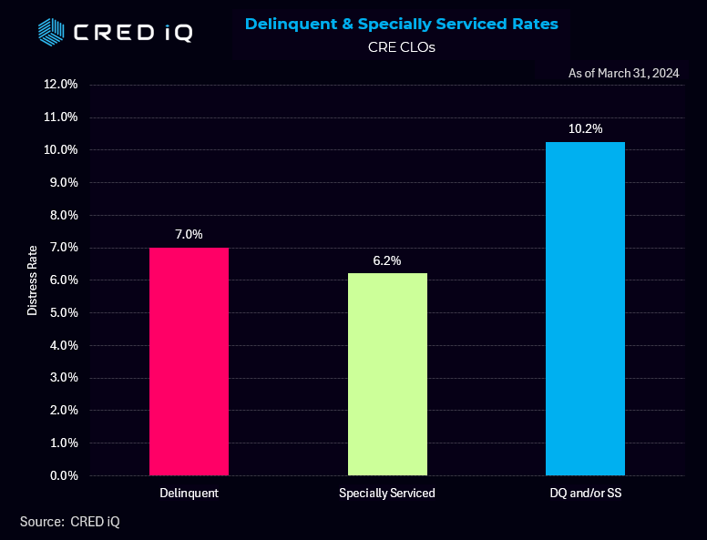
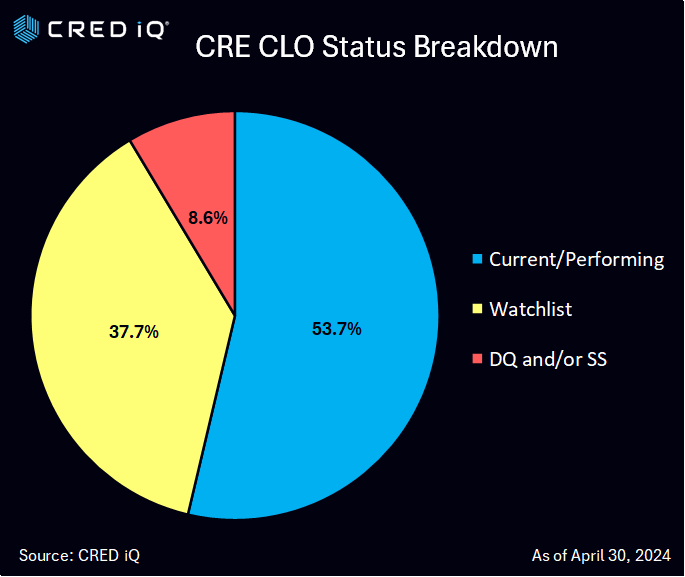
CRED iQ’s Overall Distress Rate for CRE CLO surged in 2023—from 1.4% to 7.4% and jumping even further in January to 8.6%.  This metric includes any loan that reported 30 days delinquent or worse as well as any loan that is with the special servicer.  

Outstanding CRE CLO loans amount to approximately $80 billion in loans.   The vast majority of these CRE CLO loans are structured with floating rate loans with 3-year loan terms equipped with loan extension options if certain financial hurdles are met.  Some of the largest issuers of CRE CLO debt over the past five years include MF1, Arbor, LoanCore, Benefit Street Partners, Bridge Investment Group, FS Rialto, and TPG. 

CRED iQ consolidated all of the loan-level performance data for every outstanding CRE CLO loan to measure the underlying risks associated with these transitional assets.  Many of these loans were originated in 2021 at times where cap rates were low, valuations high, low interest rates, and are starting to run into maturity issues given the spike in rates. 

CRED iQ’s analysis uncovers that in the course of 12 months, the amount of CRE CLOs under distress ballooned from $1.3 billion in February 2023 to over $6.8 billion as of the latest January 2024 reporting period.  Distress levels grew over 440% over the past 12 months.  The sudden spike up started happening in July and August 2023 when distressed rates were around 1.7%, and then each month started increasing by an average of 1.2% each month.  The latest distressed levels total 8.6% for all of CRE CLO loans as of January 2024.  

CRE CLO Office Loan

700 Louisiana and 600 Prairie Street is a 1,259,314-SF high-rise office property in downtown Houston, TX, is backed by a $232.0M initial loan with a fully funded commitment of $252.0M. The interest-only loan failed to pay off at its September 2023 maturity date and has only paid through September. The 56-story office tower was built in 1983 and renovated in 2011. The asset was appraised as-is at $403.0M at underwriting in June 2023 based on 66.7% occupancy at of April 2019. A 0.77 DSCR (NCF) and 65.8% occupancy was reported in the September 2023 financials. The largest tenant, TransCanada USA Pipeline, represents 23.0% of the net rentable area (NRA) with a lease scheduled to expire in February 2036. The remaining tenants each represent 4.0% or less of the NRA.

Multifamily Loan

An example of upcoming distress despite a “current” loan status is Caden at East Mil. The Caden at East Mill is a 768-unit multifamily property in Orlando, FL, backed by a $98.9M loan that was originated by Arbor. The loan is scheduled to mature in October 2024 with a fully extended maturity date in October 2026. The most recent financials from year-end 2022 reported a 0.65 DSCR (NCF), down from 1.56 at contribution in September 2021. The property was 96.2% occupied and valued at $120.1M in September 2021, at underwriting. Occupancy at the property fell to 85.6% as of November 2023.

About CRED iQ

CRED iQ is a commercial real estate data, analytics, and valuation platform providing actionable intelligence to CRE and capital markets investors. Subscribers use the platform to identify valuable leads for leasing, lending, refinancing, distressed debt, and acquisition opportunities.

The platform also offers a highly efficient valuation engine which can be leveraged across all property types and geographies. Our data platform is powered by over $2.0 trillion in transactions and data covering CRE, CMBS, CRE CLO, Single Asset Single Borrower (SASB), and all of GSE / Agency.
CRE Valuation Trends in 2023

0

CRED iQ analyzed 556 properties that were re-appraised during 2023. We were interested in the overall valuation impacts by quarter and property type.   

The Top 25 valuation declines all received an updated appraisal, and we dug into that data. The updated valuations offer a rich perspective on the overall market along with trends that can add meaningful dimensions in forecasting. Each of these properties were either delinquent and/or transferred to the special servicer. 

In total, the average decline in value compared to the original valuation at issuance was 42% – remaining in the narrow range between 41% and 43% that prevailed throughout 2023.    

Sector Perspectives

Not surprisingly, the office sector turned in the largest valuation decline in 2023 at 50%. Office valuation declines peaked in the first quarter at 52%, with the subsequent quarters showing reductions (Q2: 51%, Q3: 50%, Q4: 47%)

Retail came in a close second with 49% valuation decreases in 2023.  Retail also peaked in Q1 at 57%, but saw a choppier pattern for the remaining quarters ( Q2: 50%, Q3: 45%, Q4: 35%)

Multifamily was in third place for 2023 with a 35% valuation decline followed by the hotel segment at 30%

The Industrial segment also posted a 30% decline; however, this is based upon only three properties/loans—which continues a theme that we have seen throughout 2023.  Many would consider these edge cases that offer a somewhat misleading print. 

Here are the most notable properties that made our Q4 list:

Portals I: Washington DC

This 449, 933 SF Class A office building plus a 261,500 SF below grade parking garage.  Portals I is part of a six-phase, mixed use complete currently containing 3 office building and a Mandarin Oriental Hotel.  All office tenants have either vacated at the end of their lease term or signed termination agreements.  Occupancy is currently 4.67%. The property saw a valuation drop from $235 million ($494/SF) to $87.6 million ($184/SF) 

The Brass Professional Center, San Antonio, TX

This suburban office complex in San Antonio, TX consisting of 11 buildings throughout a 35-acre plot. The buildings were constructed between 1968 and 1998. The collated was valued at $79.1 million at underwriting in June 2020 and has since dropped to $41.9 million in August 2023, representing a 47.0% decline. The asset became REO in October 2023 and is backed by a $55.6 million loan that is scheduled to mature in August 2030.

While overall valuation losses remained largely flat throughout the year, we saw both retail and office sectors come off their peak decreases from earlier in the year.  For office, there may be a favorable trend; however, retail, and multifamily seem to be more unpredictable as we move into 2024. 

About CRED iQ

CRED iQ is a commercial real estate data, analytics, and valuation platform providing actionable intelligence to CRE and capital markets investors. Subscribers use the platform to identify valuable leads for leasing, lending, refinancing, distressed debt, and acquisition opportunities.

The platform also offers a highly efficient valuation engine which can be leveraged across all property types and geographies. Our data platform is powered by over $2.0 trillion in transactions and data covering CRE, CMBS, CRE CLO, Single Asset Single Borrower (SASB), and all of GSE / Agency.

CRE Debt Market Update: February 12, 2024

0

Our first post of our brand new blog series with Lakebrook Capital and CRED iQ. This first post covers the following topics, Interest Rates, Agency Pricing Grids, Notable Trends Survey, and a new Podcast.

CRED iQ is pleased to welcome Lakebrook Capital to our affiliate series! Lakebrook Capital and Brandon Roth have over 17 years in experience in commercial real estate spanning appraisal, banking, and brokerage, 120 deals and nearly $10 billion in capital raised.
Lakebrook Capital bring together surveys, rate data, and market sentiment from various capital providers. CRED iQ is arming the Lakebrook team with our precise data and research, market opportunities, real-time distressed assets, and recent closed loans and their granular details.

Interest Rates

The chart below shows the 10-year treasury yield over the past 30 days. The rate fell to 3.86% by the end of January, but has since climbed back 31 basis points to 4.17%.

Treasury yields were falling at the end of January as negative data was released that gave investors the belief that the Fed would start reducing rates soon.

However, yields reversed direction once payroll data was released on February 2nd showing 353K jobs were added in January instead of the 180K that were expected. In addition, several members of the Federal Reserve started pushing back on the idea that they’re going to be reducing rates in the near-term.

The chart below shows the projections for the Fed meeting in March. A month ago, the market was betting that there was only a 19% chance that the Fed would continue to leave rates unchanged through the March meeting, but that has now increased to 85%.

Agency Pricing Grids

The grid below was updated based on today’s rates. There are many factors influencing agency pricing including loan size, vintage, location, level of affordability, acquisition vs refi, etc. If you need a soft quote showing the loan sizing and pricing for your property, then please reply to this email.

Notable Trends

Last Friday, I reached out to GP’s and LP’s to ask if they saw any notable trends in January. Here are the top responses, grouped by asset type:

MULTIFAMILY

West Coast MF Investment Firm

• Although there’s a lot of variability, in general Bay Area rental traffic was seasonally slow, leading to greater than historical use of concessions and slightly negative rent growth.

• More coming to market; however, greater off-market activity as owners needing to sell are hoping to avoid airing their “dirty laundry.”

• Large bid/ask spread remains for most properties on the market.

• Majority of transactions closing are a “basis” play, so while the market talks about 5%+ cap rates, in-place cap rates are still sub-5% (at least in infill coastal markets).

Pacific Northwest Private Investor

• Vacancy up 2-3% – traffic has slowed and going back to having to work to get vacant units rented.

• Rehabbing all of our garden style assets (1990’s) and construction costs have gone up probably 15-20% since we began a couple years ago.

• I anticipate slowing NOI growth across our portfolio as expenses are increasing across the board. I’m underwriting flat to 3% NOI growth. Onsite staff is costing more. Our insurance premiums went up 15% YOY and are up 59% from 2022. Our stuff is mostly 90’s, and the one newer (2018) asset we have is flat since 2020 regarding premiums.

Large Institutional LP

• Groups are underwriting outsized rent growth in the outer years to reflect the supply drop off predicted in 2025+.

• Everyone at NMHC is a net buyer this year – no net sellers.

• Market may be overly optimistic on rate cuts this year.

• Insurance costs continue to rise and are a big issue on expense mgmt.

• Bad debt is increasing across our whole portfolio.

Multifamily Investor

I’m seeing continued uptick of ongoing expenses especially insurance and sellers are becoming impatient with rising costs of inflation and debt, which is leading to conversations about selling and leaving what they perceive as money on the table.

National Developer

• I’ve seen increased LP equity and lender appetite. Equity groups are tired of sitting on the sidelines and want to find a way to make deals work. That said, the YOC needs to be 6.5%+ for urban MF, 6.75%+ for suburban MF, and 7%+ for industrial with a first or second band location.

• Banks are trying to get back in, but need to be realistic when it comes to requesting deposits. This should be good for life co’s that are doing construction loans – we are going to try to tap into that more this year, but find that life co’s can be a little tight on proceeds.

LP Equity Fund

• In general for multifamily I’ve seen operating expenses putting serious pressure on NOI. Repairs and maintenance are up and our forthcoming insurance premiums are up at minimum 25%.

• We have begun to see bad debt starting to increase.

Institutional Investor

• In general we are seeing construction costs dropping slightly in most markets (south FL being the exception where pricing is generally flat). Markets with less MF product in their pipeline as a % of the total product are seeing some of the sharpest cost decreases nationally.

• Denver continues to see modest rent growth despite the record supply. I was recently there with a few of our local partners and think that the record number of migrants are helping support the overall rental market.

Utah Developer

• In Salt Lake City, construction costs haven’t dropped much if at all, which has led to a lot of developers still remaining on pause. There are rumors of a few starts but we haven’t really seen them. If they are starting it has to be from very patient or long-term capital.

• Cap rates here seems to be somewhere between 5.25-5.5%. The only yield on cost that people are interested in for ground-up development is 6.5-7% which is very rare to find.

Large Institutional Investor

• In TX and FL, we’re finally seeing insurance renewals flatten out and in some cases retrace a bit.

California MF Property Manager

• There is a challenge with Class A property demand and supply. Class A property rent is stabilizing, but still lower than last year…and, the use of concessions of 6 to 8 weeks is common in core markets.

• Workforce, Class B and C properties, are performing; however, new Class A supply has created market rotation as tenants seek the best value for high-end properties that have great amenities.

California Developer

• It feels like asset management fires are waning and there is a renewed focus on new acquisitions.

• Development yields make no sense when compared to yields on existing product.

• Some of the most attractive deals today are the ones that started marketing processes 18 to 24 months ago.

• Institutional equity remains herded and unwilling to stretch.

Georgia Developer

• January was a fairly quiet month in the Savannah market, but has started picking up in February.

• Some lenders appetites are increasing, albeit solely relationship driven for the powder they do have.

• Construction costs are still high and starts of new projects continues to slow or not exist at the moment.

• Tenant demand in the Savannah market is still present, but tenants are starting to control the terms and demands as vacancy rates continue to increase.

Private Multifamily Investment Company

• Las Vegas has been really interesting. After months of being backed up with the courts, problematic tenants are finally out and our delinquent balances at each property have gone from $50-100k down to pretty much 0. The courts are working quickly in our favor and people are paying rent. We are seeing this across LV and cash flow is dramatically improving despite the fact that rents are still low.

• We are seeing increases in both physical and economic occupancy. January has been our best month in the last 12+ months. Traffic/tours/leasing is the best I’ve seen since pre-COVID.

• We are getting SLAMMED on insurance in Vegas. In properties where we have densely occupied buildings (ex: two buildings with 150 units each), we are getting crushed. Florida-type insurance increases.

Institutional LP Equity

• In land constrained/infill submarkets there continues to be such strong demand that pricing for core, stabilized acquisitions is well below accretive debt.

• Development remains difficult as land capitulation has been slow in core markets (really only looking at industrial/multi) while there has been some land price reduction it doesn’t seem to be enough for most deals to pencil.

• On a recent MF development deal in the Bay Area that we originally saw in Fall 2022, we’re seeing it again now and the developer got a significant land price reduction. They also saw low double digit reduction in total project costs over the past 1.5 years. This is one of the first tangible examples we’ve seen of a large decrease in construction costs. This is a trend folks have been postulating on for awhile as land pricing and financing costs have made development quite challenging – smaller pipelines means more availability of GC’s and more aggressive bids from subs.

West Coast Multifamily Investment Firm

• Not as many launches in the new year as hoped; holding or otherwise working it out behind the scenes still feels like the primary choice among potential sellers.

• Operations holding on better than expected (less concessions than anticipated, good leasing activity) but still expecting largely flat NOI in 2024

• Increased lender appetite seems to be compressing spreads by ~10 bps, but won’t know until it’s time to execute if that is real.

• Fading optimism for significant rate cuts in 2024, closer to the “higher for longer” mentality from last fall.

Family Office (LP Equity)

• New supply in Class A has led to flat or deteriorating rent growth in our Class A properties across most of the country for 2023 and 2024 expectations.

• On the other hand, we have seen a continuation of 5%+ rent growth at many of our Class B & C properties. We hypothesize that there will be a trickledown effect on our Class B & C properties from the new Class A supply, but this has yet to materialize.

West Coast Developer

• We saw a large uptick in traffic and transactions in the beginning of January, but then fell off a cliff. The SF market is still seeing a lot of concessions. Trade-outs / renewals are averaging around -10% at a lot of our properties.

• Operating expense ratios are off from what is traditionally expected (30%-40%), which is due to many reasons but some are increased need for longer security hours, rising payroll costs, and rising property insurance cost.

National Developer

• We’re seeing variations in construction costs for senior and multifamily housing across different markets, with a focus on Southern California and Seattle as we’re actively pricing development deals there.

• Recently, there’s been a noticeable softening in costs, indicated by subcontractors seeking work due to a slowdown in their late 2024 pipeline, a trend I’ve heard from other developers and architects. However, this softening is not uniform.

• In Southern California, construction costs continue to rise, albeit more slowly. I’d say this is due to the high cost of doing business in the state raising the floor on pricing.

• Conversely, Seattle is experiencing a willingness among subcontractors to lower their prices, attributed to a more pronounced decrease in housing starts compared to Southern California. I see some potential for further cost reductions as the market adjusts to the surplus from the 2021/2022 pipeline.

OFFICE

East Coast Investor

While a lot has been said about the office slowdown and the precipitous drop in values (which are all true and real), over the last 6 months I’ve noticed smaller tenants (5-10k SF) be the most active I’ve ever seen. They’re snapping up pre-built suites at a record pace, driving pricing on Class A-/B+ commodity product up and providing a mini lifeline for a lot of landlords. The activity is not only prevalent in New York, but I’m also seeing it across the country.
Coworking space is being snapped up extremely quickly too, and even in cities like SF which dominate the headlines, coworking is on average 90%+ occupied and spec suites are doing well.

So, is this enough to make a dramatic dent in both direct and shadow inventory – definitely not. However, it is a small bright spot in the office leasing market and something I see lenders paying attention to although many are still hesitant to fund pre-built inventory simply just because of their already-inflated bases in these assets.

The reality is that trophy product is doing well and large blocks are largely all occupied, so we’re seeing some trickle down to other parts of the market and this is one of them. Doesn’t mean there aren’t loads of obsolete buildings that have no potential, because there are. But I see a comeback for some levels of well-located and managed commodity office product.

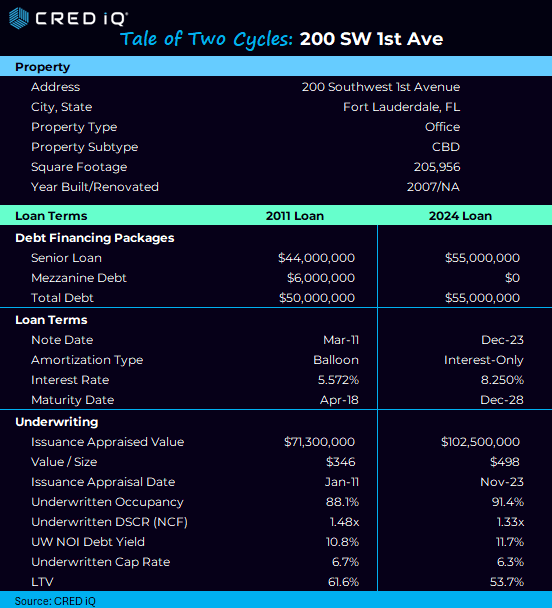
The Tale of Two CRE Cycles – Same asset, 2 different loans, 12 years apart – CRED iQ Analysis

Office Property Manager

I’ve been a property manager in Washington, DC for 3+ years now. I’ve had responsibilities at 20+ office buildings (class A&B) totaling 3M+ sq ft of office/retail. In January, I finally saw a broker close on a deal for the first time in my career.

I’ve seen lots of tenant move-outs and mortgage defaults, but will be completing my first tenant move-in in over 3 years.

California Developer

Lots of interest in San Francisco office basis plays.

Bay Area Investor/Operator

• With owners of office in the Bay Area, there seems to be a common thread of “2024 is a really important year for us”. As in a make-or-break year, there isn’t going to be any more kicking the can, the rubber is meeting the road. I only note this as a change in trend because since the start of COVID the narrative has been to buy more time for the office market to improve via short term loan extensions, etc., but it feels like that time is officially running out, and this year is becoming critical for those with office exposure. Feels like we will see a big uptick in office distress by the end of this year.

INDUSTRIAL

West Coast Investor and Operator

• Industrial rent growth projections slowed is the most meaningful trend for January. Primarily I’m thinking of Sacramento, Reno, and especially Phoenix. Drivers are both slower leasing demand and a lot of supply being delivered spec.

• Leasing slipped for industrial as of last year, starting to see more activity late January into February. For the leasing we’ve been trading paper on this year, the rent escalations have slowed too. In Sacramento market was still 4% last year, this year down to 3%. Similar story in Reno.

• Flurry of marketed deals at the end of last year and the seasonal holiday lull, seeing more come to market late January, which is typical, but the trend continues for deals to come back to market after not hitting their price albeit less frequently for well positioned assets.

Institutional LP Equity

• Investor appetite for infill, Class A industrial remains very strong, a deal which Clarion is selling (Eden Rock – Hayward, CA) is tied up in the market now – had significant interest from our institutional peer set.

• Lender appetite, specifically in the debt fund space for core location class A industrial lease up plays (such as this) appears to be quite strong. This deal has a tenant paying well below market rent which will either vacate or downsize to +/- 50% (or less) of the building at their LEX in 11 months. As such many groups are underwriting debt fund style execution at closing – lots of capital chasing this deal profile, expected to be 60-65% LTV with 60-100% future funding of capex and leasing capital – expecting SOFR + low 300s.

Bay Area Industrial Developer/Operator

• Acceptance by sellers and selling brokers that exit caps are in the 6% range for underwriting purposes.

• General agreement that a speculative development deal needs to pencil to a return on cost of 7.0% or greater.

• Certain sellers who bought using yesterday’s assumptions such as ROC of 5% and exit cap of 4% are looking to exit their land positions at a loss.

• Sellers who are realistic on sale cap rates are able to transact as there is plenty of capital out there looking to buy industrial.

• The market is coming to accept that the current cap rate for sales of industrial is plus or minus 6%. Very few buyers are willing to take on negative leverage so I would say the fact that the 10-year treasury has ticked up in the last couple weeks is pushing cap rates up further than 6%.

California Developer

• It’s a tale of two cities in the Inland Empire big box industrial market. Lots of vacancy in the small box size range (i.e. <300k sq ft). Very little vacancy in the large box size range (>800k sq ft) with significant increases in tenant activity over the last month or so, tilting supply/demand dynamics in the favor of landlords.

• Banks continue to be choosy in the construction lending universe, mostly lending to existing relationships or to new relationships that bring material new deposits over to the bank. LifeCos remain active, but generally in the larger check size range. As a result, it’s generally difficult / expensive to get construction financing for mid-sized projects.

MISCELLANEOUS

Self-storage Developer

• We are seeing plenty of continued interest from small local/regional banks to lend on storage, both construction loans and perm loans.

• We are getting fixed rate pricing between 6.75% (stabilized) and 8.20% (construction).

• Purchases are generally stipped to 75% of as-stabilized value (will not include closing costs/fees)

• Loan sizing for construction is shaking out to +/- 65% LTC. Overall I’m just encouraged by the availability of bank debt for small storage deals in secondary & tertiary markets.

Family Office (LP Equity)

• On the hotel side, expenses have far outpaced RevPAR growth over the past few years at our full-service hotels. We are finally seeing expenses start to level out lending to some optimism around growing NOI and increasing margins.

About Brandon Roth & Lakebrook Capital

I’ve worked in the commercial real estate industry for 17 years. The last 10 years were spent with the #1 debt capital markets firm in the country (HFF/JLL) where I arranged debt and equity for all asset types. During this time, I had the opportunity to raise over $9.7B in capital for both institutional and private clients.

On May 1st, I left the nest and started Lakebrook Capital, Inc. I’m continuing to help clients with their financing needs, which most recently has been heavily focused on sourcing preferred equity and bridge debt.

In addition, I’m also spending time with lending relationships to assist with the distressed loans in their portfolio by either connecting them to a buyer to purchase the note/asset off-market, or to a local developer if a property needs to be managed or re-entitled (e.g. office to multifamily).

Recap Podcast

I started a podcast last week where I interview CRE capital providers about their company, buckets of capital, how they’re sizing and pricing deals, market outlook, etc. You can check out the first episode using the links below.

Spotify: https://t.co/XKQnIibJn2

Apple: https://podcasts.apple.com/us/podcast/recap-with-brandon-roth/id1729873750

About CRED iQ

CRED iQ is a commercial real estate data, analytics, and valuation platform providing actionable intelligence to CRE and capital markets investors. Subscribers use the platform to identify valuable leads for leasing, lending, refinancing, distressed debt, and acquisition opportunities.

The platform also offers a highly efficient valuation engine which can be leveraged across all property types and geographies. Our data platform is powered by over $2.0 trillion in transactions and data covering CRE, CMBS, CRE CLO, Single Asset Single Borrower (SASB), and all of GSE / Agency.

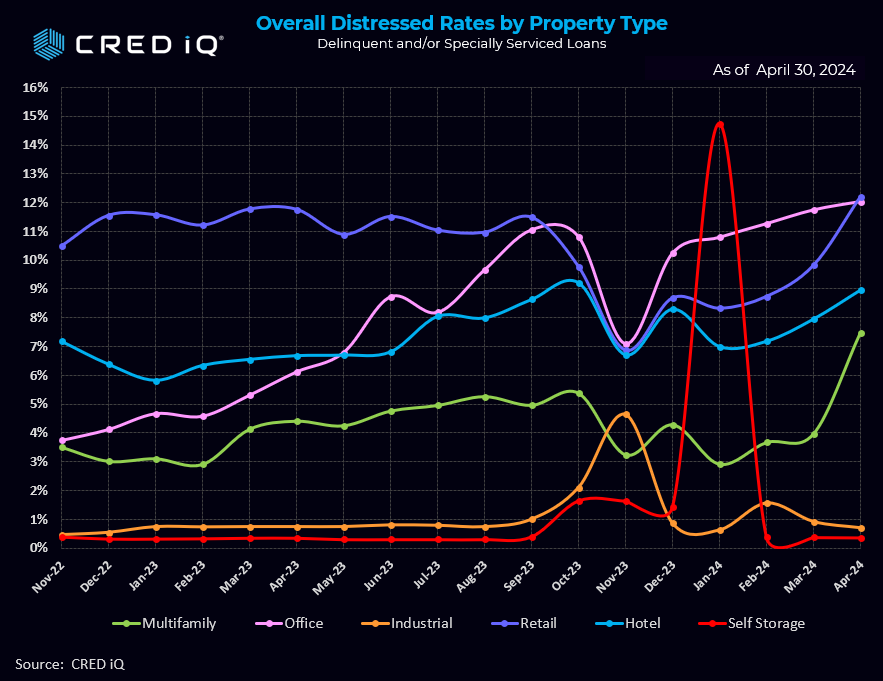
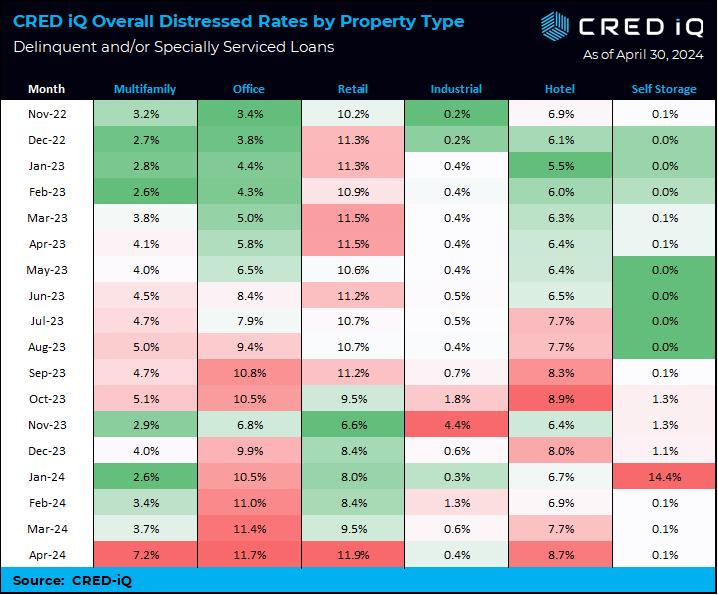
CRED iQ’s Overall Distress Rate Increased in January. Office climbs back above 10%

0

CRED iQ aggregated all of the payment statuses reported by each loan in January as well as its special servicing status to arrive at the Overall Distress Rate.

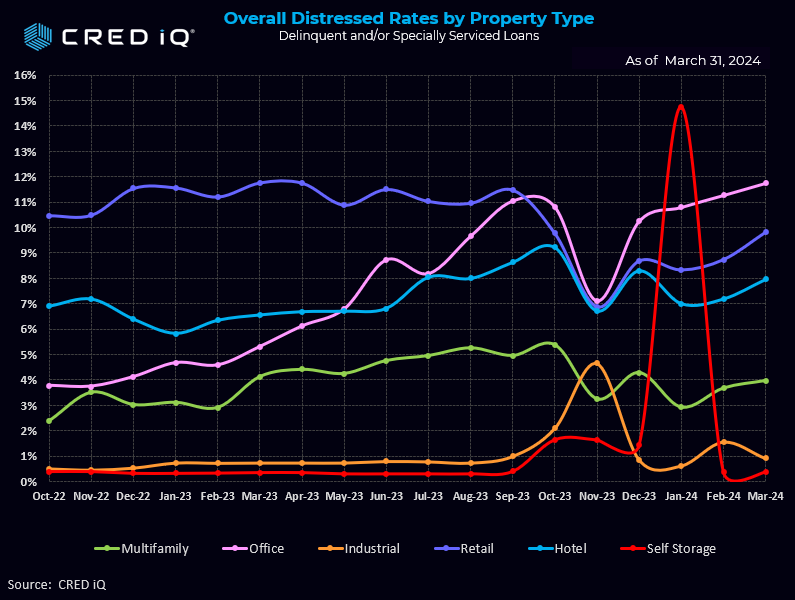
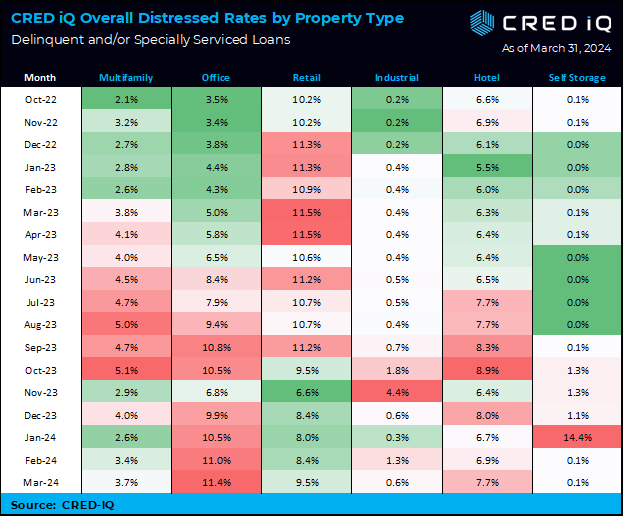
CRED iQ’s overall distress rate for CMBS increased by 22 basis points in January to 7.39% from 7.17% – snapping a two-month streak of declines.

The office segment added 55 basis points in January following a 315-point increase in December. Office has now crested over 10% in overall distress for the first time since October. 

Meanwhile, multifamily, retail, and hotel sectors all saw decreases in the January print. 

CRED iQ’soverall distress rate aggregates the two indicators of distress – delinquency rate and special servicing rate – into an overall distressed rate.  This includes any loan with a payment status of 30+ days or worse, any loan actively with the special servicer, and includes non-performing and performing loans that have failed to pay off at maturity.   

The CRED iQ delinquency rate rose in parallel with the overall distress rate –adding 23 basis points, while the specially serviced rate shaved off 5 basis points.   

The self-storage segment, which has spent most of the past 12 months under 1.0% in overall distress, saw its overall distress level skyrocket in January.  Most of this is attributable a $2.1 billion loan backed by a 112,084 SF portfolio consisting of 16 self-storage properties throughout New York City. The loan passed its January 9, 2024 maturity date, but continues to perform. The loan was added to the servicer’s watchlist in December due to upcoming maturity. Servicer commentary indicates the borrower’s request for a maturity extension is being reviewed.

Office remains the segment with consistently highest percentage of overall distress at 10.50% (excluding this month’s self-storage spike, which we expect to come down to its normal trend of below 1.0%). 

Additionally, One Market Plaza, a 1.6 million SF office tower in San Francisco, is backed by a $975.0 million loan that transferred to the special servicer in January due to the February 6, 2024 maturity. Servicer commentary indicates the borrower is discussing a potential extension. The property was 95.8% occupied as of September 2023 with Google (21.6% of GLA) being the largest tenant.

The industrial segment, once again, saw the greatest decrease in overall delinquency—dropping 24 basis points in January following a whopping 3.8% reduction in December. We have discussed the anomalies in the Industrial prints in October and November largely attributable to the  the $2.2 billion industrial portfolio (BX Trust 2021-ACNT) that failed to pay off on its initial November 9, 2023 maturity date is now listed as current by its servicer, Key Bank.  Industrial now settles back to familiar territory of 0.32% overall distress.   

About CRED iQ

CRED iQ is a commercial real estate data, analytics, and valuation platform providing actionable intelligence to CRE and capital markets investors. Subscribers use the platform to identify valuable leads for leasing, lending, refinancing, distressed debt, and acquisition opportunities.

The platform also offers a highly efficient valuation engine which can be leveraged across all property types and geographies. Our data platform is powered by over $2.0 trillion in transactions and data covering CRE, CMBS, CRE CLO, Single Asset Single Borrower (SASB), and all of GSE / Agency.
Diving into Multifamily Occupancy Trends Nationwide

0

CRED iQ explores occupancy trends within the multifamily sector.

CRED iQ’s research team wanted to explore the multifamily sector which has been in the spotlight of late.  Indeed, according to the MSCI Commercial Property Report, Multifamily prices have been slipping for sixteen consecutive months (December’s flat print broke that streak).   Naturally there are many factors at play here – from the macro interest rate environment to inflections arising from massive construction-driven unit growth. 

How do these factors impact occupancy?   What trends emerge as we look across recent occupancy performance?  Our team dug in to the top 50 MSAs to see what we can learn. 

Overall, the average occupancy increased by 0.3%. However, of the 50 largest MSAs tracked by CRED iQ, many markets had declines in occupancy since their previously reported rent roll.  CRED iQ examined all multifamily properties that had an occupancy change.  Our discovery is that 26 of the Top 50 markets showed an overall decline in their reported occupancies by number of properties. 

In one market example, Raleigh’s apartments showed that 59% of the properties reported a decline in occupancy and 33% reported an increase, while 8% remained unchanged. 

Occupancy at The Proper Raleigh Apartments in Raleigh, NC decreased from 60.2% in December 2022 to 44.8% in September 2023. The 384-unit property is backed by a $44.4 million loan and was added to the servicer’s watchlist in July 2023 due to decreased occupancy. Increased vacancy is attributed to regular unit turnover along with decreased total units due to renovations. Servicer commentary indicates the borrower intends to spend $16.6 million ($43,219/unit) on renovations with work estimated to be completed in 2024.

Atlanta was another market that showed a significant number of properties with falling occupancies.  In the CRED iQ analysis, 362 apartment buildings representing 58% of the total we tracked, had a reported drop in occupancy.

The third-largest percentage showing a drop in occupancy was Jacksonville.  Approximately 56% of the multifamily properties reported an occupancy decline, 33% increased, while 11% was unchanged. 

The top 10 markets with the highest occupancy increases (by property counts):  New Orleans, Birmingham, Louisville, Cleveland, Virginia Beach, Houston, Tucson, Detroit, Milwaukee and Kansas City. 

The Whitney Manor Apartments is a 199-unit multifamily complex located in the New Orleans market. The 21-building complex is backed by a $10.8 million loan that was added to the servicer’s watchlist in October 2023 due to DSCR triggers. Increased expenses drove the DSCR (NCF) to drastically drop from 1.66 at origination in 2020 to 0.18 in September 2023. Despite financial struggles occupancy at the property has increased from 62.0% in December 2021 to 90.0% in September 2023.

The top 10 markets with the highest occupancy decreases: Raleigh, Atlanta, Jacksonville, Las Vegas, Austin, Memphis, Pittsburg, Dallas, Charlotte, Indianapolis

There were 13 markets where at least half of the total properties reported a decrease in occupancy:  Allentown, Atlanta, Austin, Charlotte, Dallas, Indianapolis, Jacksonville, Las Vegas, Memphis, Nashville, Pittsburgh, Raleigh and San Antonio.

About CRED iQ

CRED iQ is a commercial real estate data, analytics, and valuation platform providing actionable intelligence to CRE and capital markets investors. Subscribers use the platform to identify valuable leads for leasing, lending, refinancing, distressed debt, and acquisition opportunities.

The platform also offers a highly efficient valuation engine which can be leveraged across all property types and geographies. Our data platform is powered by over $2.0 trillion in transactions and data covering CRE, CMBS, CRE CLO, Single Asset Single Borrower (SASB), and all of GSE / Agency.

2,085FollowersFollow
6SubscribersSubscribe