
Home Blog Page 17

Diving into Multifamily Occupancy Trends Nationwide

0

CRED iQ explores occupancy trends within the multifamily sector.

CRED iQ’s research team wanted to explore the multifamily sector which has been in the spotlight of late.  Indeed, according to the MSCI Commercial Property Report, Multifamily prices have been slipping for sixteen consecutive months (December’s flat print broke that streak).   Naturally there are many factors at play here – from the macro interest rate environment to inflections arising from massive construction-driven unit growth. 

How do these factors impact occupancy?   What trends emerge as we look across recent occupancy performance?  Our team dug in to the top 50 MSAs to see what we can learn. 

Overall, the average occupancy increased by 0.3%. However, of the 50 largest MSAs tracked by CRED iQ, many markets had declines in occupancy since their previously reported rent roll.  CRED iQ examined all multifamily properties that had an occupancy change.  Our discovery is that 26 of the Top 50 markets showed an overall decline in their reported occupancies by number of properties. 

In one market example, Raleigh’s apartments showed that 59% of the properties reported a decline in occupancy and 33% reported an increase, while 8% remained unchanged. 

Occupancy at The Proper Raleigh Apartments in Raleigh, NC decreased from 60.2% in December 2022 to 44.8% in September 2023. The 384-unit property is backed by a $44.4 million loan and was added to the servicer’s watchlist in July 2023 due to decreased occupancy. Increased vacancy is attributed to regular unit turnover along with decreased total units due to renovations. Servicer commentary indicates the borrower intends to spend $16.6 million ($43,219/unit) on renovations with work estimated to be completed in 2024.

Atlanta was another market that showed a significant number of properties with falling occupancies.  In the CRED iQ analysis, 362 apartment buildings representing 58% of the total we tracked, had a reported drop in occupancy.

The third-largest percentage showing a drop in occupancy was Jacksonville.  Approximately 56% of the multifamily properties reported an occupancy decline, 33% increased, while 11% was unchanged. 

The top 10 markets with the highest occupancy increases (by property counts):  New Orleans, Birmingham, Louisville, Cleveland, Virginia Beach, Houston, Tucson, Detroit, Milwaukee and Kansas City. 

The Whitney Manor Apartments is a 199-unit multifamily complex located in the New Orleans market. The 21-building complex is backed by a $10.8 million loan that was added to the servicer’s watchlist in October 2023 due to DSCR triggers. Increased expenses drove the DSCR (NCF) to drastically drop from 1.66 at origination in 2020 to 0.18 in September 2023. Despite financial struggles occupancy at the property has increased from 62.0% in December 2021 to 90.0% in September 2023.

The top 10 markets with the highest occupancy decreases: Raleigh, Atlanta, Jacksonville, Las Vegas, Austin, Memphis, Pittsburg, Dallas, Charlotte, Indianapolis

There were 13 markets where at least half of the total properties reported a decrease in occupancy:  Allentown, Atlanta, Austin, Charlotte, Dallas, Indianapolis, Jacksonville, Las Vegas, Memphis, Nashville, Pittsburgh, Raleigh and San Antonio.

About CRED iQ

CRED iQ is a commercial real estate data, analytics, and valuation platform providing actionable intelligence to CRE and capital markets investors. Subscribers use the platform to identify valuable leads for leasing, lending, refinancing, distressed debt, and acquisition opportunities.

The platform also offers a highly efficient valuation engine which can be leveraged across all property types and geographies. Our data platform is powered by over $2.0 trillion in transactions and data covering CRE, CMBS, CRE CLO, Single Asset Single Borrower (SASB), and all of GSE / Agency.
Liquidations & Losses: January 2024 Update

0

CRED iQ analyzed a sample of CMBS transactions that have incurred realized losses from liquidations during the 4th quarter of 2023.  In our analysis, CRED iQ identified 23 loans with an unpaid balance of $288 million that resulted in a total loss amount of $187 million.  Of the 23 workouts resulting in losses, severities for the fourth quarter ranged from 1% to 111%, based on outstanding balances at disposition and liquidation expenses. 

Consistent with the earlier quarters in 2023, Q4’s property type, workouts were concentrated in lodging and retail. Lodging workouts accounted for 8 of the 23 distressed resolutions in Q4 2023 and retail workouts accounted for 7 distressed workouts. Distressed workouts for retail properties had the highest total of aggregate realized losses ($131 million) by property type, which accounted for 70% of the total for the quarter. Distressed lodging workouts had the second-highest total of aggregate losses by property type with $26 million, or 14% of the total.

The largest realized loss of the quarter was the WPC Department Store Portfolio in November which notched both the highest loss severity of 111.6% and also the greatest realized loss of $62.7 million.   The retail segment held the top three with the  Shops at Northern Boulevard in Long Island City New York, and Oak Court Mall in Memphis TN  taking second and third place respectively.   

Here are two workout examples which took place in Q4 2023. 

Kirlin Industries, a 95,000 SF flex office property in the Washington, DC market liquidated with a realized loss of $6.4 million in December 2023. Kirlin Industries was the sole tenant of the property until it vacated in March 2020 without notice, despite its 2029 lease expiration. The loan collateralized by the subject property  was added to the watchlist in April 2020 but did not transfer to the special servicer until July 2021. The realized loss to the trust represented a 50% loss severity.

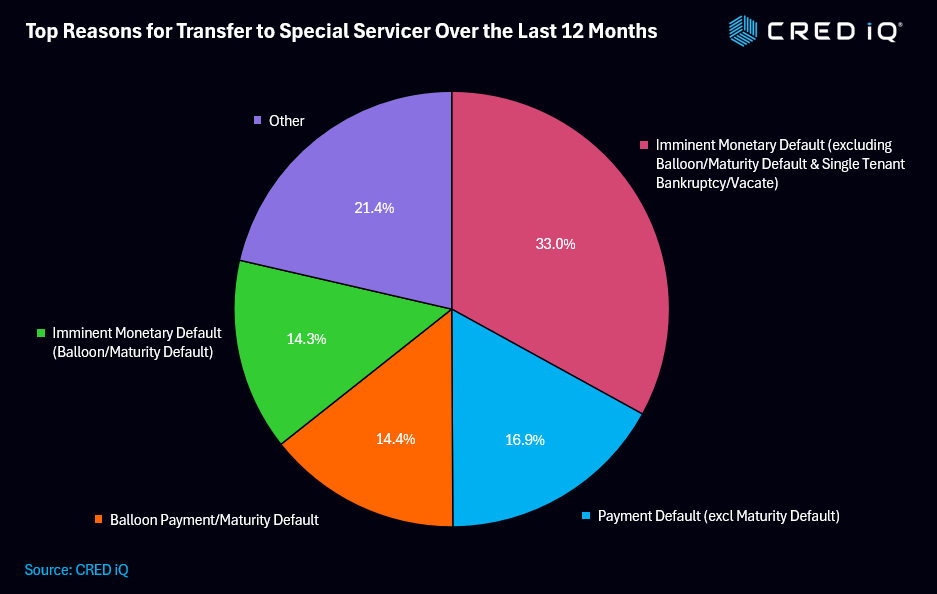
The Fairfield Inn & Suites Kansas City, a 99-room lodging property in Kansas City, MS liquidated with a realized loss of $4.4 million. The limited-service property was included in a September 2023 auction, resulting in a closing date in November 2023. Outstanding debt at the time of disposition totaled $6.5 million, representing a 61% loss severity. The property has been REO since August 2021 and had been in special servicing since October 2020 due to imminent monetary default.

About CRED iQ

CRED iQ is a commercial real estate data, analytics, and valuation platform providing actionable intelligence to CRE and capital markets investors. Subscribers use the platform to identify valuable leads for leasing, lending, refinancing, distressed debt, and acquisition opportunities.

The platform also offers a highly efficient valuation engine which can be leveraged across all property types and geographies. Our data platform is powered by over $2.0 trillion in transactions and data covering CRE, CMBS, CRE CLO, Single Asset Single Borrower (SASB), and all of GSE / Agency.

Distress Accelerated in the Second Half of 2023

0

CRED iQ examined loans that were added to the servicer watchlist in during the second half of 2023.  Building upon our mid-year 2023 report, our objective was to explore the underlying factors and the associated trend of distressed CRE loans.

As of the December 2023 remittance reports, 15,373 loans were added to the servicer watchlist in the second half of 2023 (July-December). During the final 6 months of 2023, almost $100 billion of loans have been added to the watchlist for signs of upcoming distress. In that same 6-month period 860 loans were transferred to the special servicer.

When factoring in the first half results, a total of 23,085 loans were added to the servicer watch list in 2023, with the second half accelerating the pace by roughly 110% compared to the first half of the year. October had the highest amount of loans added to the watchlist with a total of 4,843 loans with a combined unpaid loan balance of $20.7 billion. In total, over $133 billion of loans were added to the watchlist in 2023.  This compares to approximately $25 billion that transferred to the special servicer. 

Diving into the underlying credit factors for loans added to the watchlist during the second half of 2023:

  • 35.8% of all Watchlist loans were attributable Pending Maturity or ARD. 
  • DSCR Triggers for Floating Rate loans represented 15.3% of the names on the list.  Low DSCRs for Fixed Rate loans compared to underwriting amounted to 8.6% of watchlisted loans in the second half of 2023. Low DSCR Triggers for Fixed Rate loans amounted to 4.9%.  Adding the three DSCR buckets together totals 28.8% of all recently added watchlist loans. 
  • Delinquent taxes accounted for 5.5% of loans added to the watchlist in H2 2023. 
  • Major tenant expirations were attributable to 5.1% of Watchlist loans during July and December 2023.    

An example is the $525.0M loan (inclusive of $143.0M subordinate debt) that was added to the servicer’s watchlist in September 2023 due to concerns with the second largest tenant, WeWork. The loan is backed by the Midtown Center, an 867,654 SF office tower located in downtown Washington, DC. Fannie Mae serves as the largest tenant of the property, accounting for 82% of the gross leasable area (GLA). The subject currently serves as Fannie Mae’s global headquarters. However, the tenant’s space is listed as available for lease starting June 2029, coinciding with Fannie Mae’s lease expiration date. Furthermore, WeWork (13% GLA) declared bankruptcy in November 2023 causing additional occupancy concerns, despite the tenant’s November 2036 lease expiration.

The property most recently reported a 100% occupancy and 2.97 DSCR (NCF) in June 2023. The most recent performance compares to the August 2019 underwritten occupancy of 100%, DSCR of 3.98 (senior debt) and 2.90 (total debt), and an implied cap rate of 4.95%. The most recent property value was the appraised value of $960.0M in August 2019.

About CRED iQ

CRED iQ is a commercial real estate data & analytics platform used by investors, lenders, brokers, and other CRE finance professionals. The easy-to-use interface is fully equipped with official loan and financial data. The platform is supplemented with true borrower and ownership contact information, valuation software and refinance models.

As an official market data provider, CRED iQ’s is powered by over $2.0 trillion of audited loan and transaction data that includes all property types and geographies. CRE professionals leverage CRED iQ for a wide spectrum of use cases such as uncovering acquisition & lending opportunities, market analysis, underwriting, and risk management.

Over 200 Million Square Feet of Office Leases set to Expire

0

CRED iQ examined lease expiration data across CMBS office collateral for the near term, 24-month horizon, as well as the next 5+ years. Office vacancies nationwide have reached an all-time high as we enter 2024. CRED iQ’s data shows approximately 217 million square feet of office space have leases with expiration dates in 2024 or 2025.  As tenants regroup and re-size their office footprints, CRED iQ explored the intersection of record vacancy rates with near- and medium-term lease expirations.    

Downsizing and non-renewal by office tenants is a contributing factor to headwinds facing the office sector, which has been plagued by sustained growth of  remote working and tenants’ need to shed space, reduce real estate costs, and right-size physical footprints during a period of economic uncertainty.

A high-level view of lease expirations provides a general sense, or foreboding in some instances, of the mechanics that the office sector needs to work through as the property type falls out of favor with lenders, investors, and other CRE industry constituents. Lease expiration analysis offers an important dimension to evaluate when and where the next pockets of elevated office distress will materialize.

Office collateral has been a primary contributor to incremental distress in commercial real estate throughout 2023. CRED iQ’s distressed rate for CMBS office loans, which includes delinquent loans and specially serviced loans secured by office collateral, was 9.9% as of December 2023. Furthermore, the distressed rate for office collateral has more than doubled compared to 12 months prior.

CRED iQ examined over 866 million square feet for CMBS office and mixed-use collateral properties. For this exercise, CRED iQ focused on upcoming lease rollover over the next five plus years.  It should be noted that office collateral securing CMBS does not represent the entire office market, but rather serves as proxy to identify challenges facing the larger universe of office properties.

Takeaways from our observations include: over 500 million square feet of net rentable area (NRA) is scheduled to expire over the next 5 years for office and mixed-use properties secured by CMBS loans. 112 million square feet of office space is set to expire in 2024; and another 105 million square feet in 2025 for a total of 217 million square feet of near-term rollover risks. 

Lease expiration figures were further parsed by geographic location to provide a granular view by MSA. A detailed view of lease expirations by individual office market helps identify which markets’ vacancy rates are at risk of being stressed. The data was parsed to isolate the next two years and the next five years.

In both timeframes, the New York MSA had the highest gross space in the country and the most leases scheduled to expire.  More than 173 million square feet of leases in the New York MSA are scheduled to expire in through 2028, with 32 million square feet scheduled to expire in 2024 and 2025.

Other noteworthy MSAs with elevated lease rollover in the next two years include the Los Angeles (15M SF), Chicago (12M), Philadelphia (9M), and San Francisco (8M) markets, accounting for an aggregate 44 million square feet.   

Let us highlight two major assets to monitor in 2024:

The $940.0M loan secured by the Worldwide Plaza office tower in New York City will be facing increased vacancy in 2024 with 33% of the NRA scheduled to expire. The 2024 lease rollover is highly impacted by the second largest tenant, Cravath, Swaine & Moore LLP’s lease expiration on August 31, 2024. The tenant currently represents 30% of the NRA and has confirmed it will be terminating its lease at expiration to downsize and relocate to Hudson Yards. Two additional top five tenants have leases scheduled to expire in the next five years including Worldwide Plaza Garage (6% NRA, 2027) and WNET.org (5%, 2026). The property was 91% occupied as of September 2023.

More than 1,500 leases from tenants that are the sole occupant of a property are scheduled to expire in the next five years. This represents 161M SF (19%) of the total NRA set to expire. Over 275 leases are scheduled to expire in the next two years, however the max leases expire in 2028.

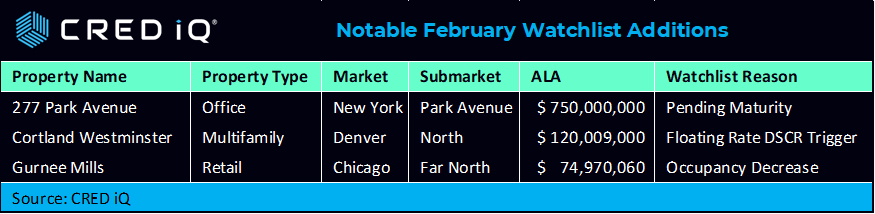
The Google and Amazon Office Portfolio is backed by two sole-tenant office properties in the San-Jose market. The Technology Corners property (700,000 SF) and Moffett Towers Building D (357,000 SF) are leased by Google and Amazon, respectively. Google accounts for 66% of the portfolio NRA with a lease expiration scheduled on September 30, 2024, while Amazon’s lease expires on February 29, 2024. Neither tenant has early termination options, however Google has a seven-year renewal option and Amazon has two, seven-year renewal options. Servicer commentary indicates the borrower is negotiating with Google for a renewal. On top of the upcoming lease expirations, the $412.4M loan is scheduled to mature this month.

To be fair, many tenants will renew or even expand footprints in certain office buildings. However, rising vacancy rates — in excess of 20% and even reaching 30% in certain markets — indicate a high level of risk that many tenants will downsize or fail to renew altogether. Lease expirations may have possibly favorable outcomes for office landlords, including a renewal or new direct lease that resets rents higher if market conditions allow. However, high vacancies and downward pressures on net effective rents may lead to reductions in cash flow and trigger subsequent distressed scenarios.

About CRED iQ

CRED iQ is a commercial real estate data & analytics platform used by investors, lenders, brokers, and other CRE finance professionals. The easy-to-use interface is fully equipped with official loan and financial data. The platform is supplemented with true borrower and ownership contact information, valuation software and refinance models.

As an official market data provider, CRED iQ’s is powered by over $2.0 trillion of audited loan and transaction data that includes all property types and geographies. CRE professionals leverage CRED iQ for a wide spectrum of use cases such as uncovering acquisition & lending opportunities, market analysis, underwriting, and risk management.

CRED iQ’s Overall Distress Rate is Down, but Multifamily, Office, Retail, and Hotel Spike Up

0

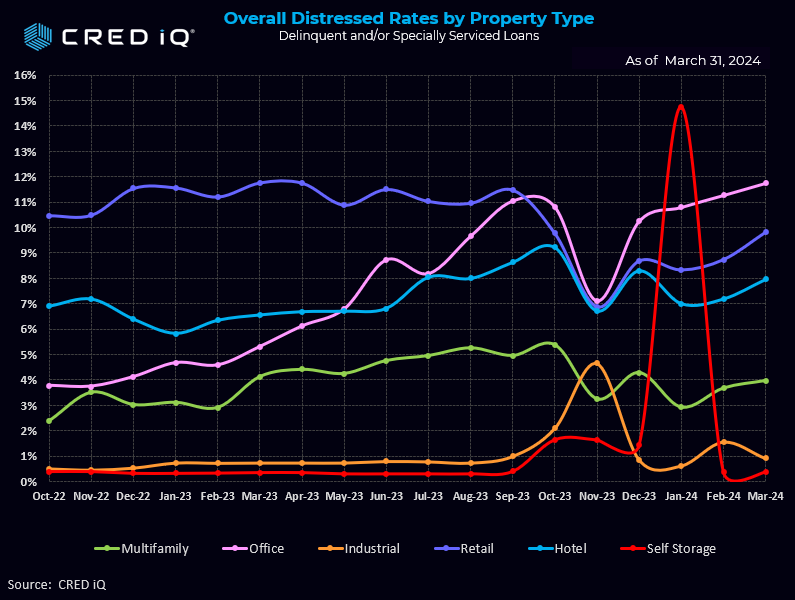
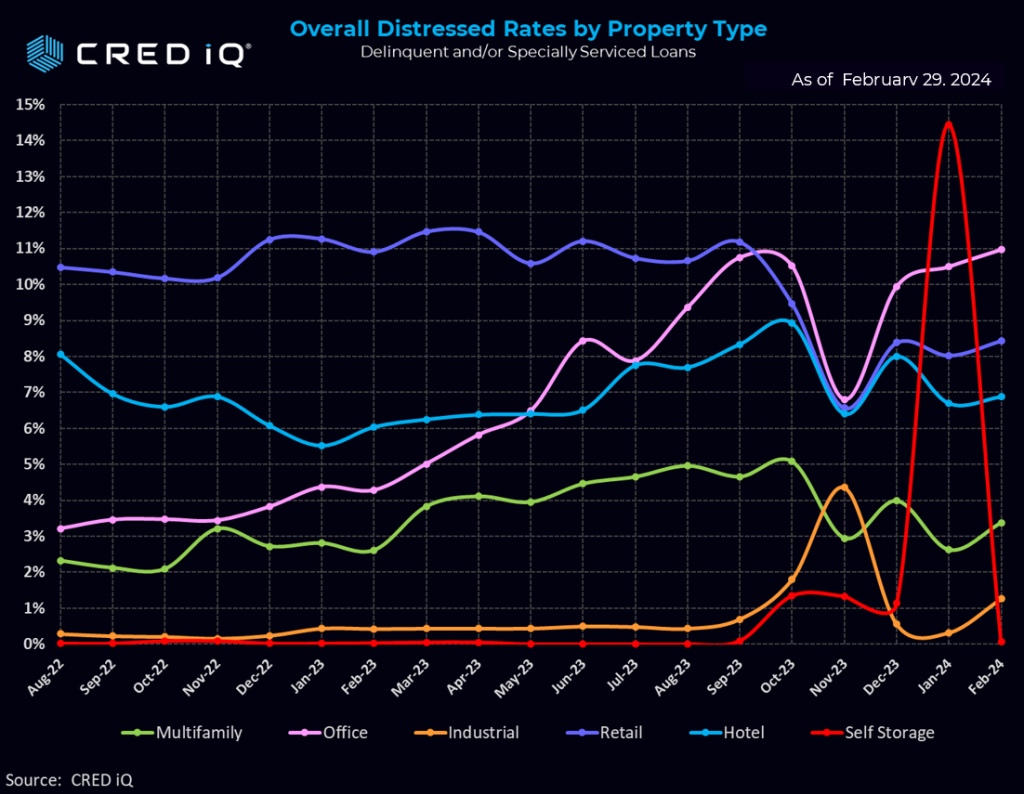
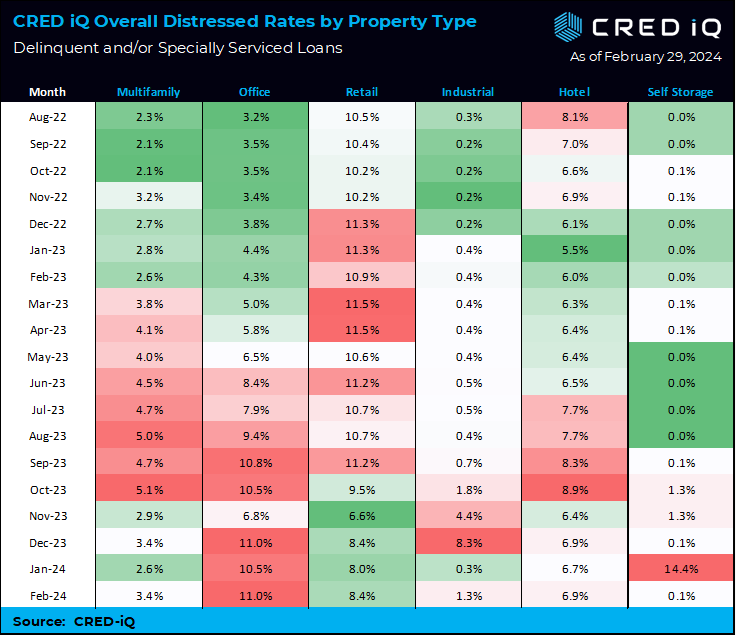
CRED iQ’s overall distress rate for CMBS fell 36 basis points in December to 7.17% from 7.53%.

This notched a second straight monthly decrease and matches the August metric.  However, office, multifamily, retail, and hotel sectors all increased significantly.  The main driver behind the overall metric for all property types was caused by the resolution behind several massive industrial portfolios that helped bring the weighted average down. 

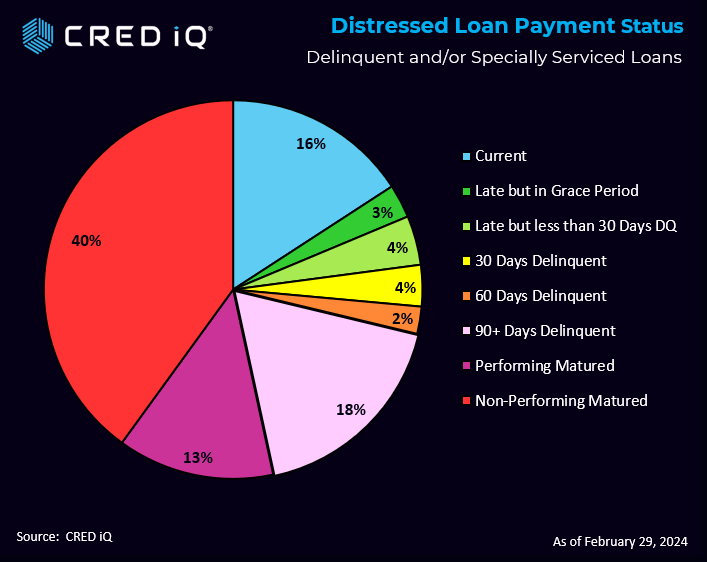
CRED iQ’s overall distress rate aggregates the two indicators of distress – delinquency rate and special servicing rate – into an overall distressed rate.  This includes any loan with a payment status of 30+ days or worse, any loan actively with the special servicer, and includes non-performing and performing loans that have failed to pay off at maturity.    

The core delinquency rate fell, albeit modestly, from 5.28% to 5.22%.  Our special servicing rate, which represents the percentage of CMBS loans that are with the special servicer (includes both delinquent and non-delinquent), fell by 13 basis points to 6.72%. following a modest increase in November.

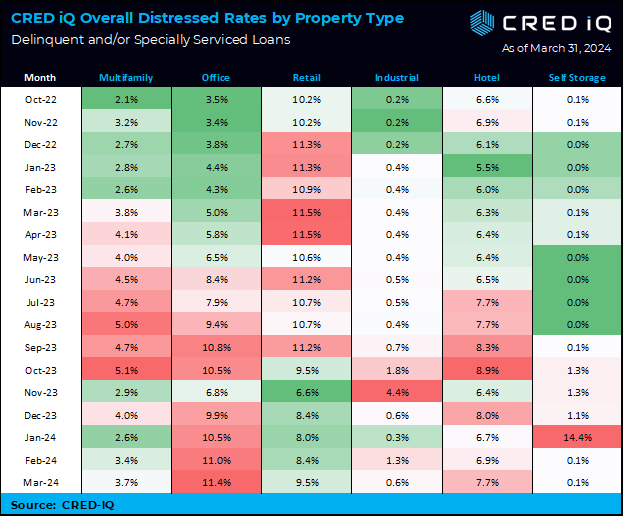
Overall distress rates for multifamily jumped from 2.94% in November to 3.99% this month.  Additionally, the hotel’s distress rate increased 159 basis points to 8.00, while retail’s distressed rate went up by over 180 basis points in one month. 

The industrial segment saw the greatest decrease in overall delinquency—dropping a whopping 3.8% to 0.6% –the 10th month in 2023 with a sub 1% overall distress rate.  As we reported in November, a major factor was the $2.2 billion industrial portfolio (BX Trust 2021-ACNT) that failed to pay off on its initial November 9, 2023 maturity date is now listed as current by its servicer, Key Bank. 

The office segment saw the greatest month-over-month overall distress rate increase from 6.80% to 9.95%. A significant factor was the $285 million The Gateways portfolio (CSMC 2021-GATE), a 1.7M-sf portfolio consisting of three properties with a mix of office and retail space in Newark, NJ. The portfolio failed to pay off at its initial December 9, 2023, maturity date, causing the payment status to change from current to performing matured.

About CRED iQ

CRED iQ is a commercial real estate data & analytics platform used by investors, lenders, brokers, and other CRE finance professionals. The easy-to-use interface is fully equipped with official loan and financial data. The platform is supplemented with true borrower and ownership contact information, valuation software and refinance models.

As an official market data provider, CRED iQ’s is powered by over $2.0 trillion of audited loan and transaction data that includes all property types and geographies. CRE professionals leverage CRED iQ for a wide spectrum of use cases such as uncovering acquisition & lending opportunities, market analysis, underwriting, and risk management.

Commercial Real Estate Loan Modifications Spike in 2023

0

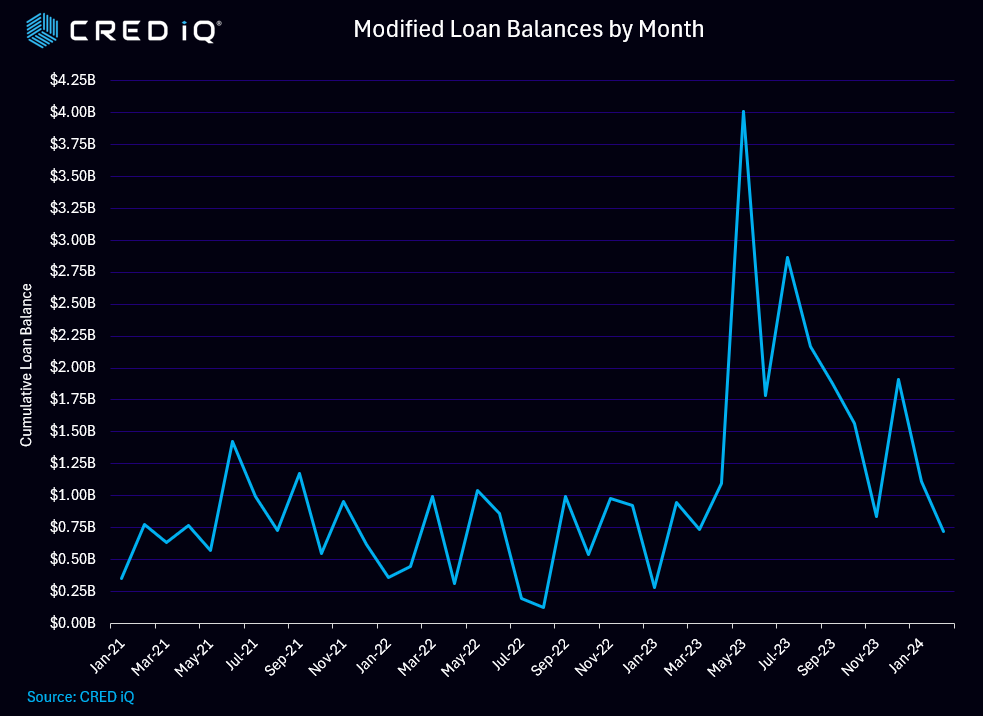
With higher rates and a challenging lending environment, more and more borrowers are seeking to modify their loans. CRED iQ analyzed all modifications that occurred in 2023 within the securitized universe, including all CMBS, CRE CLO, SASB, Fannie Mae, Freddie Mac, and Ginnie Mae.

In total, $13.6 billion across 441 loans were modified in 2023. The highest volume of modifications occurred in the second quarter of the year. Single Borrower Large Loan (SBLL) deals represented almost half of this year’s modifications, followed by CRE CLO deals. Office ($4.6B) and multifamily ($3.3B) loans were modified the most in 2023.

Loan Modifications by Count

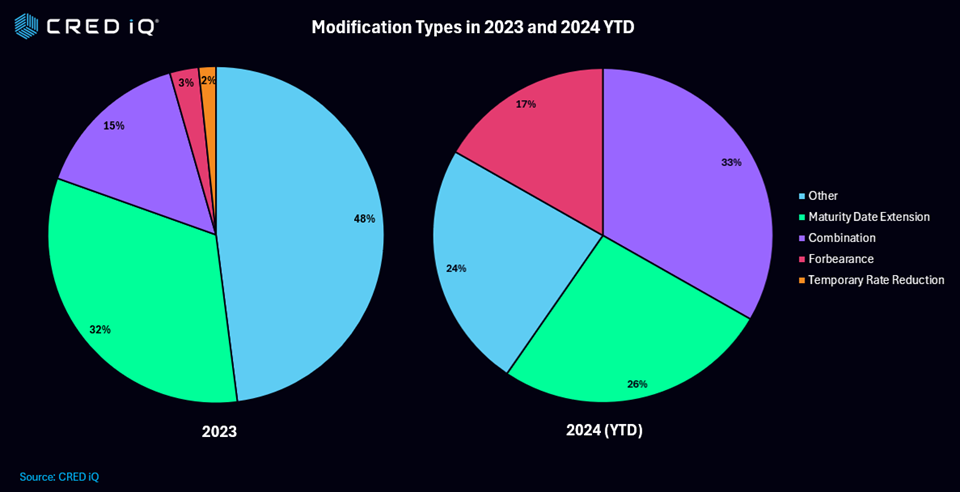
The number of modifications in 2023 almost doubled compared to 2022. Extending the loan term has been the most popular modification type in 2023. CRED iQ predicts maturity extension modification will continue to be a popular tool for borrowers in 2024, when $209.6B of CRE debt is slated to mature across the securitized sectors.

Some of the largest loan modifications in 2023 include:

  • The 831,000-sf office building at 375 Park Avenue backs $782.8M in debt and was originally set to mature in May 2023. The maturity date was extended by a year.
  • The $536.0M loan backed by the Aon Center, a 2.8M-sf office tower in Chicago, was originally set to mature in July 2023. The loan was modified by extending maturity by three years with no change to the interest rate.
  • Two modifications occurred in 2023 for the $219.6M loan secured by Aven, a 563-unit multifamily building located in Los Angeles, CA. The first modification took place in May to convert the loan from LIBOR to SOFR. The second modification occurred in September when the one-year maturity extension was utilized to extend the original March 2025 maturity to March 2026.

Property Type & Loan Balance

Deal Type

CRED iQ subscribers get full access to all modified loans, their modified loan terms, full loan details, financials, and borrower contact information.

About CRED iQ

CRED iQ is a commercial real estate data & analytics platform used by investors, lenders, brokers, and other CRE finance professionals. The easy-to-use interface is fully equipped with official loan and financial data. The platform is supplemented with true borrower and ownership contact information, valuation software and refinance models.

As an official market data provider, CRED iQ’s is powered by over $2.0 trillion of audited loan and transaction data that includes all property types and geographies. CRE professionals leverage CRED iQ for a wide spectrum of use cases such as uncovering acquisition & lending opportunities, market analysis, underwriting, and risk management.

How this Mall took a $93 Million Loss

0

CRED iQ and Cedars Hill Group team up on another Case Study that analyzes a mall in Ohio that resulted in a loss of $92.7 million.

In our last two case studies on The Gas Company Tower and Crossgates Mall we reviewed the history of those properties that led up to their troubles and eventual liquidations that resulted in massive losses for CMBS bond holders. Igal Namdar of Namdar Realty Group, who has been one of the most prolific buyers of distressed malls in the US, made the distinction between distressed and over levered in a Bloomberg interview by pointing out that just because a property has too much debt doesn’t mean it’s a bad property. Commercial real estate has been prominently featured in the press this year and has come to be regarded as a poisonous asset class. However, this viewpoint misses Namdar’s distinction entirely and risks overlooking value-laden investment opportunities. Accordingly, this case study is going to speculate on what the future may hold after these “distressed” properties deleverage through foreclosure or bankruptcy.

CRED iQ’s unique data platform is a tool that can help identify opportunities like properties that are going to enter receivership, or properties that need recapitalization or refinancing, and properties that need capital for revitalization. In today’s rapidly changing market this tool can be combined with creative and innovative financing and other insightful solutions to navigate and unlock value in the ongoing credit cycle. In choosing the property for this case study we turned to CRED iQ’s monthly listing of liquidated loans and coincidentally found a property that Igal Namdar recently purchased.

The Mall at Tuttle Crossing headlines CRED iQ’s listing of liquidated loans for the largest realized loss to the CMBS trust after it was purchased in October by a partnership of Namdar Realty Group, Mason Asset Management, and CH Capital Group for $19.5 million which was below the Franklin County Auditor’s assessment of $50 million and the April 2013 appraisal of $240 million.  Tuttle Crossing is just the latest in a long series of enclosed malls selling at pennies on the dollar, but it affords us the opportunity to learn what opportunities high-quality, but over levered properties like this may present to discerning investors.

The latest financials we have available are from the six months ending in June and show net cashflow (NCF) of just over $2 million, which provides the Namdar led group with a rough 20% cash-on-cash annualized yield on their investment. Namdar is well-known for their strategy of buying malls like Tuttle Creek at attractive cash-on-cash yields and operating the property as-is, forgoing big and expensive capex investments, instead focusing on bringing in new tenants at cheaper rents which they can afford given their low investment basis. Most municipalities prefer a new owner to inject new capital and redevelop underperforming properties and Namdar has received some criticism for their strategy but many times there are major impediments to redevelopment.

In Tuttle Crossing’s case the major barrier to redevelopment is the fact that the anchor boxes are still owned by the department stores that once filled those spaces. The former Sears box is listed for lease or sale as a mixed-use redevelopment opportunity which would be ideal for retail, multifamily, hotel, office, and industrial. The fact that the site is parceled out and that the Namdar group does not own the site in its entirety makes redevelopment far less attractive for the new owners. The demographics of the area are favorable for a combination of retail, hotel, and multifamily or office if Namdar were able to bring in some higher end tenants turning the property into a living and entertainment destination, but significant capex would be required to do so.  

While the ownership of the site is a major impediment there are other recent developments that have made redevelopment of these properties more attractive. First, the recently passed Inflation Reduction Act (IRA) has created new tax credits for green energy manufacturing, solar, and battery storage which can help owners and developers realize significantly more operational savings and offset capex costs.  Second, the advent of Commercial Property Assessed Clean Energy (C-PACE) financing has opened up a new and attractive source of capital for the commercial real estate industry. C-PACE utilizes a tax assessment mechanism typically used in tax increment financing (TIF) to provide owners and developers with cheap, long-term capital to make energy efficient investments in their properties. This financing can fund a significant part of any redevelopment project and helps to offset the tightening in credit we have seen from other commercial real estate lenders.

C-PACE financing can be combined with construction financing or replace costly mezzanine or equity financing. Construction financing is typically short-term whereas C-PACE financing can be structured to match the usable life of the installed equipment and be up to 30 years in duration. The tax assessment levied against the property which is used to pay back the lender can usually be passed along to tenants in the form of increased rent. A report published by JLL in January 2022 estimated that properties with green certifications result in a 6% rent premium which demonstrates that tenants are willing to pay a premium for energy efficient properties. A new Westin in Milwaukee was developed which utilized C-PACE financing and was able to pass along the assessment cost via a per day surcharge on guest bills. C-PACE financing is cheaper than equity or mezzanine financing and can be as much at 30% of a capital stack resulting in much higher returns for the developer and their investors.

Ohio has already passed enabling C-PACE legislation and the Columbus-Franklin County Finance Authority administers the C-PACE lending program. In the case of the Mall at Tuttle Crossing the ability to utilize C-PACE financing could align the interests of the Namdar led group with the Columbus-Franklin County who surely wants to see their former premier retail property be revitalized and create new jobs for their community. For the Namdar-led group the ability to borrow at T+400-500bps for 30 years is an attractive source of long-term capital that can be accretive to their bottom line. Additionally, the cost savings from lowered energy usage and tax credits, and the ability to give an older property a modern upgrade and charge premium rents could tip the scales in favor of redevelopment of the site.

The benefits of new financing mechanisms like C-PACE take time to be fully realized by the industry and an awareness must grow among investors and industry participants before its full potential can be realized. CRED iQ provides a treasure trove of information that can help municipalities, lenders, and other industry participants identify these opportunities across the country to revitalize and improve commercial properties.

About Joshua J. Myers, CFA

After a successful 20+ year investing career, Joshua Myers, CFA launched Cedars Hill Group to bring large market expertise to broader audiences. He primarily serves as an outsourced CIO/CFO for family offices, RIAs, and small-to-medium sized businesses. He started as an assistant trader at Susquehanna Investment Group during the Russian default and LTCM failure in 1998. Afterwards, he was Head of Fixed Income at Penn Mutual Life Insurance during the Global Financial Crisis of 2008-2009. He traded distressed CMBS securities in the aftermath of the GFC at Cantor Fitzgerald and most recently was Chairman of the Board for an oil production company during the COVID pandemic. He is a lifelong student of financial markets and writes about current events with a focus on the art of decision making and cognitive psychology.  

For more market commentary from Josh subscribe to his Substack at Cedars Hill Group (CHG). You can also follow Josh on LinkedIn and X.

About CRED iQ

CRED iQ is a data & analytics platform used by commercial real estate brokers, lenders, investors, and appraisers. It provides an easy-to-use interface, comprehensive and official loan data, true borrower and owner contact information, and a built-in valuation tool. As an official data provider, CRED iQ’s precise and audited data includes across all property types and geographies, all of which help CRE professionals leverage CRED iQ for a wide spectrum of use cases such as uncovering acquisition and lending opportunities, market analysis, underwriting, & risk management.

2024 CRE Maturity Outlook: A Deep-dive Analysis into the Wall of Maturities

0

CRED iQ prepared for the year ahead in commercial real estate by analyzing securitized commercial mortgages with maturity dates scheduled in 2024 and 2025. CRED iQ’s database has approximately $210 billion in commercial mortgages that are scheduled to mature in 2024, with an additional $111 billion of CRE debt maturing in 2025.  In total, CRED iQ has aggregated and organized a total of $320 billion of commercial mortgages slated to mature within the next 24 months. 

The dataset included is comprised of loans securitized in CMBS conduit trusts, single-borrower large-loan securitizations (SBLL) and CRE CLOs, as well as multifamily mortgages securitized through government-sponsored entities.

The next 12 months have the highest volume of scheduled maturities for securitized CRE loans over a period of 10 years ending 2033. Let’s dive into the details. 


Commercial Mortgages Maturing

  • Includes CMBS, Insurance, Bank/Balance Sheet, Agency, and Debt Funds
  • In 2024, $659 billion in commercial loans are slated to mature
  • In 2025, $539 billion in commercial loans are slated to mature
  • In total, $1.2 Trillion will mature in the next 24 months

Maturity by Year:  Active Loan Balances of Securitized Universe

  • CRED iQ’s securitized universe includes CMBS, SBLL, CRE CLO, Freddie Mac, Fannie Mae, and Ginnie Mae
  • 2024 and 2025 have the largest aggregate balances of maturing loans
  • In 2024, $210 billion of CRE debt will mature.
  • In 2025, $111 billion of CRE debt will mature.

CMBS Issuance Trends

  • Since 2012, CMBS issuance has averaged $76 billion per year
  • The market significantly slowed down in 2008-2010 due to the Great Financial Crisis
  • In 2021, CMBS issuance totaled $111 billion as the market rebounded after the Covid shutdown.

Property Type Analysis

  • Multifamily represents the largest asset class of maturing loans.  $113 billion (35%) of multifamily will mature these next 24 months. 
  • The second-largest sector is office ($46.6 billion) then hotel with $42.3 billion.
  • Retail loans coming due over the next 24 months total $31 billion.
  • Industrial loans totaling $30 billion are slated to mature in 2024 or 2025.
  • Self-storage loans have approximately $5.3 billion coming due over the next two years.

Search all Commercial Property Types on the CRED iQ Platform

Origination Dates

  • Approximately $100 billion of upcoming maturing loans were originated in 2014 or 2015 as 10-year loans.
  • Over $80 billion of 2021 originated loans are set to expire in the next 24 months.

Market Analysis – Top 25 MSAs

Second-Tier Market Analysis (Top 26 to 50)

  • The New York MSA has the largest amount of maturing loans in the next 24 months.
  • LA, Dallas, San Francisco and Atlanta are in the Top 5 markets with the highest totals of CRE debt coming due.
  • Charlotte, NC ranks in the top of the second tier of markets with $1.8 billion of CRE debt maturing by 2025.
  • Nashville, Detroit, Raleigh, and Allentown round out the Top 5 largest markets with maturing loans within the second tier.

Current Interest Rates

  • Of the $320 billion set to mature in 2024 or 2025, 43% have current interest rates below 5.00%.
  • 14.7% of maturing loans in the next two years have an existing interest rate under 4.00%.

Original Cap Rates

  • 35% of the maturing loans had an original cap rate of less than 4.0% at the time of loan origination.
  • 18% of the maturing loans in the next two years had a cap rate between 4.0% and 5.0%.
  • Most of the maturing loans were originated in 2014 and 2015, during a period of lower cap rates.
  • Multifamily had the lowest average cap rate with 5.48%. 
  • The second-lowest average cap rate was 5.81% for the self storage sector.
  • Average office cap rates at the time of loan origination was 6.84% for the loans that are coming due in the next 24 months. 

About CRED iQ

CRED iQ is a data & analytics platform used by commercial real estate brokers, lenders, investors, and appraisers. It provides an easy-to-use interface, comprehensive and official loan data, true borrower and owner contact information, and a built-in valuation tool. As an official data provider, CRED iQ’s precise and audited data includes across all property types and geographies, all of which help CRE professionals leverage CRED iQ for a wide spectrum of use cases such as uncovering acquisition and lending opportunities, market analysis, underwriting, & risk management.

CRED iQ November 2023 Delinquency Report

0

Overall distressed levels remain relatively unchanged, while industrial segment’s distressed rates almost double this month.

Following 10 consecutive increases CRED iQ’s overall distress rate for CMBS fell modestly in November by 5 basis points to 7.52%.  There are important variables impacting these results—including some previously reported anomalies in the October print.

The core delinquency rate increased by 13 basis points to 5.27% – after recording a minor reduction in October.  Similarly, our special servicing rate, which represents the percentage of CMBS loans that are with the special servicer (includes both delinquent and non-delinquent), increased by 6 basis points to 6.84%.

Looking across the CRED iQ Distressed Rate Heat Map, the retail segment enjoyed its second consecutive month turning in an overall distress rate under 10%. On a month-over-month basis, however, retail overall distress increased by 35 basis points to 9.82% – putting a three month/sub 10% trend on thin margins.


Industrial saw the greatest month-over-month distress increase from 1.81% to 4.53%.  The industrial segment has spent most of 2023 below 1.0% until October.  One significant factor was the $2.2 billion industrial portfolio (BX Trust 2021-ACNT) that failed to pay off on its initial November 9, 2023 maturity date. The failure to pay off at maturity caused the payment status to change from current to performing matured. There are three 12-month extension options, allowing for an extended maturity through November 2026.  The floating rate loan, which was originated in October 2021, is structured with an interest rate that equates to one-month LIBOR plus a 2.37% spread rate, which has now spiked to 7.82%.  The sponsor of the loan, Blackstone, had their interest rate cap agreement expire on November 15, 2023, which had an original strike rate of 3.50%.

Lodging, multifamily and the well-watched office segments all trimmed their Distressed Rate month-over-month modestly. 

Self storage continued to dominate the overall delinquency rate performance at 1.33%, 2 basis points off the 2023 high of 1.35%. Self storage logged three months with 0% delinquency, and most months in 2023 were in the single digits. 

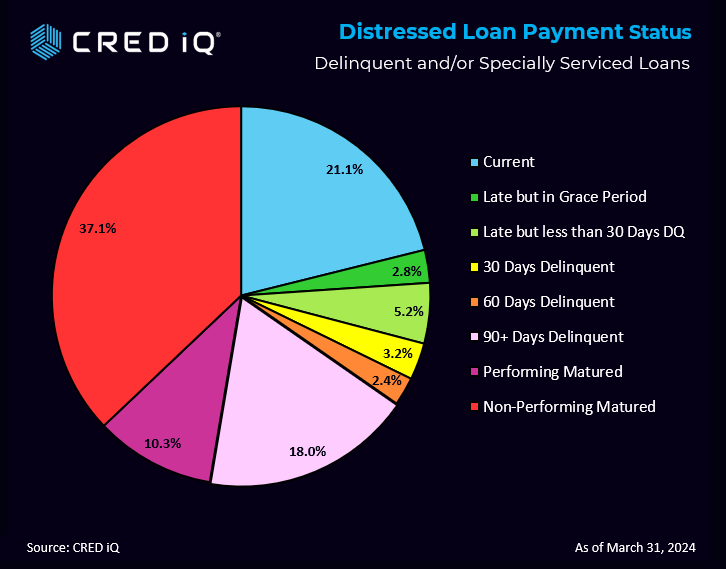
Nearly half of the delinquencies were categorized as Non-Performing Matured Balloon.  Approximately 25% were 90+ Days Delinquent and just below 20% were Performing Matured Balloon. 

CRED iQ’soverall distress rate aggregates the two indicators of distress – delinquency rate and special servicing rate – into an overall distressed rate.  This includes any loan with a payment status of 30+ days or worse, any loan actively with the special servicer, and includes non-performing and performing loans that have failed to pay off at maturity.    

As with the October report, we caution that November’s results are inconclusive from a trending perspective. With that said, it is noteworthy that all but 2 defined segments logged reduced delinquency month over month (the Other category saw an increase).     

About CRED iQ

CRED iQ is a data & analytics platform used by commercial real estate brokers, lenders, investors, and appraisers. It provides an easy-to-use interface, comprehensive and official loan data, true borrower and owner contact information, and a built-in valuation tool. As an official data provider, CRED iQ’s precise and audited data includes across all property types and geographies, all of which help CRE professionals leverage CRED iQ for a wide spectrum of use cases such as uncovering acquisition and lending opportunities, market analysis, underwriting, & risk management

2024 CRE Maturity Outlook – Live Webinar

0

Please join CRED iQ for our upcoming webinar 2024 CRE Maturity Outlook. Full details below.

Agenda:

  • Deep-Dive analysis into next year’s wall of CRE Loan Maturities
  • Current lending landscape
  • Proven strategies to uncover loan-level opportunities
  • Building a list of upcoming loan maturities
  • Connecting with borrowers and lenders

Registration:

Date & Time: Tuesday, December 12th, 3:30 PM EST

Hosts: Michael Haas, Christopher Aronson, Shane Beeson

Zoom Webinar: Register below

About CRED iQ

CRED iQ is a data & analytics platform used by commercial real estate brokers, lenders, investors, and appraisers. It provides an easy-to-use interface, comprehensive and official loan data, true borrower and owner contact information, and a built-in valuation tool. As an official data provider, CRED iQ’s precise and audited data includes across all property types and geographies, all of which help CRE professionals leverage CRED iQ for a wide spectrum of use cases such as uncovering acquisition and lending opportunities, market analysis, underwriting, & risk management

2,085FollowersFollow
6SubscribersSubscribe